



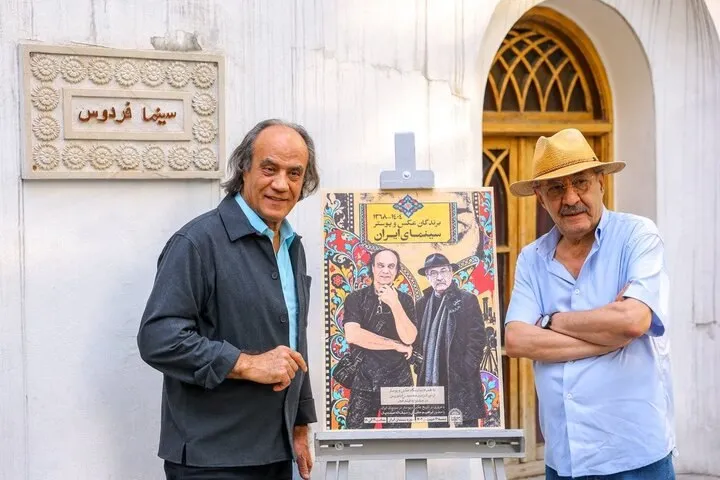
Seifollah Samadian now has another distinction to his name: an award from the Cinema Museum, honoring his decades-long presence in the world of images. But if we are to talk about Samadian merely because he has received this award, we will probably miss the most important part of the story. The Cinema Museum’s award is less the conclusion of a journey than an opportunity to pause and look at the career of an artist who, for nearly half a century, has never put down his camera and has played a role in shaping Iran’s visual culture—from photojournalism and social photography to documentary cinema, from cinematography to publishing, and from education to organizing artistic events.
Samadian is not someone who can easily be reduced to a single professional title. If we call him a “photographer,” we leave out a significant part of his cinematic work; if we call him a “cinematographer,” we overlook his contributions to photography, publishing, and the organization of the Image of the Year Festival; and if we call him a “documentarian,” we ignore the role he has played in creating a professional space in which different generations of artists could be seen. Perhaps “a man of images” is a more accurate description: someone for whom photography and film have been two different forms of a shared impulse—to see and to record.
The Cinema Museum award comes at a time when, simultaneously, an exhibition of selected photographs and posters from the Fajr Film Festival has been organized through his efforts, while his new documentary, On the Road with Kiarostami, is scheduled to have its world premiere at the 31st Busan International Film Festival. This coincidence is not accidental, because both sides of this story—archiving the past and preserving the memory of a great filmmaker—lead directly back to the same concern Samadian has pursued throughout his career: not allowing images to be erased from memory.
From Photojournalism to Preserving the Memory of a Generation
Samadian began taking photographs at a very young age, and from the outset, his approach to photography was not merely aesthetic. His photographic world has been more closely connected to reality, people, streets, events, and fleeting moments. It was precisely this foundation in documentary and photojournalistic photography that would later become an important part of his visual language.
A World Press Photo award, the Golden Leopard of the Tashkent Film Festival, and honorary diplomas from photography competitions in various countries constitute part of his international record. Yet perhaps the significance of these awards lies less in the titles themselves than in the fact that Samadian’s photography managed to cross Iran’s geographical borders and gain recognition within the professional world of international photography.
He later became active in photojournalism education and other professional activities, passing on to younger generations the experience he had accumulated in the field of photography. This is an important aspect of understanding Samadian: he never remained merely a producer of images. Part of his journey was devoted to transmitting experience and creating opportunities for others.
In 1992, he also began publishing Tasvir magazine with Mortaza Momayez and Mahmoud Kalari. The experience demonstrates that even at that stage, his concerns extended beyond the production of photographs. He viewed media, graphic design, cinema, and other branches of the visual arts as parts of a single interconnected system.
If we look back, we can trace one constant concern throughout this journey: recording the times. The photojournalist freezes an era within a single frame; the documentarian records it in motion; the journalist writes about it; and the archivist attempts to ensure that what has been recorded survives. Samadian has occupied all of these roles.
Perhaps this is why his career cannot be measured simply by the number of photographs or films he has made. Part of the value of his work lies in what flows between his individual works: a kind of obsession with preserving moments, people, and events that may no longer exist tomorrow.
Kiarostami: When Two Cameras Looked at the Same World
Among all the chapters of Samadian’s career, the chapter devoted to Abbas Kiarostami holds a special place. Their relationship was not merely a cinematic collaboration. Friendship, travel, conversation, and years of companionship turned Samadian into one of the closest visual witnesses to Kiarostami’s life and work.
The result of this intimacy eventually became one of the most distinctive visual portraits of the filmmaker in 76 Minutes and 15 Seconds with Abbas Kiarostami. Rather than relying on formal interviews and explanatory narration, the film draws on images recorded during years of friendship and travel: dozens of hours of footage that Samadian had captured during his everyday life and journeys with Kiarostami, from which the final film was later assembled.
This is where one can understand the difference between Samadian and an ordinary filmmaker. When he turns on his camera, he is not necessarily looking for a “subject”; he is looking for a moment worth preserving. That is why his images of Kiarostami are not merely information about a famous director. At times, they are fragments of a friendship—simple, unassuming moments that, under ordinary circumstances, no one might imagine would one day become historical documents.
Now, ten years after Kiarostami’s death, Samadian has returned once again to the same archive and the same memories. On the Road with Kiarostami is a visual account of the numerous journeys the two made together over three decades, and its world premiere is scheduled to take place at the Busan International Film Festival.
This project may be the best example of explaining Samadian’s relationship with the image: for him, an image is not something that is simply produced in a given moment and then finished. An image can be revisited years later, acquire new meanings, and become part of collective memory. Kiarostami is not a subject for Samadian; he is part of his life, and now the camera must tell that story to others.
The Man Who Built Frames for Others, Too
Even if we look only at Samadian’s photographs and films, we may still miss an important part of his career. Perhaps one of his most significant legacies is the Image of the Year Festival, an event that over the years has become one of the most important gathering places for photographers, graphic designers, cartoonists, and filmmakers.
The significance of the Image of the Year Festival lies not simply in the number of editions it has held or the number of works it has exhibited. Its importance lies in the fact that an artist has devoted part of his professional life to creating a platform through which others could be seen.
On the surface, this may seem different from photography or filmmaking, but at its core, it follows the same concern: “An image must be seen.”
Samadian could have spent years focusing solely on his own work. As an established photographer, he could have continued participating in exhibitions and festivals and pursuing his personal projects. But he also chose another path: creating a field for generations who wanted to be seen.
The publication of Tasvir magazine can also be understood within this same trajectory. From the beginning of the 1990s, the magazine sought to bring together different fields of the visual arts.
It could perhaps be said that, at this stage of his professional life, Samadian evolved from a “producer of images” into a “maker of visual memory.” The distinction between the two is important. An artist creates a work; a maker of memory helps ensure that the works of a generation do not disappear, that they are seen, and that they become part of history.
The recent project of collecting selected photographs and posters from the Fajr Film Festival is another continuation of this approach. Samadian has turned to works that form part of the visual history of Iranian cinema and attempted to bring them together into a coherent collection. In a country where archives are often scattered and incomplete, such an undertaking is no less valuable than producing a new work.
Samadian: Not a Single Frame, but a Current
We can now understand why the Cinema Museum’s award to Seifollah Samadian should not be regarded merely as a commemorative ceremony. The issue is not simply the honoring of a veteran artist; it is the recognition of a part of Iran’s visual history in which Samadian has been at once a witness, a recorder, and, at times, a creator.
In his photojournalistic and documentary photography, he has recorded part of Iran’s social reality; in cinema, he has stood behind the camera; in documentary filmmaking, he has followed people and moments; through his magazine, he has written about images and created spaces for dialogue; through the Image of the Year Festival, he has created exhibition opportunities for others; and through his archival projects, he has tried to prevent the works of the past from being lost.
On the surface, these may appear to be disparate activities, but they share a common thread: a belief in the value of the image.
Perhaps this is why Samadian cannot be introduced merely through his “best photograph” or “most important film.” His legacy is more like a current than a single work—a current that began with photography, reached cinema, moved from cinema into the archive, and from the archive into the hands of subsequent generations.
Seen from this perspective, the Cinema Museum’s award is more than a medal. It is a sign that part of the history of Iranian cinema has not been written only in the films projected on screen. It has also been recorded in behind-the-scenes photographs, posters, documentary frames, personal archives, and the memories of people who have spent years standing beside the camera.
Seifollah Samadian is one of those people.
Perhaps his most important quality is that he never consistently turned the camera toward himself; instead, he devoted much of his career to ensuring that other people, moments, and the world around him could be seen.
And now, after several decades, perhaps it is time to place him within the frame himself and ask: if a part of Iranian cinema’s visual memory is still alive today, how much of that is owed to the man who spent years standing beside this cinema with a camera in his hands?
© 2026. Phoenix Review