



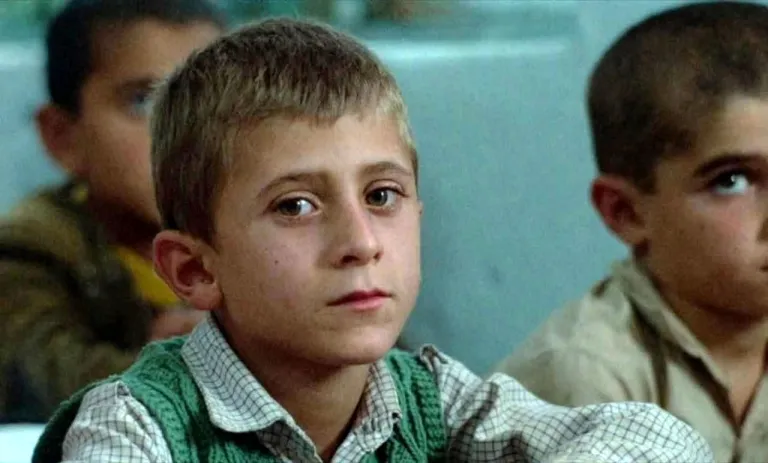
The news was brief: Ahmad Ahmadpour has passed away at the age of 44. Perhaps many have never even heard his name—or if they have, they might not recall who he was. That’s why, immediately after his name in the news, it read: “Actor of Abbas Kiarostami’s film, Where Is the Friend’s House?”
Those who have seen Kiarostami’s film will likely remember the two boys: one appearing only in the opening and closing scenes, and the other—the main character—played by Babak Ahmadpour.
But as a viewer who always feels deep anger and sorrow when I see children made to cry on screen, how could I ever forget Ahmad Ahmadpour’s tears? How could I forget that innocent, heartbreakingly expressive face—his name, Ahmad; and that Babak, his real-life brother, was both his classmate in the film and the one desperately searching for him throughout, enduring hardship after hardship?
The acclaimed Where Is the Friend’s House?—the first part of Kiarostami’s “Koker Trilogy”—opens in an elementary school in the village of Koker, near Rostamabad in Gilan province. The teacher enters the classroom, irritated by the children’s noise and his own slight delay. He begins inspecting their homework notebooks, checking each one off. Then he reaches Mohammad-Reza Nematzadeh, played by seven-year-old Ahmad Ahmadpour. Seeing his blank pages, the teacher scolds and threatens to expel him if it happens again. The boy bursts into tears—but that cry transcends acting; it is real.
Kiarostami himself once explained that, to capture the scene authentically, he asked the teacher to push Ahmad to the point of genuine tears. Watching that moment is almost unbearable—the small, pale face, the heartbreakingly sad green eyes, the tears streaming from a child who did not yet know what immortality in cinema meant. With that single scene, Ahmad Ahmadpour became eternal in the history of Iranian cinema. He may never have known how deeply his gaze, his sorrowful expression, and his uncontrollable tears would mark the memory of audiences.
Still, I firmly believe that no director has the right to make a child cry in reality, even for the sake of realism on screen.
It must be unbearably difficult for Babak Ahmadpour to accept that his younger brother—the very one he spends the entire film searching for, to return a mistakenly taken homework notebook and save him from expulsion—lived only forty-six years.
In Where Is the Friend’s House?, Babak, as Ahmad, realizes after school that he has accidentally taken Mohammad-Reza’s notebook home. Determined to return it, he sets out on a long and lonely journey. No one listens—his mother, his grandfather, the villagers, the people beyond the hill, not even the neighbors. No one can help him find his friend’s house. No one knows where it is.
Babak Ahmadpour, too, had one of those unforgettable faces—radiating simplicity, sincerity, and quiet determination. At only eight years old, he shows no fear of scolding, dark roads, strange places, or the night itself. He never loses hope, never gives up. In the end, he writes his friend’s homework himself—becoming, in a sense, the “friend’s house” he was seeking, discovering the meaning of friendship and humanity.
From 1986, when the film was made, until Abbas Kiarostami’s passing, the two brothers remained close to the great filmmaker. Before the village had telephones, Kiarostami would visit them every year; afterward, they stayed in touch regularly. After Kiarostami’s death in 2016—caused by a medical error—the brothers visited his grave in Lavasan every year. Babak settled in Tehran; Ahmad served in the army and retired there. Then, suddenly, on October 22, 2025, his heart stopped.
And what a wave of young deaths heart failure has brought upon Iran.
Why should a 46-year-old father of three die of cardiac arrest? Why do we hear, every day, of so many sudden deaths—athletes, artists, doctors, engineers, teachers—young lives cut short, each a precious part of this country, now gone? And what has happened to us, that even the death of the young no longer shakes us?
Even in his final photos, Ahmad still had those sad eyes, that innocent, stunned gaze.
In Iranian cinema, both before and after the revolution, many children have given remarkable performances. Yet after the revolution, perhaps only five of them—none professional actors, and none who continued acting—have remained deeply etched in memory:
Majid Niroumand as “Amiro” in Amir Naderi’s masterpiece The Runner (1984); Adnan Afravian as “Bashu” in Bahram Beyzai’s Bashu, the Little Stranger (1985); Babak and Ahmad Ahmadpour as “Ahmad” and “Mohammad-Reza” in Abbas Kiarostami’s Where Is the Friend’s House? (1987); and Mehdi Bagherbeigi as “Majid” in Kiumars Pourahmad’s beloved TV series Majid’s Tales (1991).
In recent years, perhaps only Rayan Sarlak’s performance in Panah Panahi’s Hit the Road (2021) could be said to carry the same emotional weight.
The sudden, brief news of Ahmad Ahmadpour’s death left Iranian cinema lovers in shock. It felt as though he was the very child Sohrab Sepehri wrote of in his famous poem Where Is the Friend’s House?—the same poem that inspired Kiarostami’s poetic film:
“Where is the friend’s house?
It was dawn when the rider asked.
The sky paused.
The passerby, with a branch of light at his lips, gave the darkness of the sand
a gift,
and pointed to a poplar and said:
‘Before you reach that tree, there is a lane greener than the dream of God.
In it, love is as blue as the wings of honesty.
Go to the end of that lane, which emerges beyond adolescence,
Then turn toward the flower of solitude.
Two steps from the flower,
By the everlasting fountain of the earth’s legends, you will pause,
and a transparent fear will seize you.
In the fluid intimacy of space, you will hear a rustle—
You will see a child
who has climbed a tall pine tree to take a chick from the nest of light,
and you will ask him:
Where is the friend’s house?”