



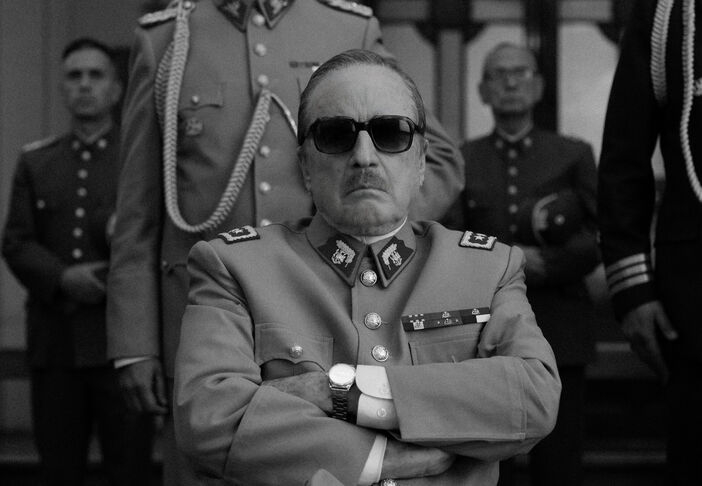
Contemporary history has long been Larraín’s central preoccupation. The Chilean filmmaker has brought to the screen historical figures such as Jacqueline Kennedy (Jackie), Princess Diana (Spencer), and Pablo Neruda (Neruda). In Neruda, about the celebrated Chilean poet, he wove together fact and fiction in the form of a crime drama. In Spencer, though set in the real world, he portrayed Diana as a ghostly, restless spirit, more akin to a fairytale princess than a historical figure. What connects these works is the tension between the public and private lives of the famous personalities he portrays.
Earlier in his career, Larraín explored Chile’s recent past in Post Mortem and No—both centered on the years following Pinochet’s coup against Salvador Allende and the dictator’s eventual fall after seventeen years of oppressive rule. In El Conde (Spanish for “The Count”), Larraín turns his gaze directly to Augusto Pinochet himself—but through a grotesque, darkly comic, and horror-infused lens. El Conde is a macabre, delirious black comedy rooted in a very real terror.
In an interview with Time, Larraín explained his imaginative approach to depicting historical figures:
“We’re not making a realistic story, because realism can lead to empathy—and that’s very dangerous.”
Thus, Larraín envisions Pinochet as a weary, immortal vampire longing for his own death, while his children greedily circle his fortune and his wife conspires against him with his loyal but treacherous servant. Yet despite its audacious concept, El Conde lacks an emotional core that might fully connect the audience to what unfolds on screen.
Larraín situates Pinochet within the broader, blood-soaked history of revolutions, coups, and massacres—from France to Haiti, Algeria, and Chile. The film begins as a mockumentary, narrated by a mysterious woman who recounts the tale of a young vampire named Claude Pinoche. According to her, this Claude was once a royalist soldier during the French Revolution of the 1780s who witnessed the execution of Marie Antoinette. After faking his death, he escaped abroad, fighting against revolutionaries in Haiti, Russia, and Algeria before eventually arriving in Chile, where he joined the army under the name Augusto Pinochet and rose to the rank of general.
In 1973, he led a military coup against Allende’s democratically elected socialist government, seizing power and ruling Chile through dictatorship, terror, and repression for seventeen years. Larraín depicts Pinochet as a monstrous, eternal figure—a restless, demonic soul. His acts of tearing out human hearts and drinking their blood serve as a literalized metaphor for the brutality and moral corruption of his rule, expressed through the grotesque language of horror cinema.
In Larraín’s surreal reimagining, Pinochet has lived for centuries, a witness and participant in humanity’s worst atrocities. As the vampire-dictator of Chile, he has accumulated immense wealth for himself and his family. Though fictional, the story draws upon real records of corruption and human rights abuses that stained Pinochet’s regime with the blood of thousands.
After his fall from power, the film’s Pinochet fakes his death once again, retreating to an abandoned sheep farm in the icy wastes of Patagonia. Having lived for 250 years, he grows weary of existence and decides to die—by renouncing blood and becoming, ironically, a vegetarian. His old servant, Fyodor, a Russian aristocrat turned vampire whom Pinochet once rewarded for his loyalty, dons the general’s uniform and embarks on a killing spree in Santiago, devouring human hearts. Both Pinochet’s family and the audience believe these murders are his doing—until the truth is revealed later in the film.
For Larraín, the heart of El Conde lies in the question of impunity.
“Pinochet was never tried for his crimes. He died wealthy and free, unpunished for the atrocities he committed against the Chilean people. Those directly affected— and their families—never found justice or peace. Injustice and pain are eternal.”
He continues:
“El Conde is about immunity from punishment—about how justice, though a collective desire, remains unrealized. Those responsible for history’s worst crimes so often escape unscathed. I don’t believe people ultimately receive the justice they deserve.”
Larraín concludes with a haunting reflection:
“After Pinochet’s fall, the Chilean people needed healing—but true healing only comes through justice. We never managed to bring Pinochet to trial. He died not only a millionaire but a free man. He will always be among us.”
Pinochet’s opportunistic and greedy children, believing their father intends to divide his fortune among them before he dies, travel to his remote estate. They hire a young woman named Carmen to audit the family’s wealth — but in truth, she has been sent to exorcize and kill the old general. The plan unravels when Pinochet falls in love with her.
Carmen, as it turns out, is a nun secretly commissioned by the Catholic Church to pose as an accountant. Her mission is to infiltrate the dictator’s inner circle, drive out the demon within him, and uncover the hidden locations of his vast fortune. Meanwhile, the general discovers the secret affair between his wife, Lucía, and his loyal servant Fyodor. Yet he remains indifferent, telling Fyodor he may have his wife, so long as he keeps his hands off the money.
Carmen begins investigating Pinochet’s finances, gathering evidence and documents. Eventually, she reveals her true identity as a nun and attempts to exorcize the general, but instead falls under his dark spell — seduced by his supernatural allure and power. In a grotesque twist, Pinochet bites her neck, turning her into a vampire.
Larraín, a long-time critic of the Catholic Church, continues here what he began in The Club — exposing the Church’s moral corruption and its complicity with political power. The metaphor is clear: the Church’s attempt to “save” Pinochet by sending a nun to purify his soul is itself an act of hypocrisy, a symbolic partnership between religion and tyranny.
The film’s most audacious and fantastical subplot, however, involves Pinochet’s imagined connection to Margaret Thatcher — a fictionalization rooted in historical fact. Thatcher famously intervened to secure Pinochet’s release after his arrest in London on charges of human rights violations, arguing that “it is for the Chilean people, not us, to judge him.”
In the film, Thatcher first appears as a disembodied English voice — an acousmatic narrator — but later emerges, startlingly, as Pinochet’s mother. We learn that in her youth she was assaulted by a vampire, became pregnant, and abandoned the newborn Claude (the future Pinochet) outside a bourgeois home.
In the film’s final sequence, after killing Carmen and devouring her heart, Pinochet is reborn as a little boy. His “mother,” Margaret Thatcher, takes him to a Chilean boarding school. Larraín shoots this epilogue in color — a visual signal that the vampire, the dictator, never truly dies. Evil merely reincarnates, endlessly renewed.
The image of a dictator as a vampire is not new, but Larraín wields it as a potent metaphor for the general’s insatiable appetite for blood — the lifeblood of his victims. In European Gothic mythology, vampires are seductive, accursed figures, and from Bram Stoker’s Dracula to Murnau’s Nosferatu, they have long haunted literature and cinema. By invoking the vampire myth, Larraín reminds us that the horrors of Pinochet’s regime continue to haunt Chile — a nation still wounded because its bloodthirsty ruler was never brought to justice.
During Pinochet’s dictatorship (1973–1990), thousands were executed, tortured, or disappeared. Larraín imagines that the general’s thirst for blood began centuries earlier — particularly the blood of France’s royal family. In one scene, after Marie Antoinette’s beheading, he licks the blood from the guillotine blade with sadistic pleasure. In another, he admits that he despises the taste of “common blood,” claiming that the blood of Latin Americans disgusts him. To his servant Fyodor, he confesses: “I love killing. I enjoy it.”
Narratively, El Conde mirrors the structure of Citizen Kane. Like Welles, Larraín opens with an image of the old general lying in his vast, lonely mansion before delving into his past through flashbacks and fragmented memories. The English-speaking female narrator recounts the vampire’s 250-year journey — from the age of Louis XVI to the modern day. Carmen’s investigative role echoes that of the reporter in Citizen Kane, seeking to uncover the truth behind the legend.
Yet despite these parallels, El Conde lacks Citizen Kane’s dramatic tension and mystery. The story quickly reveals the characters’ motives, diminishing narrative intrigue. The perspective, too, feels divided: the unseen narrator begins as a detached voice but is later revealed to be Thatcher herself — a twist that, while symbolically sharp, disrupts the story’s coherence. Larraín’s suggestion of a “blood bond” between the British Prime Minister and the Chilean dictator offers an unmistakable critique of Western complicity, though it sits awkwardly within the film’s family drama.
Shot in digital black and white by cinematographer Edward Lachman, El Conde pays homage to the great expressionist horror films — Dreyer’s Vampyr, Murnau’s Nosferatu, Browning’s Dracula. Lachman’s aesthetic strategy imbues the film with the eerie magic of Gothic tales and the mysticism of Latin American magical realism. He employed overhead lighting to illuminate interiors — most memorably in the scene where Pinochet dons his old military uniform and goes on a human hunt. The film’s lighting, rich in tonal contrasts, is one of its strongest visual achievements.
Lachman has said his approach was influenced by Ansel Adams’s photography:
“As a black-and-white cinematographer, I felt like Ansel Adams — adjusting my exposure to reveal the widest range of detail across shadows and highlights, defining the latitude of the image.”
Because the film was shot in black and white, the crew used blue-tinted liquid to represent blood. Lachman explained:
“Red looked too rich and heavy, but blue gave the blood a luminous transparency we couldn’t achieve otherwise.”
The most visually mesmerizing moments occur when Pinochet and Carmen — now both vampires — rise into the air, flying like bats in a trance of ecstatic abandon.
Though El Conde explores the persistence of evil, Larraín renders that evil with an unsettling beauty. The film suggests that perhaps the most dangerous idea of all is that evil can create beauty. Art history is filled with works that find sublime allure in darkness — from Goya’s Saturn Devouring His Son and Bouguereau’s Dante and Virgil in Hell to Rubens’s Head of Medusa, Bosch’s The Garden of Earthly Delights, and Fuseli’s The Nightmare. Horror cinema, too, often achieves beauty through terror — in films like Jack Clayton’s The Innocents, Ari Aster’s Midsommar, Pasolini’s Salò, Dario Argento’s Suspiria, and Friedkin’s The Exorcist.
As Larraín himself explains:
“I’m not trying to redeem these people. I don’t want to save these bastards — I want to expose them. And when you do that, you might find beauty in it. Maybe that’s the only way to feel anything at all: by trying to portray them. When we see them, analyze them, we find redemption in ourselves. We realize who we are — and why we allowed this to happen. We’re part of it.”
Despite Larraín’s ambition to depict Pinochet as a loathsome monster, the result is more pitiful than terrifying. Instead of a fearsome vampire, we are left with a greedy, senile old man enslaved by lust and avarice. Moreover, Larraín’s lingering close-ups of the general’s face as he commits acts of violence — decapitations, disembowelments, the drinking of blood — seem at times to aestheticize the very brutality he condemns.
Ultimately, El Conde, though sharply conceived and visually striking, lacks the sting and emotional power it seeks. Beyond its haunting images, the film fades quickly from memory.
What remains unforgettable are its sounds and visuals: Lachman’s expressionistic lighting streaming through tall windows, the gothic mansion’s oppressive atmosphere, and the nun’s eerie arrival — a direct echo of Jonathan Harker entering Dracula’s castle. Pinochet’s airborne flights recall the “death flights” of his regime, when dissidents were thrown from helicopters into the sea.
In the end, Larraín reminds us once again: evil endures. Like a vampire, it feeds on itself to survive. History, he insists, must repeat itself — if only to remind us how dangerously immoral, corrupt, and monstrous we can be.