



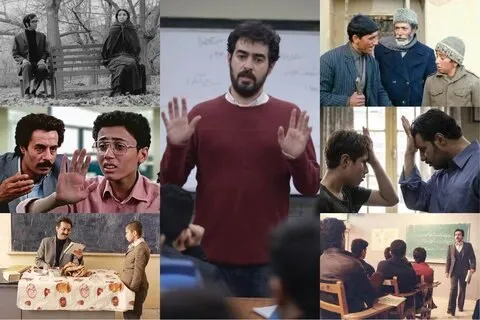
The teacher in Iranian cinema has never been just a teacher. One might even argue that what has drawn Iranian cinema to this figure is not the profession itself, but the position the teacher occupies in relation to society and children. The teacher stands between the adult world and the world of children, between knowledge and ignorance, law and freedom, education and rebellion. That is why, whenever Iranian cinema has turned its attention to teachers, it has also brought part of its own image of society to the screen.
From Bahram Beyzaie’s Downpour to Majid Majidi’s The Sun, teachers have changed, just as society has changed. Mr. Hekmati, played by Parviz Fanizadeh, could no longer be the same kind of teacher as the one Reza Attaran plays decades later in No Men Allowed, or the one portrayed by Javad Ezzati in The Sun. One represents disillusioned intellectualism, another belongs to a social comedy, and the third stands alongside children whose struggle is not yet about education, but survival. This changing image may be one of the most fascinating secondary threads in the history of Iranian cinema.
Mr. Hekmati: When the Teacher Is Society’s Own Student
To begin, we must return to Downpour, the film Bahram Beyzaie made in 1972, in which Parviz Fanizadeh played Mr. Hekmati. Mr. Hekmati may be one of the most important teachers in the history of Iranian cinema, not merely because of the character himself, but because of the meaning that being a teacher acquires within the film’s world.
He is a man devoted to culture and ideas who wants to improve his surroundings, yet finds himself caught up in the very social relations he hopes to change. Teaching is not merely his job; it is part of his intellectual identity. He wants to teach others something, but society continually reminds him that knowing does not necessarily mean being able to act.
In Downpour, the classroom is more than a physical space; it is a miniature version of society. The teacher seeks to establish order, culture, and meaning, but outside the classroom, a different set of social relations prevails. This tension makes Mr. Hekmati one of the earliest examples of the “intellectual teacher” in Iranian cinema: a man trapped between ideals and reality. Perhaps this is what distinguishes him from many teachers who appear in later films: he is not destined to save the world. He, too, is a victim of the world he seeks to reform.
The Teacher as Social Reformer
After the Revolution, the image of the teacher begins to change. Cinema needs characters who embody a sense of social responsibility, and because teachers are directly connected to the next generation, they become ideal figures for this role. Mohammad-Ali Najafi’s The Battle of Ather is one of the notable examples from this period.
The teacher is no longer defined solely by the school; he becomes involved with society, students, and their moral and social problems. In such films, the teacher becomes a kind of “social reformer.” His job is not simply to teach mathematics, literature, or science; he must shape human beings. This perspective helped turn the teacher into a moral hero in Iranian cinema of the 1980s.
But this idealization had a consequence: the teacher gradually became detached from ordinary humanity. He was expected to be patient and self-sacrificing, to always make the right decisions, and to serve as a father or mother figure to his students. Iranian cinema would eventually dismantle this idealized image.
The Teacher Who Must Learn to Speak the Child’s Language
Pouran Derakhshandeh is one of the most important filmmakers to elevate the teacher from a social type into an emotionally and pedagogically complex character.
In The Relationship, Khosrow Shakibai plays a teacher who encounters a child unable to communicate with the world around him in the usual way. The central issue is no longer the transmission of information; it is the search for a means of communication. Here, the teacher must first understand the child and only then begin to teach him. This is an important distinction. In many traditional narratives, the student is the one who “does not know,” while the teacher is the one who “knows.” Their relationship is therefore hierarchical. In Derakhshandeh’s film, however, this relationship gradually becomes more humane. The teacher must step down from his position of authority, enter the child’s world, and discover his language.
The same perspective continues in Little Bird of Happiness. Homa Rousta’s character encounters a child imprisoned in her own world because of psychological trauma and difficulties with communication. Here, the teacher and caregiver must do more than transmit knowledge; they must make it possible for the child to return to the world. In this cinema, the teacher is essentially a “translator,” mediating between a child who cannot speak and a world that does not understand her language.
Kiarostami and the Teacher Who Is Almost Invisible
Perhaps the most interesting teacher in Iranian cinema, however, is one we barely see: the teacher in Where Is the Friend’s House? Abbas Kiarostami removes the teacher from the center of the frame while maintaining his presence throughout the story. A simple reminder that homework must be completed sets Ahmad on a journey that is geographically small but morally immense. The teacher has said that the assignment must be done. Yet, in the course of fulfilling this duty, the child discovers something greater than schoolwork: responsibility toward another person.
This is Kiarostami’s genius: turning an absent character into the driving force of a story. On the surface, the teacher represents order and authority. But Ahmad’s actions lead to something beyond obedience. The child moves beyond the teacher’s instruction and arrives at ethics.
Here, cinema quietly asks: Is genuine education what the teacher says in the classroom, or what the child discovers through lived experience?
From the Saintly Teacher to the Ordinary Teacher
The further we move away from the 1980s and 1990s, the more the idealized image of the teacher begins to crack. In No Men Allowed, Reza Attaran plays a teacher who departs sharply from the stereotype of the cultivated, self-sacrificing educator. He is an ordinary person, with his own weaknesses, jokes, fears, and awkwardness. This ordinariness matters. Cinema no longer wants to place the teacher on a moral pedestal. He, too, is one of the people who make up society. He can make mistakes, fall in love, feel embarrassed, and even learn things from his students.
This shift also reflects a change in Iranian cinema’s understanding of “education.” Education is no longer a one-way relationship between an adult and a child. The child, too, can change the adult.
The Teacher in A Separation: A Witness in Search of the Truth
Asghar Farhadi takes this development a step further in A Separation. Termeh’s private tutor, played by Merila Zare’i, is not a central character, but she appears at one of the story’s most important moral junctures. She witnesses part of what happened and must testify about what she saw.
The teacher here is no longer the possessor of truth, but one of its witnesses. This is a subtle but important distinction. Farhadi strips his characters of their secure moral positions. Like the judge, the father, the mother, or the nurse, the teacher sees only part of reality. She cannot possess the whole truth. The teacher thus shifts from being a “teacher of truth” to a “witness to truth.”
The Sun: When School Is No Longer Enough
And then we arrive at The Sun, Majid Majidi’s film about child laborers. Here, school is no longer a safe space, insulated from society. The children arrive at school from the streets, from work, from poverty, and from harsh economic circumstances. The teacher can no longer assume that education alone will solve all their problems.
This is one of the most significant changes in the representation of teachers in contemporary Iranian cinema. In Downpour, the teacher’s problem lay in the social structure and its power relations. In The Sun, the problem is more deeply rooted: these are children who, before they can be students, are already workers, breadwinners, or victims of economic circumstances. A teacher can teach lessons, but can a teacher eliminate poverty? Majidi’s film offers no easy answer. Indeed, its significance lies precisely in this inability. The teacher is still necessary, but no longer sufficient.
The Teacher as a Mirror of Iranian Society
Taken together, this trajectory offers a way of tracing the transformation of Iranian society itself. Mr. Hekmati in Downpour represents an intellectual who wants to bring about change but becomes a victim of the very social structures he seeks to reform.
Teachers in the cinema of the 1980s and 1990s more often embodied morality, responsibility, and self-sacrifice. In Kiarostami’s cinema, the teacher is part of the child’s formative world and is not necessarily a hero. In the social cinema of later decades, the teacher becomes a more ordinary person, someone caught up in life’s own contradictions. And in The Sun, the teacher confronts a problem that exceeds the capacity of the classroom.
Perhaps this is why the figure of the teacher remains so compelling for Iranian cinema. The school is society in miniature, and within it the teacher occupies several roles at once: educator, judge, witness, protector, sometimes victim, and sometimes even accused.
Ultimately, however, the most important role Iranian cinema has assigned to the teacher may be that of a mediator: someone who stands between the child and the world. The child has not yet learned to understand the world, and the teacher is among the first people to make that world intelligible. Sometimes the teacher shows the child the world as it is, sometimes as it ought to be, and sometimes the teacher does not know which picture is closer to the truth.
From Mr. Hekmati to the teacher in The Sun, the trajectory of the teacher in Iranian cinema is, in essence, a movement away from “the one who knows” toward “the one who accompanies.” This transformation says less about teachers themselves than about Iranian cinema’s changing vision of humanity. A human being is no longer necessarily someone who knows the answer; sometimes, a human being is simply someone willing to set out alongside another person in search of it.
© 2026. Phoenix Review