



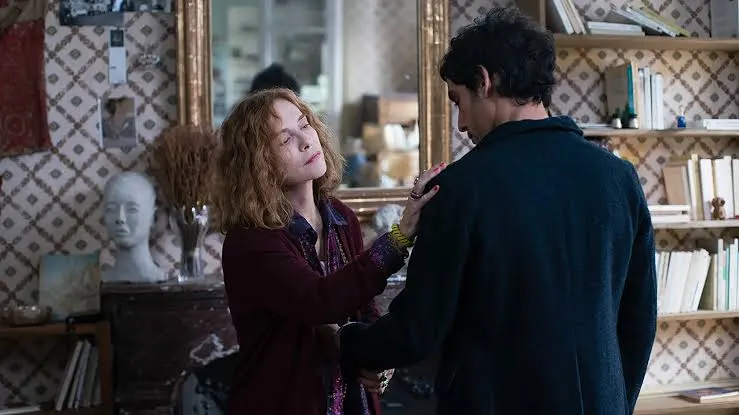
I watch Sylvie, the writer in Parallel Tales by Asghar Farhadi, spying on her neighbors, and I am reminded of myself standing by the window of my room. From my window, I can see a row of buildings, their windows always closed and their curtains always drawn. There is only one whose inhabitants I see regularly. It is an office where, unless all the employees happen to be gathered in the emergency stairwell, at least three or four of them are always there, smoking, talking, and laughing. The only time no one is in the stairwell is when they are all celebrating a birthday inside the office. Then I see them through the office window.
For a long time now, like Sylvie, I too have been watching from a fixed point a group of people who have never realized that part of their lives has become a view for me. I do not know any of them, but I have seen them often enough to know—or at least think I know—certain things about them: who likes whom, which one of them is incompetent and probably got the job through connections, and which one is probably more capable than they appear. They are fictional characters to me in much the same way that Nita, Nico, and Theo are to Sylvie. The difference is that I have never written a story about them; their lives have been too melodramatic and clichéd to make it onto the page. That is probably why, once, I had the idea of writing them a letter and telling them that I was glad they had returned after such a long absence following the war. Perhaps a story could have come out of it, but I never did.
That is why, from the very beginning of the film, the houses and their windows became more important to me than the people inside them. The story’s main setting consists of two houses separated by the width of a street. On one side is the house of Sylvie, the writer; on the other is the house where Nita and the other characters in her story live. The street itself functions as a boundary separating two territories. Sylvie’s house, through its mise-en-scène, reveals both her identity and, in a sense, her psychology. From her own home, she watches them. Her gaze passes through the camera, the window, and the street, catching fragments of the lives of the people across from her. She sees them without ever hearing their voices—precisely the element that matters in the house inhabited by the characters in her story. They produce sounds inside that house, but those sounds never reach Sylvie. She does not physically enter their home or their lives. She observes them from a safe distance and then brings what she has seen, along with her own imagination, into her story.
For me, this distance evokes something that in a city can sometimes matter more than the buildings themselves. Just as distance separates two places, it can also connect them, turning itself into a point of intersection between two lives that have no direct relationship with one another. People may see others behind their windows every night without ever having spoken to one another, even once. Sometimes, one person may simply have a view of another person’s home, while the other is completely unaware of their existence—a kind of one-sided visual relationship. Something like the distance between a writer and the character she has created.
I think this is why Asghar Farhadi himself does not come particularly close to his characters this time around. In his earlier films, he would sometimes take us into the deepest layers of his characters’ psyches. Here, however, he prefers to stand back, remaining at roughly the same distance that the writer behind the window maintains from a stranger she watches. Perhaps this distance is a weakness in the film, as some critics have argued; but perhaps it is also part of the film’s game: a film about observing others from a distance that constantly asks us to do the same. The camera, too, mostly remains at a distance, observing people in relation to rooms, windows, and one another. There is almost no place for the close-up in the film’s visual language; instead, we mostly encounter medium shots and long shots. It is as though the distance between Sylvie and the people across the street is reproduced in the distance between the camera and the characters. The film shows them to us, but rarely allows us to come close to them.
In Parallel Tales, the writer and the character remain at a distance from one another. Sylvie can see the people in the house across the street, but Nita, Nico, and Theo have no view of her at all; at the beginning, they do not even know where the writer’s house is. Nico is constantly trying to figure out where the writer is watching them from, but he cannot locate her window. This asymmetry is not accidental. The character lives within his own world; the writer observes him from somewhere outside that world, and these gazes are entirely one-sided.
Through her obsessive observation of them, Sylvie wants to write a true story, but consciously or unconsciously, she also introduces her own imagination into it. She sees fragments of a life and writes down her own interpretation of what she has witnessed. Naturally, that interpretation emerges from her lived experience: from her past life with her parents, as well as from events in her present life and her habits, such as eating canned food and even cutting her foot on a piece of glass. By connecting the events of her own life to those of her character, she effectively pours herself into the character, as every writer does. Paradoxically, it is precisely this act that makes the distance between reality and fiction even greater.
Adam is another character who enters Sylvie’s life, and by observing her life, watching her neighbor, and eventually becoming interested in writing, he begins to imitate her. This imitation gradually expands from watching the neighbors to adopting Sylvie’s worldview. Adam, who still knows nothing about writing, confuses storytelling with recording reality and watches Nita even more obsessively. He is not satisfied with observing her through a camera; he follows her in the street and even into cafés. He even believes that if the story does not correspond to Nita’s real life, then the story itself must be changed. It is as though the truth of a story is whatever actually happened. But a story is not supposed to be a record of the truth.
At this point, I am reminded of the first piece of advice given in the first session of almost every creative-writing class: “The first step toward writing is learning to see.” This familiar, perhaps even clichéd, statement is not wrong, but more often than not, its meaning is not properly explained. Many people confuse seeing well with seeing a lot and excessively collecting details. When they take a character from real life, they think they need to know what that person was wearing, what time they arrived, whom they spoke to, what they ate, how many rooms their house had, and what their relationships with other people were like. It is as though the more they know about someone’s real life, the better story they will be able to write. But seeing well does not mean seeing more. It also means recognizing the distance between what we have seen and what we imagine we have seen. A writer sees something and then has to entrust part of it to their own imagination. What has been seen is raw material, not the finished product. If we try to fill every gap between the realities we have observed with factual information, we may ultimately arrive at a more precise report, but not necessarily a better story.
This is why the camera in the film is not merely a tool for seeing. The camera determines the position from which the gaze is produced. The camera itself remains fixed, but the person sitting behind it changes, and with that change, what is seen changes as well. Sylvie, Adam, and eventually Nita see what corresponds to their own ways of thinking. It is much like several writers writing about the same subject and each producing a different story.
Nita’s position is different, however. At first, she is one of those who are being watched. But when she enters Sylvie’s house, something more significant than entering a new space takes place: she enters the position from which stories are created. This movement, this crossing over, is, to me, one of the most important events in the film. Nita crosses from the other side of the street to this side—from the house that has been the object of the gaze to the house from which the gaze has been produced. And when she stands behind the camera, her position changes. She is no longer merely a character in the story; she has now become the possessor of the gaze. She is the only one who eliminates the distance between writer and character. Even Nico comes as far as the building, but he never enters the house. It is as though Nita is the only person from the house across the street who has the potential to become a writer.
From this perspective, I find the position of the maid in the film interesting as well. She constantly moves back and forth between the two houses, and in effect between these two positions. Whatever she hears in one house, she carries to the other. She is neither entirely an observer nor entirely the object of the gaze. She is more like an intermediary narrator—a narrator whose account crosses the boundary between two worlds, but who never has complete access to the truth of either one. In a more earthly form, this woman does what the film does to us: she carries fragments of one life from one place to another and, in the process, presents a new narrative of her own.
This exchange of stories through the maid, and more importantly through Adam, gives the characters a new perspective on their own lives. They encounter a different narrative of their existence, and that narrative seeps into their lives and affects them. It is as though people are anxious about how they are seen, but at the same time absorb the effects of that gaze.
Now I am reminded of the windows in our old house. I would usually pull the curtains aside, without being afraid that I might be seen from the window directly opposite mine, just six meters away. My neighbor’s name was Armen, and people would always tell me, “Armen can see you right now,” but Armen was never behind the window. At least, I never saw him there. The curtains in their house were almost always drawn. Even so, the possibility of being seen never disappeared. Now I think: what if someone really had been standing behind that window? What if one day the curtain had been pulled aside and my eyes had met his? Would I still have walked around the house so freely? As long as I did not know I was being watched, I was free.
Something similar happens in the film. The characters are afraid of how they are being seen. The image someone else has created of them—even if it is inaccurate and imaginary—enters their lives and changes their behavior. This is where Sylvie’s story takes on a strange quality. She writes something about the people in the house across the street that is not necessarily their real life. But once the story reaches them, they can no longer regard it as merely a story. The narrative has entered their lives and begins to change them. Imagination, then, does not stand in opposition to reality; it seeps into it. This is perhaps even more interesting than the story itself: one person imagines something about another person, and that imagination becomes an actual behavior.
If I were to write a story about the employees in that office saying that one of them is in love with another, the story would be nothing more than a fantasy as long as it existed only in my head. But if one day it reached them and, because of it, the way those two people looked at each other changed, my fantasy would suddenly have become part of the reality of their lives.
So it seems that the trajectory of the narrative in the film is something like this: seeing leads to imagination; imagination leads to narrative; the narrative returns to the characters; the characters change their lives after hearing the narrative; and that change, in turn, returns to the life of the writer. In the middle of all this, space is no longer merely the place where these events occur. Space itself constructs this relationship. Nita’s entry into Sylvie’s house is therefore a crossing of a boundary.
Before her, Adam has crossed precisely the same boundary. He enters Sylvie’s house, sees the books and manuscripts, and then returns to the world on the other side. He carries something from one world into another. Just as Sylvie steals from the lives of other people and turns what she takes into a story, Adam steals from Sylvie, and later from Nita, and moves closer to becoming a storyteller himself. In this way, it is as though writing is passed from Sylvie to Adam, and Nita then completes the trajectory.
The changes the characters undergo at the end of the film can therefore be understood as the result both of what happens to them and of the changing positions from which they look at their lives. Sylvie, who initially confines herself to her house, gradually distances herself from it, eventually reaching the point where she decides to sell it, only to change her mind in the end. At first, she keeps her distance from Adam, but later embraces him. Adam, once motherless, homeless, and a thief, reaches a point where he begins writing stories himself.
But Nita’s change of position is the most important to me. Throughout the film, she is the object of other people’s gazes—both Sylvie’s gaze and Nico’s. By the end, she is the one who looks, and perhaps one day she will turn what she has seen into a story. Although all these events have disrupted her ordinary life, they have also taught her something important about her relationship with Nico and about her place in his life.
To me, it does not matter whether Nita has finally found Sylvie’s house. What matters more is that she now stands in the place from which she was previously being watched. The camera is the same camera, but the person behind it has changed. Nita can now see, imagine, and perhaps turn a scene of which she has seen only a fragment into a story. A story often begins precisely here: at the point where we no longer know how much of what we see is reality, and how much of what we do not see has been constructed by us.
© 2026. Phoenix Review