



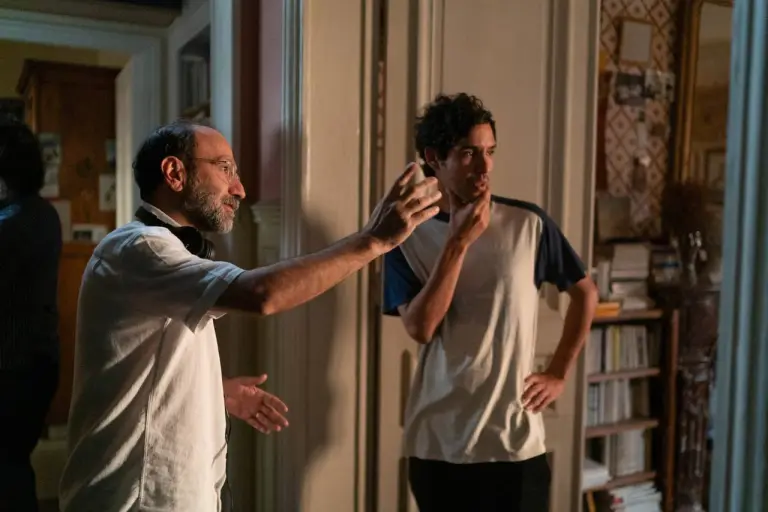
The occasion for this essay is Parallel Tales, the latest film by Asghar Farhadi, which premiered in competition at the 2026 Cannes Film Festival and is his tenth feature film. A French-language film set in Paris, it stars Isabelle Huppert, Virginie Efira, Vincent Cassel, and Pierre Niney, with music by Zbigniew Preisner. But the significance of Farhadi’s new film lies not simply in the fact that the Iranian director has once again made a film outside Iran, or that he has this time left the Persian language behind. The real significance of Parallel Tales is that Farhadi takes one of the fundamental tools of his cinema—his manipulation of truth, information, and judgment—and pushes it one step further: from narrating reality to narrating the act of narrating reality.
The story begins with Sylvie, a reclusive writer who watches her neighbors across the street as she works on her new novel. From a safe distance, she observes people who are unaware of her gaze and gradually turns their lives into a story. The arrival of Adam, a young man whom Sylvie hires to help with everyday tasks, disrupts this arrangement and causes the boundary between the story Sylvie has constructed and the reality that supposedly inspired it to collapse. The Cannes Film Festival itself introduced the film through much the same idea: a story in which the “fiction” created by the protagonist goes beyond the reality of the people’s lives.
A Truth That Is Never Present in One Place
From his important early films onward, Farhadi has been interested in a specific narrative question: What is truth, and who has access to it? In About Elly, the truth of what happened is not in the possession of any single character. Everyone knows part of the story, conceals part of it, and guesses at another part. The viewer acquires information alongside the characters and therefore cannot easily judge them from an external position.
This method becomes more complex in A Separation. There, the question is not simply what happened, but how each character narrates what happened. The film does not pursue truth like a lost object that someone will eventually find. Truth is distributed among the characters, and each account contains a part of it.
From this perspective, one of the fundamental characteristics of Farhadi’s screenwriting is the “distribution of information.” He does not give information to the viewer equally. Sometimes the viewer knows more than one character, sometimes less, and sometimes exactly as much as they do. The result is a form of suspense based not necessarily on “What will happen?” but on “What really happened?”
This is an important distinction. Classical suspense usually places the future in question; Farhadi’s suspense often places the past in question.
From Incident to Consequence
In many of Farhadi’s films, the major incident is not itself at the center of the story. What matters is the chain of consequences that follows from it. In About Elly, a disappearance transforms the dynamics of a group. In A Separation, a seemingly simple decision about caring for an elderly father generates a series of moral and legal crises. In The Salesman, a violent incident changes the life of a couple, and the central question gradually shifts from “What happened?” to “What should be done about it?” In A Hero, too, a seemingly simple matter—the repayment of a debt—turns into a complex crisis involving social credibility, the media, and truth.
In these films, Farhadi usually works through a narrative “domino effect.” One small decision makes another decision necessary; the second decision creates a secret or a lie; that secret forces another character to react; and eventually, the characters find themselves in a situation they could never have imagined at the beginning of the film.
What matters is that the characters are rarely villains. They want to protect themselves, their families, their reputations, or the image others have of them. This is precisely what allows the narrative to move beyond the simple binary of “guilty/innocent.”
Ethics Without a Judge
Farhadi rarely turns the camera into a judge of his characters. This may be the most important ethical feature of his storytelling. Rather than telling us, “This character is right” or “That one is to blame,” the film creates circumstances in which the viewer is forced to revise their judgment again and again.
Here, form and ethics converge. If the film withholds information, it is not merely to generate excitement. The withholding of information forces the viewer to experience something similar to what the characters experience. The viewer, too, must make decisions based on incomplete information. That is why the endings of Farhadi’s films are often less answers than new questions. The ending does not necessarily untangle every knot; instead, it leaves the viewer in a position of judgment.
Parallel Tales: When the Narrator Enters the Story
Parallel Tales, however, has a different structure. In his previous films, Farhadi generally placed a relatively objective reality before the viewer and then showed how the characters’ access to that reality was incomplete, contradictory, or contaminated by their personal interests.
In the new film, reality itself is intertwined from the outset with “the story a character constructs about it.” Sylvie is a writer. She is not merely a witness to other people’s lives; she turns those lives into literary raw material. We are therefore confronted with two narratives: what actually happens to the people across the street, and what Sylvie imagines is happening to them. In other words, observing the neighbors leads to the creation of a narrative that eventually separates itself from their reality.
This shift may appear small, but theoretically it is highly significant. In About Elly, the question was: “Who knows the truth?” In A Separation, we might ask: “Who defines the truth, and how?” But in Parallel Tales, the question moves to another level: “What happens when the story we have told about reality itself becomes reality?”
Farhadi and the Temptation to Watch
From this perspective, Sylvie’s telescope is one of the film’s key instruments. She watches others without allowing them to watch her. This is a cinematic position. The spectator, too, sits in the darkness of the theater and watches the lives of people who are unaware of their presence. In this sense, Parallel Tales is also, to some extent, a film about cinema itself.
Sylvie looks in order to write; the camera looks in order to make a film; and the spectator looks in order to understand the story. The film therefore keeps asking whether seeing means understanding. The answer appears to be no.
We may watch someone for hours and know almost nothing about them. We may observe a behavior and construct a story around it that has no relationship whatsoever to the truth. This is where Parallel Tales comes close to the legacy of Krzysztof Kieślowski. The film is loosely inspired by A Short Film About Love. But Farhadi introduces an important modification: the issue is not simply looking at another person; it is turning that person into a character in a story.
From Social Realism to Narrative Self-Awareness
This is where we can see the difference between Parallel Tales and a significant portion of Farhadi’s earlier work. His previous cinema, even when made in France or Spain, generally began with a tangible social and familial situation: divorce, migration, infidelity, debt, family, social class, law, reputation, and responsibility.
In Parallel Tales, these elements have not disappeared entirely, but the center of gravity has shifted. This time, “narrative” itself is the subject of the narrative.
In other words, Farhadi is no longer simply telling stories about people caught up in a crisis. He is telling the story of someone who constructs a story about other people’s crisis—and whose story begins to affect their real lives.
This may be the clearest departure of the new film from Farhadi’s familiar model.
Replacing the “Moral Dilemma” with a “Narrative Mystery”
In Farhadi’s better-known films, the moral question is usually the primary engine of the story. Should the truth be told? Can one break the law? Can protecting one’s reputation justify concealment? Can good intentions compensate for bad consequences?
In Parallel Tales, another question comes to the foreground: Which narrative are we watching?
This shift has led some critics to regard the film as Farhadi’s most distinctive narrative experience, while others have felt that this departure from his previous model diminishes its dramatic momentum. For instance, one review in IranWire continues to regard the film as valuable but argues that its suspense does not have the same pull as films such as About Elly, A Separation, or A Hero. These divergent reactions can themselves be related to the film’s structure. When Farhadi moves away from “What will happen?” and toward “Which narrative should we believe?”, he also relinquishes part of the familiar engine of suspense.
Farhadi Against Farhadi
Perhaps the most interesting way to watch Parallel Tales is not to make it compete with Farhadi’s finest previous films. The new film is not necessarily trying to repeat A Separation. If it were simply repeating that model, its significance would probably be diminished.
Here, Farhadi is talking about something that has existed at the center of his cinema from the beginning: people narrate reality, and their narratives affect reality. The difference is that in his earlier works, this was largely an implicit consequence; in Parallel Tales, it has become the subject of the film itself.
Parallel Tales can therefore be seen as a new stage in the trajectory of Farhadi’s cinema, one in which the question of truth moves from the social world into the world of narrative. He remains interested in misunderstanding, concealment, the gaze of others, and the consequences of small decisions, but this time he adds another layer: the power of a story to change the very thing it was supposed merely to describe.
This is where the title Parallel Tales takes on a fuller meaning. The parallel tales are not simply two stories moving alongside one another. Reality and imagination, life and literature, observer and observed, writer and character—all move along parallel paths until, at a certain point, they collide.
In his earlier works, Farhadi asked us not to rush to judge the truth because truth is more complicated than something that can belong to a single person. In Parallel Tales, he takes one step further. Before we can even judge the truth, we must ask ourselves who wrote the story of that truth.
For a filmmaker who has built a significant part of his reputation on stories about conflicting truths, this may be the most natural form his evolution could take. This time, storytelling itself is in the dock.
© 2026. Phoenix Review