



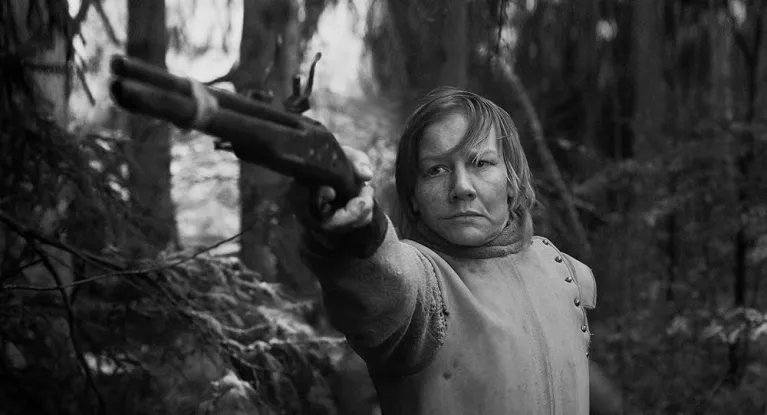
In Markus Schleinzer’s cinema, being other usually begins at the point where an individual must adapt to the existing order in order to survive—a system that appears natural and universally accepted on the surface, yet draws rigid, and sometimes violent, boundaries between us and the other. Although his three feature films, Michael, Angelo, and Rose, differ considerably in their stories, historical periods, and even the circumstances of their protagonists, they converge on a common point: an individual who cannot or will not remain in the position society has assigned them and must therefore perform a role that was never intended for them in order to secure the possibility of living on their own terms. Before fully embarking on a directing career, Schleinzer spent seventeen years working in casting, collaborating with filmmakers such as Michael Haneke, Ulrich Seidl, and Jessica Hausner. This experience later translated into a distinctive attentiveness in his cinema to actors’ bodies, the physical presence of characters, and the nuances of their behavior. In Michael (2011), he turned his attention to a man whose seemingly ordinary daily life concealed a horrific crime. Angelo (2018), meanwhile, told the story of Angelo Soliman, an African man brought to Europe as a child who eventually secured a place in Viennese aristocratic society, yet whose acceptance never amounted to genuine belonging. In both films, the issue extends beyond the fate of an individual: it concerns the relationship between the individual and social norms, and the price one must pay to be accepted. Rose pursues the same preoccupation from a different angle. This time, a woman in the seventeenth century discovers that to enjoy independence, property ownership, and basic freedoms, she must occupy the social position of a man. Schleinzer himself sees the connection between these three films in precisely this tension between individual needs and society’s norms.
Rose begins with a historical setting, but it soon becomes clear that, for Schleinzer, history is not merely a backdrop against which to reconstruct a bygone era. The story unfolds during the Thirty Years’ War, in a Protestant community in the German lands, where the war has left its mark on both the landscape and its inhabitants, and society is attempting to rebuild an order founded above all on property, religion, labor, marriage, and social status. Into this environment comes a wounded stranger, a taciturn soldier with a scarred face who claims to be the heir to an abandoned farm and possesses a document to substantiate the claim. The villagers regard him with suspicion, but he gradually establishes himself within the community by working hard, cultivating the land, and presenting himself as a trustworthy man. What they do not know is that this soldier is actually a woman who, years earlier, adopted male clothing to gain greater freedom and has continued to live under that identity ever since.
The significance of this premise lies in the way Schleinzer takes the question of identity beyond the level of a narrative secret. Rose is not simply about a woman who wants to pass herself off as a man; it is about a society that has so thoroughly tied social privileges to gender that obtaining those privileges requires performing another gender’s social role. Male clothing is not a simple metaphor for a change of identity in the film; it is a means of entering the domain of power. Trousers allow Rose to work, own land, gain social recognition, make decisions, and even occupy a different position within the institution of marriage. Thus, when the film speaks of freedom, it does not reduce it to an abstract concept. Instead, it makes freedom tangible through land, a home, labor, money, and the body.
This is one of the fundamental ways in which Rose differs from many contemporary narratives about gender identity. Schleinzer deliberately avoids turning his protagonist into a political symbol or an ideological hero. Rose is not trying to change the world. She does not even see herself as a model for future generations. Her motivation is far more personal: she refuses to accept the life prescribed for a woman in that society. For this reason, the character is morally contradictory from the outset. She lies, deceives others, and distances herself from the truth to preserve the position she has secured. Schleinzer himself emphasizes that Rose is not a revolutionary; nevertheless, her actions acquire a revolutionary character because they transgress established rules. This distinction saves the character from becoming a one-dimensional hero.
The Thirty Years’ War, meanwhile, serves a purpose that extends beyond its function as a historical reference. Schleinzer does not depict the war itself; he shows its aftermath. The scar left on Rose’s face, the devastated land, poverty, and the harsh conditions of rural life all evoke a world through which violence has passed. Here, war is less an event than a condition. This approach allows the film to move beyond the clichés of historical drama. We are not meant to witness the war itself but to see a world transformed by it. Rose, too, is a product of this world: a woman who, under wartime conditions, was able to live for a time in the guise of a soldier and experience a degree of freedom to which, after the war’s end, she can no longer easily return.
This choice is equally palpable in the film’s visual atmosphere. Gerald Kerkletz’s black-and-white cinematography strips Rose of any kind of historical spectacle. Instead of striking colors, sumptuous costumes, or an opulent reconstruction of the seventeenth century, the image foregrounds the rough textures of the earth, wood, village walls, coarse clothing, and weathered faces. The static shots and precise compositions bring the film’s world close to a series of cold, frozen tableaux, as though the characters were trapped in an environment whose rules had been written long before they arrived. Schleinzer has stressed the importance of creating an autonomous world when making a historical film, rather than offering a museum-like reconstruction of the past. This approach allows Rose to become less a depiction of a historical period than a coherent world governed by its own distinctive visual rules. Within this mise-en-scène, the village is not merely the setting in which the story unfolds; it becomes a character in its own right. The collective gaze, the houses, the fields, the church, and the relationships between families form a network of power within which Rose must constantly maneuver. Her acceptance comes when the community recognizes her usefulness: a hardworking, religious, landowning, dependable man. In this way, the film subtly demonstrates that society responds first and foremost to the role an individual performs within its social structure, rather than to that person’s inner truth. As long as Rose can convincingly perform the role of a man, society is prepared to accept her as the person it believes her to be.
This is where Schleinzer’s background in casting assumes even greater significance. More than a film built around explanatory dialogue, Rose is a film of bodies and behavior. Rose speaks little, and much of what we learn about her is conveyed not through conversation but through the way she occupies the frame. Her manner of walking, sitting, standing, looking, and using her hands all contribute to the construction of her identity. Sandra Hüller, rather than reducing masculinity to a series of exaggerated gestures, performs it in a restrained, almost internalized manner. She portrays a woman who is herself performing the role of a man, which gives her performance two simultaneous layers: the character must convince those around her, while the actor must make that process of persuasion convincing to the audience. Hüller received the Silver Bear for Best Leading Performance at the 2026 Berlin Film Festival for this role. The significance of the award extends beyond the recognition it brings the actress, since Rose is built, in essence, around her body and physical presence. By eliminating any caricature of masculinity, Hüller creates a character who is less masculine than human—a person who has learned how to behave within a particular social role. Even the scar on her face becomes part of this construction: a reminder of war, violence, and a past that the film deliberately refrains from presenting through flashbacks.
Rose’s relationship with Susanna is another crucial element that takes the film beyond a straightforward story about concealing one’s identity. In this society, marriage is not merely an emotional bond; it is a social and economic contract. When Rose enters into this arrangement, she becomes complicit in the very structure from which she had previously escaped by wearing men’s clothing. Susanna, too, is initially seen less as an independent individual than as a component of this same system of exchange. Her pregnancy marks a decisive turning point in the narrative, bringing into the open a contradiction that had until then remained concealed. From this point onward, the issue is no longer simply Rose’s secret. The question becomes how society will respond to someone who has disrupted its gender and family arrangements.
From this perspective, the off-screen narrator takes on an even greater significance. The narrator’s female voice, which flows over the images from the outset like a literary voice, is not simply a device for bridging gaps in time but an integral part of the film’s narrative structure. Schleinzer initially wrote the screenplay in prose before transforming it into a cinematic structure, and the narrator was incorporated into the film at that early, literary stage. He deliberately conceived this voice as nonjudgmental: it provides information and opens up the narrative space while allowing viewers to form their own judgments about the character and her actions. As a result, Rose sometimes feels less like a historical film than an adaptation of a historical novel. This structural choice has another important consequence: Rose, who has little opportunity to speak for herself within the world of the story, acquires a voice at the level of narration. Society observes her, judges her, and ultimately passes sentence on her, but the film refuses to leave her merely the object of its narrative. The narrator’s voice establishes a distance between what society says about Rose and the story the film tells about her. This distance prevents Rose’s trial from becoming a moral trial of the audience itself.
Structurally, the film is as restrained as its protagonist. Schleinzer refrains from showing many moments that could easily have become scenes of revelation or melodrama. There is no display of Rose’s naked body to expose the truth, her past is not reconstructed through explanatory flashbacks, and violence largely remains outside the realm of direct representation. These omissions matter because the director deliberately refuses to turn the revelation of Rose’s sex into a moment of voyeuristic curiosity about the body. As he himself has remarked, the story can work without showing the character’s naked body, and the image, too, carries an ethical responsibility.
Historical reality enters the film in a complex way. Rose is not a specific historical figure but a composite character developed through Schleinzer’s research into approximately three hundred women who wore men’s clothing over a period of nearly three centuries for a variety of reasons, ranging from access to work, education, and property ownership to escape from war, violence, and forced marriage. One starting point for this research was the story of Catharina Margaretha Linck, who lived under the male name Anastasius Lagrantinus Rosenstengel, married a woman, and was executed in 1721. The parallels between her life and Rose’s are striking, but Schleinzer insists that his protagonist is a composite figure and that the film does not directly reconstruct Linck’s life. Angela Steidele, a scholar who has researched Linck’s history, has disputed this account, pointing to numerous similarities between the film and the details of Linck’s life. She has also criticized the film’s historical accuracy in its depiction of the trial and execution. This disagreement itself demonstrates that Rose moves between documented history and dramatic reinvention and should not be regarded as the biography of any one historical figure.
The film’s most significant convergence of theme and form, however, occurs in its final scenes, when Rose is finally brought before a court and the very society that once accepted her as a useful and respectable man now seeks to turn her identity into a crime. The court here is more than a judicial institution; it embodies the collective gaze. Rose’s body, until then concealed and controlled through clothing and behavior, becomes the object of public judgment. She must answer for a choice that has meant freedom to her but represents a violation of the established order to society.
The execution scene visually connects the film to one of the most iconic images in cinema history: Carl Theodor Dreyer’s The Passion of Joan of Arc. In its final section, Schleinzer deliberately enters into a visual dialogue with Dreyer’s film. The proximity of the framing, the emphasis on the face, and the circumstances of the trial and execution make this reference unmistakable. Most strikingly, the crown placed on Rose’s head has precisely the same shape and structure as the one worn by Joan of Arc in Dreyer’s film. Without directly turning Rose into Joan of Arc, this visual resemblance elevates her image beyond that of a convicted criminal, transforming her into an icon of victimhood or martyrdom. It is as though, at the moment of execution, the film confers a different meaning upon her body and face.
At this point, the film enters more delicate territory. Rose is not Joan of Arc, nor does Schleinzer endow her with the status of a saint. Throughout the film, Rose remains a human being whose choices are morally complex, whose actions involve lies and deception, and who has even caused harm to others. The reference to Joan of Arc, therefore, cannot be understood simply as an act of glorifying the protagonist. Rather, the image speaks to the workings of power and the process through which a human being is transformed into the other: the very society that once accepted Rose now turns her body and her choices into evidence against her. In this reading, the identical crown does not so much signify Rose’s innocence as call into question the boundary between criminal and victim. In these moments, Hüller’s face, rather than resorting to exaggerated expression, remains almost frozen, and this very stillness intensifies the violence of the scene.
Rose is not a film about becoming a man; it is about a world in which being a woman restricts access to a substantial measure of freedom, while being a man—even if that identity is merely performed—opens the door to it. Schleinzer conveys this not through slogans but through mise-en-scène, the actor’s body, narrative structure, and the deliberate withholding of direct information. Trousers in the film are not merely clothing; they signify social privilege. Land is not merely land; it represents the possibility of independence. Marriage is not merely an emotional relationship; it is a contract of ownership and power. And the court is not merely a place where sentences are passed; it is where society attempts to redraw its own boundaries.
The value of Rose, then, does not lie simply in its telling an unusual story about a woman in the seventeenth century. The film’s significance lies in the way Schleinzer uses a historical situation to make the mechanisms through which social identity is constructed visible. The past is not a refuge from the present. As the director himself has suggested, history can function like a magnifying glass, bringing into sharper focus issues that, in the present, remain obscured beneath layers of habit and prejudice. Rose stands precisely at this intersection: between past and present, identity and role, individual freedom and collective order, and a human being who wants to be herself and a society that insists on deciding who she must be before she can decide for herself.
© 2026. Phoenix Review