



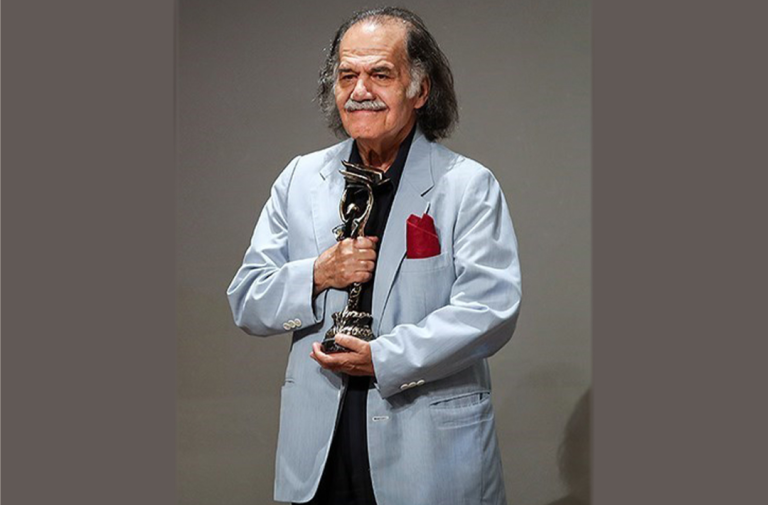
Some people are remembered by their voices before we recall their faces, their bodies, or even our shared memories with them. The same is true of actors. As someone who suffers from misophonia, or sound aversion, and is extraordinarily sensitive to sounds, my relationship with many people, actors, and even spaces and places begins with their voices. This is especially true when they possess a distinctive voice. Perhaps the most familiar example for us Iranians is Khosrow Shakibai. For me, the name Sirous Ebrahimzadeh first brings to mind a voice that is entirely unique, unlike any other. It is a voice with a rich resonance and a memorable timbre, one that registers and remains imprinted in the memory.
In Book I of Politics, Aristotle distinguishes between “voice” and “speech.” In his view, animals too possess voices, through which they express physical responses such as pleasure and pain, whereas human beings use speech to articulate complex intellectual concepts, such as advantage and disadvantage, or justice and injustice. This distinction, which dates back to ancient Greece, raises a question: if speech carries thought, what does that part of the human voice that has not yet become “speech” signify? A moan, a scream, a sigh, a shriek, a cry, laughter, or a tremor in the voice does not necessarily require a sentence. We can hear someone crying in a language we do not speak and understand the depth of their sorrow without needing a translation. Similarly, we often recognize the violence, calmness, nervousness, or kindness in a voice before understanding the meaning of its words.
Several centuries after Aristotle, the Greek philosopher who lived around four hundred years before Christ, the eighteenth-century Swiss philosopher Jean-Jacques Rousseau goes even further in his Essay on the Origin of Languages. He attributes the emergence of the first human vocalizations not to material needs, but to emotions, feelings, and passions. Rousseau argues that human needs gave rise to the earliest activities, but profound human sentiments drew the “first sounds” from the human throat. In his view, it was love, hatred, compassion, and anger that impelled human beings to give voice to their feelings and begin to speak. For this reason, the earliest languages were melodic and charged with emotion before they became logical and systematic.
These ideas are useful for understanding acting. It seems that, in the moment of performance, an actor follows the reverse path: returning written words to their emotional source. The playwright has written words on the page, but the actor must breathe life back into them, infusing them with feelings such as desire, anger, love, joy, fear—in a word, the spirit of life itself. In other words, it is people’s voices that give them their identities. The more distinctive a voice is, the more enduring its owner’s identity and presence become in the mind, and the more readily they can be recognized.
Sirous Ebrahimzadeh is one of those actors whose voice remains in the memory before his face or performance. I first fell in love with theatre as an adolescent, listening to the radio’s nightly storytelling programs and radio dramas, without ever seeing a performer act onstage. My only means of forming a deep connection with actors was through their voices. That is why I remember many of Iran’s older theatre actors by their voices first, rather than by their performances. Sirous Ebrahimzadeh is certainly one of them. His voice was warm, powerful, resonant, and richly textured, with each vocal grain emerging from his vocal cords deliberately and at just the right moment, making its way toward the listener’s ear. He was also a successful actor, particularly in comic and tragicomic roles.
But not every capable and powerful actor possesses an affecting voice. An actor may articulate every word correctly, speak clearly and forcefully, understand the use of pauses, and even be technically flawless, yet still fail to stir anything in us. Conversely, an actor may have a broken, rough, hoarse, or seemingly unattractive voice, and yet that very voice can captivate us in a strange and inexplicable way.
Marlon Brando, the legendary American actor, is a case in point. He rose to fame at a time when Hollywood’s leading actors generally had beautiful voices and impeccable diction. Brando, by contrast, had a nasal, husky, unattractive voice and often left his words half-formed. Yet these very qualities made him a singular star, because the texture of his voice had such a powerful effect on the audience.
In other words, the audience does not receive merely “sound quality”; it senses the body concealed behind the voice. Age, fatigue, anxiety, desire, fear, power, vulnerability, and even a character’s history can all settle into the texture of a voice. This is why a powerful voice and flawless diction do not necessarily produce a voice that shakes or deeply moves us. In acting, what matters more is a voice that announces its presence, shoots forth like an arrow from a bow, and finds its mark in the listener’s heart.
The actor’s manner of delivery is, of course, equally important. An actor with an affecting voice is often someone who also understands silence and knows how to value it. The artful use of silence—in the delivery of words and in the spaces between them—is itself another source of a voice’s power. This is a technique of which some aspects may be innate, but whose more substantial elements can be acquired through extensive practice.
In this respect, too, Sirous Ebrahimzadeh possessed considerable technical mastery. I remember him from the many televised stage productions in which he appeared during the 1980s and 1990s, according to the Iranian calendar. Despite his short stature and small frame, he commanded a powerful presence onstage. And I still remember the beautiful smile that became imprinted in my mind when I was a child.
Words can be repeated countless times. The same line may be spoken by hundreds of actors on theatre stages, in films and television series, and in radio dramas. The sentence remains the same. But each time, the voice is a new event. From this perspective, Sirous Ebrahimzadeh was one of the delightful and unforgettable events in Iran’s theatrical performances and cinematic frames. That particular tremor, that breath, that fragility, that pause, that composure, and that hidden body standing behind his voice will never be repeated.
© 2026. Phoenix Review