



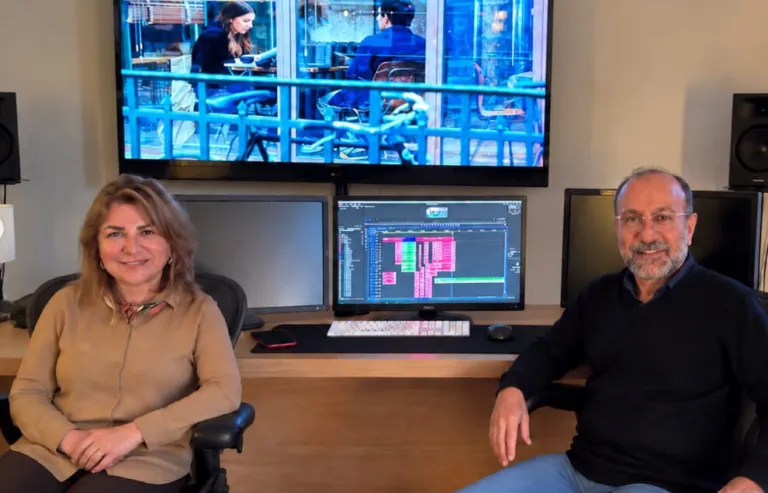
In Asghar Farhadi’s cinema, editing is not merely a stage in which filmed shots are assembled; it is part of the process of discovering the narrative. That is why Hayedeh Safiyari’s name, alongside Farhadi’s cinema, carries a meaning that extends beyond the title of “editor.” Their collaboration began with Fireworks Wednesday and continued through About Elly, A Separation, The Salesman, Everybody Knows, A Hero, and now Parallel Stories. It is a longstanding partnership that has reached its seventh collaboration.
But what accounts for this continuity? The answer may lie in a single concept: the rhythm of information.
Farhadi is a filmmaker who constructs a significant part of his drama not through events themselves, but through the amount and timing of the information he reveals. The viewer must know something, but not everything; they must believe they have understood the truth, only to encounter new information a few minutes later that changes their previous interpretation. In this kind of cinema, therefore, the editor does more than determine the rhythm. The editor decides what the viewer understands, when they understand it, and from what perspective.
This mechanism is particularly evident in About Elly. Elly’s disappearance transforms what appears to be an ordinary gathering into a situation charged with tension, while the editing gradually releases information to the audience. In A Separation, editing becomes the architecture of a state of “not knowing”: at many points, viewers cannot be certain exactly what happened at the moment of the incident, and subsequent information changes the meaning of earlier scenes. Safiyari’s work on About Elly and A Separation can likewise be understood in terms of this management of information, the delayed disclosure of truth, and the shifting interpretations of the audience.
From Invisible Editing to the Editing of Information
One common misconception about Farhadi’s editing is that it can be described simply as “invisible editing.” The more important issue is not whether the cut goes unnoticed, but whether the mechanism through which truth is constructed remains invisible.
Safiyari places cuts where viewers are more absorbed in the situation than in the act of editing itself. Behind this invisibility, however, lie highly precise choices: Where should a scene begin? Where should it end? Which actor’s reaction should be retained? Which glance should be removed? How much of a conversation should be heard? And, most importantly, at what point should the information available to the film be conveyed to the audience?
In an interview, Safiyari explained that, in her collaboration with Farhadi, editing is inseparable from the filming process. Their discussions about a film begin at the screenplay stage and continue until editing is complete. She has also said that, on About Elly, A Separation, The Salesman, A Hero, and their other collaborations, she begins editing while filming is still underway and moves on to the fine-cut stage with Farhadi once principal photography has ended.
This point is crucial to understanding Farhadi’s cinema: editing is present from the moment the narrative begins to take shape.
How Does Safiyari Construct Farhadi’s Rhythm?
Rhythm in Farhadi’s cinema does not necessarily mean speed. In fact, many of his scenes are long, built around pauses, silences, glances, and the actors’ reactions. Safiyari must strike a balance between two competing demands: preserving the natural, real-time duration of a situation while preventing its tension from dissipating.
Safiyari has explained that Farhadi sometimes films important scenes in a single, extended take, after which the scene’s duration, points of entry and exit, and the placement of cuts are adjusted in the editing room to establish the final rhythm. She has cited the confrontation between Nader and Razieh in A Separation, which was initially filmed as a continuous sequence but ultimately required cuts in the editing process to preserve its rhythm.
Safiyari’s editing, then, cannot be explained in terms of “more cuts” or “fewer cuts.” The central issue is how she manages the duration of the viewer’s experience of a situation.
“Parallel Stories”: Where Editing Must Move Between Multiple Realities
Safiyari’s collaboration on Parallel Stories takes on particular significance because Farhadi is experimenting with a different narrative structure this time.
The film follows a writer who draws on her neighbors’ lives for her fiction. With the arrival of Adam, her writing begins to enter the real world in unexpected ways. Within such a structure, editing is no longer concerned with time alone; it must navigate different levels of reality. We need to know which world we are in: the characters’ actual world, Sylvia’s imagined world, the world of her writing, or a world into which her writing has intruded.
Here, a simple shift between shots can move an event from “reality” into “imagination,” or from “imagination” into “reality.” The value of Safiyari’s work on this film, therefore, lies in how she manages these shifting boundaries.
If editing in About Elly concealed information, in A Separation it postponed the revelation of truth, and in A Hero it managed the credibility of conflicting accounts, then Parallel Stories presents a more complex challenge: the very boundary between narrative and reality has become the film’s subject.
Why Do Safiyari and Farhadi Keep Returning to Each Other?
The answer should not be sought in a simple similarity of editing styles. More important is their shared working language. In an interview about her longstanding collaboration with Farhadi, Safiyari explained that they discuss the characters and story from the screenplay stage onward, and that this dialogue continues until editing is complete. She has also emphasized that Farhadi has a different sense of rhythm from some other directors, and that their years of working together have allowed them to develop a shared language.
In a separate interview about The Salesman, Farhadi explained that he gives Safiyari the screenplay before filming and discusses the characters and story with her. Then, in the editing room, Safiyari initially establishes the structure of the scenes, after which the two reach an agreement on their duration, rhythm, and fine cut.
This approach shows that their relationship goes beyond the traditional director-editor dynamic. It has evolved into a form of authorial collaboration in the architecture of the narrative.
Farhadi knows when Safiyari should allow a scene room to breathe and when a cut can alter its meaning. Safiyari, in turn, understands Farhadi’s narrative logic from the screenplay stage. As a result, not every decision needs to be explained from scratch in the editing room.
“Parallel Stories” and the Changing Language of Farhadi’s Editing
The significance of Parallel Stories for the study of Farhadi’s editing lies precisely here. At least in terms of its narrative structure, the film moves further toward an interplay of narrative, imagination, and reality than Farhadi’s more socially oriented works. A recent report on the film has also examined Safiyari’s contribution to its editing alongside the screenplay, production design, and other elements. Consequently, the film’s editing cannot be explained solely through criteria such as “invisible editing,” “smooth cuts,” or “visual continuity.” The more fundamental question is how editing shifts the viewer’s position in relation to the truth.
In Farhadi’s cinema, we usually think we are discovering the story. In reality, however, we are being moved from one interpretation to another. Each new piece of information revises the picture we had formed before. Safiyari is one of the most important architects of this shift.
From this perspective, her longstanding collaboration with Farhadi should be understood not as the result of habit, but as the product of a shared cinematic language—a language in which editing continues the work of the screenplay, and the fine cut becomes the final stage of writing the film.
In Parallel Stories, this shared language enters a new phase. If, in Farhadi’s earlier films, editing largely brought a concealed truth gradually to light, here it must contend with a world in which narrative itself can produce reality. Perhaps this is why Hayedeh Safiyari is more than just an editor in Farhadi’s cinema: she is one of the people who help his films compel viewers to see the truth not once, but over and over again.
© 2026. Phoenix Review