



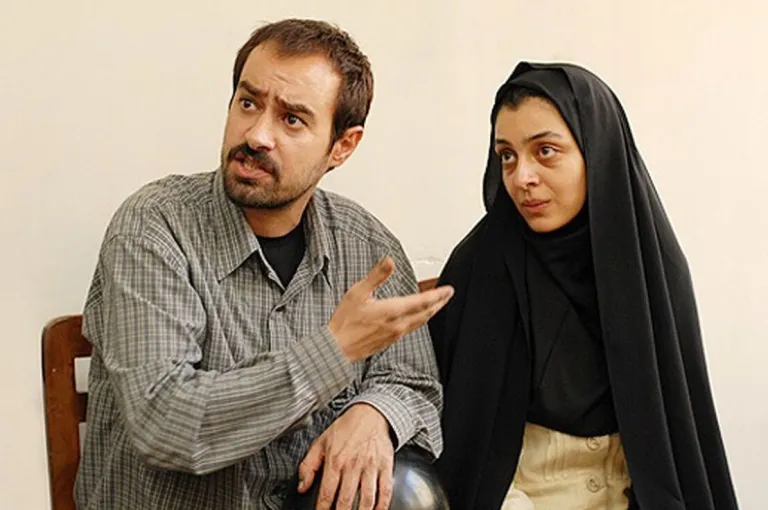
People today have more opportunities than ever to speak, be seen, and make choices. But are they equally capable of changing the world around them? This question captures one of the central contradictions of contemporary life: a condition in which individuals appear free to make decisions, respond to events, and strive to shape their own lives, yet in practice find themselves caught in a web of economic, social, moral, and institutional constraints rather than in control of their own destinies. The gap between wanting and being able to act has become one of the defining experiences of contemporary existence—an experience that Iranian social cinema explores in various ways.
If the cinematic hero was once someone who stood against the status quo and changed the course of events through sheer will, courage, or a decisive act, today a significant strand of Iranian social cinema presents us with characters who are neither entirely resigned nor capable of fundamentally transforming their circumstances. They make choices, but cannot be certain of their consequences; they take action, but the outcome does not necessarily correspond to their intentions. They find themselves caught between responsibility and constraint, ethics and expediency, the desire for change and the fear of its consequences. This is what might be called a “crisis of agency”: a crisis that does not arise from the absolute powerlessness of human beings, but instead points to the growing difficulty of making a meaningful impact on the social world.
The Crisis of Agency: When Choice Exists but Freedom Is Incomplete
In sociological terms, agency refers to the capacity of individuals to intervene in the social world and influence the conditions of their own lives. The problem is that people do not make decisions in a vacuum, nor do they have equal resources at their disposal to put those decisions into practice. Social class, economic circumstances, power relations, cultural norms, and legal institutions all help determine the scope of individual choice.
In contemporary society, this contradiction has taken on a more complex form. On the one hand, responsibility for success and failure is increasingly placed on individuals, as though everyone were entirely responsible for their own destiny. On the other hand, many of the factors that determine their lives remain beyond their personal control. Individuals are expected to succeed, build their futures, manage their relationships, and overcome crises—even when they lack the means necessary to meet these expectations.
In his discussion of liquid modernity, Zygmunt Bauman describes the instability of relationships, institutions, and identities, a condition that diminishes social security while increasing individual responsibility. Byung-Chul Han, in his analysis of the burnout society, likewise shows how the constant pressure to succeed, remain active, and be visible can wear people down. Under such conditions, individuals may remain in perpetual motion without necessarily making progress or bringing about change. Repeated reactions take the place of effective action, and the feeling of being active does not necessarily translate into a sense of having an impact.
This gap is not merely an individual problem; it has social dimensions. A society in which people gradually come to regard change as unlikely may experience a kind of erosion of collective will, even when opportunities for intervention do exist. The crisis begins when people become uncertain not only about their ability to act, but also about whether they can imagine a different future at all.
Farhadi: Ethics at an Impasse of Choices
Among Iranian filmmakers, Asghar Farhadi’s cinema offers an important lens through which to understand this condition. His characters are usually ordinary people: neither grand heroes nor entirely powerless victims. They find themselves in situations that demand decisions, yet no choice is simple, cost-free, or entirely predictable.
In About Elly, the crisis begins with Elly’s disappearance but quickly develops from an unforeseen incident into a crisis of truth, trust, and responsibility. A group of educated, urban middle-class people, confronted with an unexpected situation, are forced to reconsider their image of others and even of themselves. Concealment, fear of judgment, and expediency destabilize relationships that had appeared ordinary and secure. The characters act in an attempt to contain the crisis, but each intervention risks making the situation more complicated.
In A Separation, a family dispute becomes a legal matter and then develops into a moral crisis. The characters are caught in a web of class relations, family obligations, legal requirements, and ethical considerations. No one can easily declare themselves entirely innocent or the other person wholly to blame. Decisions are made with incomplete information, while their consequences slip beyond the characters’ control.
In The Salesman, too, the issue extends beyond a traumatic experience. The protagonist becomes trapped between a desire for justice, the temptation of revenge, and the effort to preserve an ethical image of himself. Will his actions lead to justice, or will they generate further violence? Can one disregard another person’s suffering in the name of justice?
The significance of Farhadi’s cinema lies in its refusal to reduce ethics to a set of ready-made answers. He shows how people may genuinely seek to do the right thing while finding themselves in situations where determining what is right has become difficult. In this world, agency has not disappeared; it has become fragile, constrained, and fraught with risk. Any action may resolve part of a problem while simultaneously creating a new one.
A Generation Whose Future Has Been Deferred
The crisis of agency takes a different form in the cinema of Parviz Shahbazi. Whereas Farhadi’s characters are often caught in a complex web of ethical choices, Shahbazi’s films invite us to explore this crisis through the experience of the younger generation and its relationship with the future.
In Deep Breath, the issue is not simply the dissatisfaction of a few young people with their circumstances. It is the predicament of a generation suspended between a past that cannot return and a future that has yet to take shape. The characters want to move forward, but they see no clear destination ahead. They are dissatisfied with the existing order, yet lack the means to change it. Neither rebellion offers them a clear path to liberation nor does accommodation with the status quo guarantee a fulfilling life.
Here, suspension is no longer merely a temporary condition; it becomes a way of living. People move without knowing where they are going; they wait without knowing whether the event they are waiting for will ever take place. The future, rather than serving as a horizon of possibilities, becomes an obscure and unpredictable space.
Perhaps one of the most important questions concerning the situation of young people today is this: when the ability to plan for the future becomes limited, what happens to will, hope, and the sense of individual responsibility? The problems facing young people cannot all be attributed to a lack of motivation or a weakness of will. Sometimes the issue is not that people do not want something, but that a substantial gap has opened up between what they want and the means available to realize their desires.
Rasoulof: Choice and the Price of Resistance
In Mohammad Rasoulof’s cinema, the crisis of agency becomes most apparent in the individual’s relationship with structures of power. His characters find themselves in situations where the possibility of choice has not entirely disappeared, but the price of choosing can be devastatingly high. Their security, social standing, family relationships, and even their ability to continue living may all be put at risk.
In films such as There Is No Evil and The Seed of the Sacred Fig, the central issue is not simply distinguishing right from wrong. It is how individuals can preserve their moral responsibility under pressure from structures of power. Ethical choices become even more difficult when their consequences extend beyond the individual and put others at risk as well.
Under such circumstances, agency cannot be measured solely by the degree of freedom one has to choose. The ability to bear the consequences, the possibility of resistance, and the capacity to preserve one’s sense of human responsibility are also part of it. Action is no longer necessarily a straightforward, liberating act; it becomes a costly decision that requires individuals to reckon with its consequences.
Nevertheless, Rasoulof’s cinema does not entirely eliminate the possibility of resistance. Even under the most restrictive conditions, the question of ethical choice remains. The significance of these narratives lies in showing that power can restrict the scope of action without easily eradicating the question of human responsibility.
Open Endings: The Aesthetics of an Unfinished Society
One of the defining features of contemporary Iranian social cinema is its tendency toward open endings and unresolved conflicts. In these films, crises do not necessarily reach a definitive conclusion; characters remain suspended in unfinished situations, leaving viewers with questions that have no easy answers.
This tendency can be examined as more than a formal choice or an aesthetic preference. In many cases, the open ending corresponds to a social experience in which crises have no definitive solutions and the future remains uncertain. Rather than resolving every conflict through a final decision, cinema confronts viewers with the complexity of the situation.
Of course, not every open ending should be interpreted directly as a reflection of a particular social condition, nor should definitive conclusions about society be drawn from cinematic form without further investigation. Nevertheless, the recurrence of unresolved situations, costly decisions, and uncertain futures in a significant strand of Iranian cinema raises an important question: does this cinema merely depict individual crises, or does it also reveal signs of a transformation in the social imagination of the possibility of change?
Cinema does not simply reflect reality; it also participates in shaping how we imagine the world. Films show us what kinds of action are possible, what choices are available to individuals, and which constraints have become so normalized that they are no longer even noticed. Sometimes, depicting powerlessness is not an invitation to surrender but a way of recognizing the mechanisms through which powerlessness is produced.
Can We Imagine the Possibility of Action Again?
The shift from the active hero to the suspended subject should not be understood as the end of human agency or as evidence that structures have gained complete control over people’s lives. Such an interpretation could itself reproduce the very impasse it seeks to criticize. The problem is not that people are no longer capable of acting, but that the relationship between will, possibility, and outcome has become more complex and uncertain.
Returning to classical heroes is not necessarily an answer to this crisis, either. The contemporary world cannot be easily transformed by an extraordinary decision or an individual act of will. Perhaps new forms of agency must instead be sought in small acts, the preservation of ethical responsibility, the creation of collective bonds, resistance to the normalization of indifference, and efforts to open up new possibilities.
Social cinema can play a role beyond merely documenting failure when it moves from depicting existing conditions to questioning how those conditions are produced. Why has action become so difficult? What forces constrain individual choices? Why is the burden of failure placed on individuals when so many of the determining factors lie beyond their control? And how can scattered individual experiences be brought together into a collective understanding of the problem?
These questions concern more than the characters in films; they lead us back to our own social lives. When individuals feel that their decisions have little impact on the world, when the future becomes an obscure horizon, and when every choice carries unpredictable costs, the problem extends beyond individual psychology and becomes a social issue.
Perhaps the fundamental difference between the hero and the suspended subject is that the hero believes change is possible and acts to bring it about, whereas the suspended subject must first grapple with doubt about whether change is possible at all. Yet this very doubt can become a starting point for understanding, provided it does not harden into an inevitable destiny.
By portraying people caught between wanting and being able to act, Iranian cinema offers an image of a society in which making decisions is difficult, truth is fragmented, and the future is uncertain. But depicting this condition does not necessarily mean accepting it. Sometimes the first step toward overcoming an impasse is to look closely at the very forces that have produced it.
Perhaps the challenge today is no longer to find a hero capable of saving the world single-handedly, but to rebuild the belief that people, even under restrictive conditions, can create opportunities for intervention, resistance, and change. Cinema cannot act on society’s behalf, but it can keep alive the question of whether action is possible—a question without which the future is lost before it can even be made.
For the most dangerous form of powerlessness is not always the absence of power. Sometimes it is the moment when people can no longer imagine the existing order as something that could be changed. Perhaps the task of art, before it is to create new heroes, is to restore this very possibility to the collective imagination: the recognition that what exists is not necessarily the only thing that could exist.
© 2026. Phoenix Review