



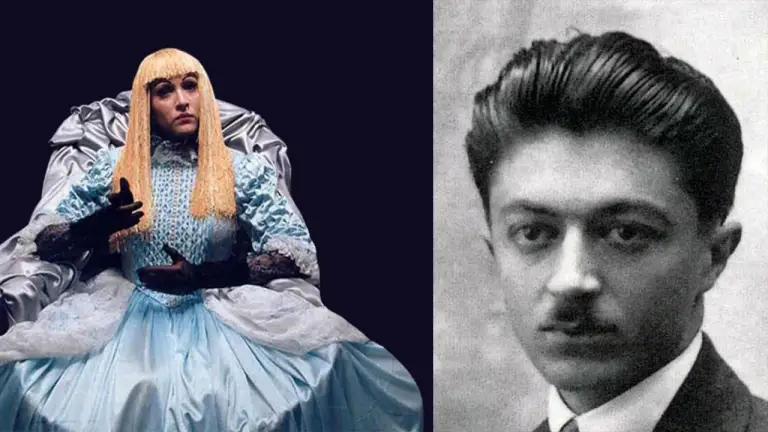
At first glance, Sadegh Hedayat’s short story The Doll Behind the Curtain appears to be about a man who falls in love with a doll and eventually becomes unable to distinguish it from a living person. To read it merely as a tale of psychological deviance or unconventional love, however, is to lose sight of its complexity. The story begins with a private attraction, turns that attraction into a standard by which reality is measured, and ultimately allows it to take such complete control of the protagonist’s perception that even a living person can no longer take the place of the image. Darakhshandeh, Mehrdad’s cousin, is not merely a victim of his madness. She, too, attempts to turn herself into an image that might draw the gaze of the man she loves toward her. This essay approaches the story from precisely this point: the distance between seeing a human being and seeing the image we have constructed of that person.
Two Ways of Relating to the Other
To clarify this distance, Martin Buber’s distinction between two kinds of relation to the world is useful. In an “I–Thou” relationship, the other exists as an independent being whose presence makes a demand on me that I cannot anticipate in advance. In an “I–It” relationship, the other becomes an object of knowledge, experience, or use. Buber’s crucial point is that this distinction is not between human beings and things, but between two ways of relating. One can relate to a human being as an “It” and to a tree as a “Thou.”
These concepts do not provide the definitive key to the story, but they illuminate a tension that has been present from the beginning. The issue is not simply that Mehrdad mistakes Darakhshandeh for the doll at the end; even before that, he seeks a relationship in which the other never departs from his preferred image. In this sense, the doll is not merely a substitute for a human being. It is the perfect embodiment of a relationship in which the other’s capacity to respond and exist independently has been eliminated.
Isolation and the Unresisting Doll
Mehrdad’s journey to Europe is supposed to expose him to new experiences and people, yet its outcome is withdrawal. This isolation should not be attributed simply to shyness or social ineptitude. It creates conditions in which fantasy can develop undisturbed. In solitude, the mental image remains untouched; in a relationship with a real person, however, one inevitably encounters something beyond one’s control. The other speaks, responds, and has desires that may not correspond to our own conception of them.
The doll is precisely what eliminates this encounter. Its beauty does not depend on its own will; it does not speak or have an independent narrative within the relationship. Mehrdad has not discovered a beloved; he has found one whom he can imagine according to his own desires. The image appears to be the product of selection and exclusion: characteristics that conflict with the viewer’s desires have no place in it. The doll makes this process tangible. It is not a human being about whom Mehrdad has formed mistaken impressions, because it is not human at all and cannot correct his fantasies.
After returning from Paris, “Mehrdad treated his fiancée, Darakhshandeh, very formally and did not even bring her a souvenir. On the third day, his mother called him over and reproached him, reminding him in particular that Darakhshandeh had spent the past six years waiting for him at home, had turned down several suitors, and that he was ultimately obliged to marry her. Mehrdad listened calmly to all this, then poured cold water on his mother’s hopes, replying that his views had changed and he had decided never to marry.”
This image of a woman without will or the capacity to respond is no accident, either. Mehrdad wants a woman who is lovable without possessing desires or an independent will that might confront his own. This desire can also be read within the framework of patriarchal conceptions of women, but the story pushes it to a point where we are no longer dealing with an ordinary preference or even a romantic fantasy. This is the turning point. As long as the image remains within the realm of fantasy, it is a representation of reality. Once Mehrdad makes it his standard, the relationship is reversed: reality itself must conform to the image.
The Cousin: A Human Being Who Tries to Become an Image
If we devote all our attention to Mehrdad, Darakhshandeh remains merely his ultimate victim. Yet the most painful possibility for interpretation lies in her own position. She wants to be seen, and by putting on the doll’s clothes and taking its place, she attempts to occupy a position from which Mehrdad might finally accept her.
“To win Mehrdad’s affection, Darakhshandeh took her cues from the statue, adopting its style and taste. Her hair was cut and curled like the statue’s, and she had a pistachio-colored dress made in the same style as the statue’s clothing. She even copied the statue’s shoes. During the day, whenever Mehrdad left the house, Darakhshandeh would go into his room, stand in front of the mirror, and imitate the statue.”
This choice is not a conscious decision to become a thing. She does not want to relinquish her humanity; she wants to find a way to reach Mehrdad. But the path she chooses diminishes the very difference on which a human relationship depends: the difference between an independent person and the image another person wants them to embody. Rather than inviting Mehrdad to see her as she is, she tries to become something he already desires.
The tragedy here is more painful than one-sided madness alone. The closer Darakhshandeh comes to the image, the less Mehrdad encounters her as a person, because resemblance to the image takes the place of recognizing a human being who continues to exist beyond it. Two opposing movements are at work. Mehrdad prefers the image to the human being, while Darakhshandeh draws closer to the image in order to reach Mehrdad. These movements are intertwined, but they never arrive at a common point.
In Buber’s terms, what we see here is not a relationship that has been lost, but one that never had a place in Mehrdad’s ideal world to begin with. The closer Darakhshandeh comes to the image, the more she is transformed from a “Thou” into an “It”—and it is precisely this transformation that makes Mehrdad feel no need to see her.
What Is Being Killed?
At the level of plot, the story ends with Darakhshandeh’s murder. Symbolically, however, Mehrdad also destroys the last possibility of reality entering the sealed world of his fantasy. This does not mean that he makes a conscious decision to do so. The tragedy is intensified by the fact that he can no longer distinguish what stands before him from the image in his mind. In the final moment, Darakhshandeh and the doll merge in his perception. He intends to destroy the doll but kills a human being instead.
“Like a madman, Mehrdad made a movement as if to flee, but at that moment an idea occurred to him. Almost involuntarily, he reached into his trouser pocket, pulled out his revolver, and fired three shots in quick succession at the statue’s face. Suddenly, he heard a groan, and the statue fell to the ground. Terrified, Mehrdad bent down and lifted its head, but it was not the statue; it was Darakhshandeh, lying immersed in her own blood.”
The distinction between the character’s intention and the meaning of the event is important. If we interpret the murder as a deliberate decision to preserve his fantasy, we attribute to Mehrdad a degree of awareness and agency that the story does not necessarily support. Yet the catastrophic result of this perceptual collapse is the preservation of the very world in which the image has triumphed over the human being. In a conventional narrative, an encounter with reality brings a character out of illusion. Here, the final encounter does not lead to awakening, because the person whose existence could have reminded Mehrdad of the distance between image and reality is the very one who is destroyed.
Behind the Curtain of Which Image?
From this perspective, the story’s title acquires a deeper significance. The curtain marks the boundary between what is seen and what remains hidden, but this boundary does not lie solely between the doll and the outside world. It can also be understood as the distance between a human being and their image. What Mehrdad sees is less the presence of another person than a reflection of his own desire and attraction. By dressing like the doll, Darakhshandeh tries to pass through this curtain, but her attempt brings her closer to the image and further away from the possibility of being truly seen.
At night, when Mehrdad returned home, he would lock the doors, put a record on the gramophone, drink, and draw back the curtain in front of the statue. He would then sit for hours on the bench opposite it, absorbed in its beauty. What aroused the suspicions of the other members of the household, however, was that he had placed a woman behind the statue’s doorway in his own private room. She wore a pistachio-colored dress, one hand resting on her hip and the other hanging at her side, and she smiled.
The story, then, is not about a simple opposition between fantasy and reality. Fantasy is not inherently the enemy of reality, and not every image prevents us from recognizing another person. The problem begins when the image ceases to be a means of engaging with the world and becomes instead a standard to which reality must conform. Under these conditions, a real person is accepted only to the extent that they correspond to the desired image.
The story ends with the death of a human being, but its tragedy begins much earlier, at the moment when the image takes the place of the person.
© 2026. Phoenix Review