



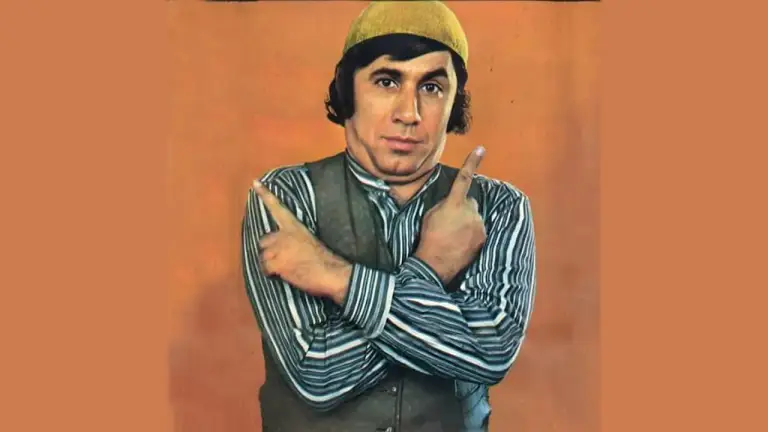
Parviz Sayyad cannot be known solely through “Samad.” Samad is the most important character of his career, but perhaps more important than Samad himself was Sayyad’s social intelligence in identifying characters that society had experienced in everyday life before ever seeing them on screen. On Cinema Day, perhaps the best way to pay tribute to Parviz Sayyad is to look beyond Samad and Asadollah Mirza’s catchphrases and turn our attention once again to the intelligence behind them—an intelligence that understood that society sometimes recognizes itself in the mirror of comedy and cinema before it is able to take itself seriously.
This date on the calendar provides a fitting opportunity to remember figures without whom the history of Iranian cinema would be incomplete—not simply because they were actors or directors, but because they helped shape a part of the social memory of Iranians. Parviz Sayyad belongs to this group: a multifaceted artist who explored different paths in acting, writing, directing, producing, and theater, and, more importantly, managed to move between popular cinema and serious, artistic filmmaking—something few figures in Iranian cinema have achieved with comparable success. The Parviz Sayyad Foundation, in presenting his career, has likewise emphasized this unusual combination of mass popularity, commercial success, and artistic experimentation.
Sayyad was not one of those artists who first chose cinema as a profession and only afterward sought to understand its audience. He came to cinema through stories, theater, and people. As a child, he became familiar with the world of storytelling through tales he heard at home and during sessions devoted to the Shahnameh and Eskandarnameh. In high school, he would tell others stories he had created from his own imagination. That ability to tell stories would later find its way, in different forms, into his playwriting, acting, and filmmaking.
His desire to become an actor was serious. He wrote plays, but in his imagination he saw himself on stage. The formation of an independent theater troupe grew out of the same impulse: the desire to become part of the world he was creating. His early experiences in theater and playwriting gradually led him to television, and his collaboration with Parviz Kardan on series such as Sar Kar Ostovar, during the early years of National Iranian Television, paved the way for the emergence of one of the most enduring characters in Iranian popular culture: Samad.
But Samad was more than a comic character. His significance lay in Sayyad’s understanding that a simple-minded rural character, when placed within the context of social transformations, could become a mirror through which society could see itself. Samad moved through different social situations, and each time he carried something of his own era with him. Sayyad later explained that Samad had not been created according to a fully developed, predetermined design from the outset; rather, the situations themselves shaped Samad, and he changed in response to different social circumstances. This may well be the key to understanding Sayyad’s ingenuity.
He understood that people do not go to the cinema merely to laugh. In laughter, they see themselves, their neighbors, their managers, the bureaucratic system, their aspirations, their failures, and even the contradictions of society itself. That is why Samad was able to evolve from a simple character into an independent cultural figure—a character who remained in the public memory even decades later. Sayyad himself later remarked that Samad was no longer entirely under the author’s control and had continued to live an independent life in the minds of the people.
This is where Sayyad distinguishes himself from an ordinary comedian. His gaze upon society was that of a keen observer. He noticed situations, recognized social types, and understood which behaviors could be transformed into the language of comedy. In the Samad films, humor often emerged from the gap between what society claimed to be and what it actually was.
This social intelligence also meant that his work was never confined to popular entertainment. Sayyad worked simultaneously in theater, television, and cinema, and he also played a role in recording and presenting forms of popular performance, including ruhozi and ta’zieh. His interest in popular culture allowed him to understand the language of ordinary people not as something superficial, but as an integral part of social culture.
At the same time, Sayyad quickly realized that commercial success could create opportunities for artistic experimentation. The series of Samad films provided him with the means to make and support films and projects that were closer to his artistic and social interests. His producing credits include Sohrab Shahid-Sales’s Still Life, The Mina Circle, The Bumblebee, Sattar Khan, and The Suitor.
This part of Sayyad’s life may have received less attention than Samad, but it is crucial to understanding his place in Iranian cinema. He used the income and prestige of commercial cinema as a means of moving toward more unconventional filmmaking. Helping to make Still Life possible for Shahid-Sales is a significant example of this approach: an artist who, on one side of his career, had created the hugely popular character of Samad and, on the other, contributed to the production of a work by one of the most important filmmakers of Iran’s alternative cinema.
Even his acting career was not limited to comedy. He appeared in Ali Hatami’s Hasan Kachal, acted in The Bumblebee, and appeared before Ebrahim Golestan’s camera in The Secrets of the Treasure of the Jinn Valley. But perhaps one of the most important moments in his acting career came when Nasser Taghvai offered him a role in My Uncle Napoleon.
Sayyad accepted the role and turned Asadollah Mirza into one of the most memorable characters in the history of Iranian television. The character came alive through Sayyad’s intonation, pauses, gestures, gaze, and manner of presence. Many of Asadollah Mirza’s catchphrases became permanently embedded in the public memory.
This demonstrates that, contrary to the common perception, Sayyad was not simply “Samad.” He was an actor capable of taking a character out of the text and transforming it into a social being. Asadollah Mirza was fundamentally different from Samad, but the two shared one essential quality: Sayyad understood how to translate a character into the language of the people.
On the other hand, with Dead End, Sayyad revealed another dimension of his artistic identity. The film occupies an important place in his career and was later screened at the Moscow International Film Festival. Dead End was no longer the world of Samad’s jokes. It was a closed, anxiety-ridden, socially charged world in which the individual confronted the limitations surrounding him. This shift demonstrated that Sayyad had not become trapped by the success of a single character; he wanted to explore other possibilities as well.
Along the Night is another example of the breadth of his activities. In that project, Sayyad was involved not only as director but also in writing the screenplay. Such collaborations demonstrate that the success of Samad served as capital for him to enter other realms of cinema.
Sayyad understood the value of a mass audience, but he did not equate popularity with superficiality. His understanding of popular culture allowed him to create films and characters that audiences could embrace while, beneath the surface, still carrying traces of social criticism.
After the Revolution, he made The Emissary outside Iran. Produced with limited resources, the film managed to find an audience at festivals and on television networks. His experience with The Frontier continued along the same path; years later, the film once again attracted attention and prompted discussion about its political and social dimensions.
A continuous thread can be traced throughout Sayyad’s career: from Samad to The Emissary, from comedy to politics, from television to alternative cinema, his central concern remained the human being within a social situation.
Even when Sayyad was making comedies, he took society seriously. That is why his jokes were never merely intended to make people laugh. He understood that comedy can sometimes be the most precise form of social criticism, because rather than explaining society from the outside, it reveals its contradictions to the people themselves.
This is why it remains impossible to speak of the history of Iranian cinema and television without acknowledging Parviz Sayyad. He was one of the architects of Iran’s visual culture and public memory across several decades—an artist who moved between theater and television, commercial and artistic cinema, laughter and bitterness, the people and politics.
Sayyad deserves to be seen anew—not merely as “Samad Agha,” but as an artist who understood that to create something enduring, one must create a character; and that to create an enduring character, one must understand the era, the people, and the social relations that shape their lives.
© 2026. Phoenix Review