



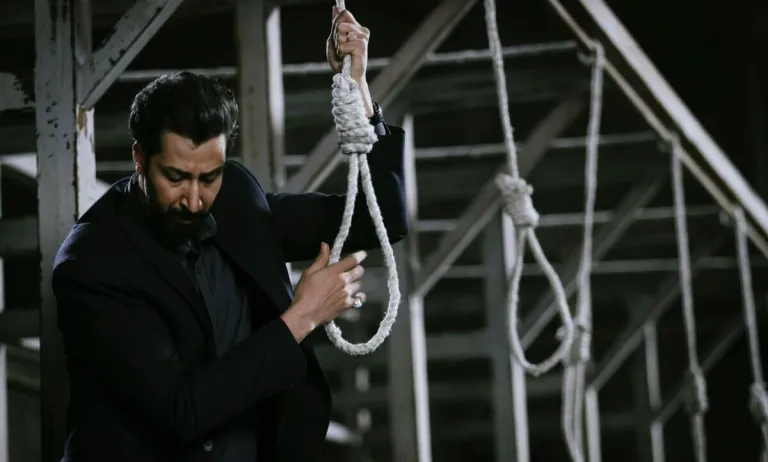
Revenge is one of those subjects that Iranian cinema has repeatedly returned to, each time managing to draw from it a dramatic and emotionally charged situation. This is because Revenge is not merely a legal sentence; it is a point of intersection between several fundamental human concepts: death, revenge, justice, forgiveness, mourning, and the right to choose. For this reason, cinema centered on Revenge cannot simply be categorized as a subgenre of courtroom or crime cinema. In most films dealing with this subject, Revenge serves as a pretext for entering deeper layers of social and moral relations. Zendehshur by Kazem Daneshi follows this trajectory: a film that places five people sentenced to Revenge in a compressed and suffocating situation during the final hours of their lives, focusing not simply on how the crime was committed but on the moment when the law is about to result in the death of a human being. Perhaps the history of Revenge in Iranian cinema can be understood as a movement from “crime” toward “the human”: from films in the 1990s that focused primarily on a murder and its legal consequences to works that today attempt to look beyond the sentence toward the families, poverty, honor, anger, love, and suffering of the people involved. Zendehshur stands precisely at this point, where Revenge is transformed from a legal term into a tragic situation.
I Want to Live: Revenge in the Turbulent Cinema of the 1990s
One of the most important stages in this trajectory is I Want to Live, directed by Iraj Ghaderi from a screenplay by Rasoul Sadrameli. Released in 1994, the film addressed an issue that was both socially contentious and highly capable of attracting audiences during the early years of the 1990s. The film places the story of Aslan and Mah-Monir and a fractured family alongside an unintended killing and its consequence—Revenge—while developing the narrative through love and family relationships. The importance of I Want to Live lies in the way it uses Revenge as a “dramatic situation”: a situation capable of tearing a family apart, pushing a love story into crisis, and suddenly confronting people who had previously been living ordinary lives with the question of death. The film can be regarded as an important example of the socially oriented popular cinema of the 1990s, a period when filmmakers were looking for subjects that could both engage with social issues and bring audiences into theaters. From this perspective, I Want to Live is significant because it demonstrates how Revenge can be incorporated into a romantic and familial melodrama without being reduced to a purely legal discussion, thereby generating tension and suspense. The film is also representative of a period in which stars and popular actors, alongside socially contentious subjects, played an important role in the box office success of films. In this sense, it can be considered one of the earliest significant examples of the connection between “Revenge,” “melodrama,” and “mass audiences” in post-revolutionary Iranian cinema.
Beautiful City: When Revenge Moves Beyond Law and Reaches Ethics
If I Want to Live explored Revenge through melodrama and romantic narrative, Asghar Farhadi’s Beautiful City took an important step toward complicating the subject. In Beautiful City, Akbar is awaiting the execution of his Revenge sentence in a juvenile detention and rehabilitation center, while his friend Ala attempts to obtain forgiveness from the victim’s family. Yet the story soon moves beyond a criminal case and becomes a story about love, poverty, loneliness, and moral choice. From the outset, Farhadi places the spectator in a position from which it is impossible to judge any of the characters easily. The victim’s family has the right to be angry, but must that anger necessarily result in the killer’s death? The condemned man’s family likewise has the right to fight for their son’s life, but can the suffering of the victim’s family simply be ignored? It is precisely this ethical back-and-forth that distinguishes Beautiful City from many comparable works. Farhadi neither presents Revenge as good nor as bad; he turns it into a question. Perhaps this is why the film remains one of the most important Iranian films about Revenge. Beautiful City demonstrates that cinema can successfully confront a legal issue when it distances itself from issuing a verdict. The film does not seek to take the judge’s seat; it places the spectator in the difficult position of having to judge. From this point onward, Revenge in Iranian cinema is no longer merely “the execution of a murderer”; it becomes a question of how far a person can relinquish their own rights, and whether forgiveness is always a virtue or can itself become a painful and complicated decision.
Pay the Price, I’m His Mother, and Jāndār: Revenge in the Shadow of Crime, Family, and Revenge
Following Beautiful City, Revenge took on increasingly diverse forms in Iranian cinema. In Hassan Fathi’s Pay the Price, Revenge does not occupy the center of the narrative, but it serves as its driving force. Borzou is on the verge of execution and his family struggles to raise the blood money, but the theft of the money draws his brother into a network of crime and corruption. Here, Revenge becomes a device for opening up a crime story and exposing the complex relationships between its characters. In Fereydoun Jeyrani’s I’m His Mother, Revenge once again returns to the center of the drama, this time in connection with sexual assault, revenge, and the disintegration of a family. After being sexually assaulted by Saeed, Ava kills him and becomes subject to Revenge herself—a situation that turned the film into one of the most controversial social dramas in Iranian cinema. The controversies surrounding the film also became part of its history, generating both strong support and opposition. Yet regardless of those controversies, I’m His Mother is significant because it demonstrates how Revenge can become a site where several social taboos collide: sexual assault, family, infidelity, revenge, and execution. Jāndār, too, continues along this trajectory, connecting Revenge to violent social relations and neighborhood culture, transforming a killing on a wedding night into a family crisis. In all of these films, Revenge is no longer the end of a story; it becomes an engine for producing further crises. One person’s death creates the possibility of another person’s death, and violence continues along its path in a legally sanctioned form. This is where films about Revenge implicitly raise the question of whether punishment truly brings violence to an end, or whether it can sometimes be the final link in a chain that concludes with another act of violence.
Butterfly Swimming and Bi-Badan: Revenge in Crime Cinema and Social Life
Mohammad Kart’s Butterfly Swimming and Bi-Badan each approach this subject from a different angle. In Butterfly Swimming, Revenge is narrated against the backdrop of honor killing and the violent social world inhabited by certain groups—a world in which violence, honor, reputation, and revenge are intertwined, and death can appear to be the natural outcome of a pathological set of social relations. Rather than attempting to formulate a legal argument about Revenge, Kart primarily depicts a social environment in which violence has already become embedded in people’s everyday relationships before a case ever reaches the courtroom. In such a world, Revenge is not merely the law’s response to a crime; it is a continuation of the same logic of violence that has already been operating in the streets, homes, and family relationships. Bi-Badan, likewise, brought the issue of Revenge and forgiveness back to the center of public attention by focusing on a criminal case, demonstrating once again that Revenge remains capable of being transformed into compelling drama in contemporary Iranian cinema. What these works have in common is that they do not portray Revenge in a vacuum; each connects it to an aspect of the characters’ social lives. From this perspective, one might say that Iranian cinema about Revenge has gradually moved from a “cinema of the sentence” toward a “cinema of context.” In other words, filmmakers are no longer asking only who should be punished, but also what social relations have brought these people to a point where death appears to be the only solution. This shift represents an important development in Iranian social cinema, because it transforms the question of crime from an individual act into a social problem.
Zendehshur: The Final Hours of Life and the Moment When the Law Becomes Human
Zendehshur follows all of these cinematic experiences by bringing Revenge to its final moment—to the point at which the crime has already been committed, the trial has taken place, the sentence has been issued, and only its execution remains. This temporal shift is significant because it moves the film from the question “Who is guilty?” to the question “What should be done with the guilty?” Five people sentenced to Revenge find themselves, during the final hours of their lives, with an opportunity to revisit their lives, regrets, fears, and hopes, and it is this waiting that shapes the drama. In such a situation, the gallows are not merely the site where a sentence is carried out; they become a place where conscience itself is put to the test. If we place Zendehshur alongside I Want to Live, Beautiful City, Pay the Price, I’m His Mother, Jāndār, Butterfly Swimming, and Bi-Badan, we can trace a revealing trajectory in Iranian cinema: Revenge began as a contentious and audience-oriented subject, then became an ethical question, and in recent years has evolved into a framework for examining violence, poverty, family, honor, and social relations. Rather than issuing a statement about whether Revenge is right or wrong, Zendehshur confronts us with people whose fate has already been decided by the law. Perhaps the value of cinema about Revenge lies precisely here: it refuses to allow the “condemned” to remain merely a legal designation. Behind every sentence, there is a face, a family, and a life. And cinema, precisely at the moment when the law says “sentence,” can ask: “What does the human being say?”
© 2026. Phoenix Review