



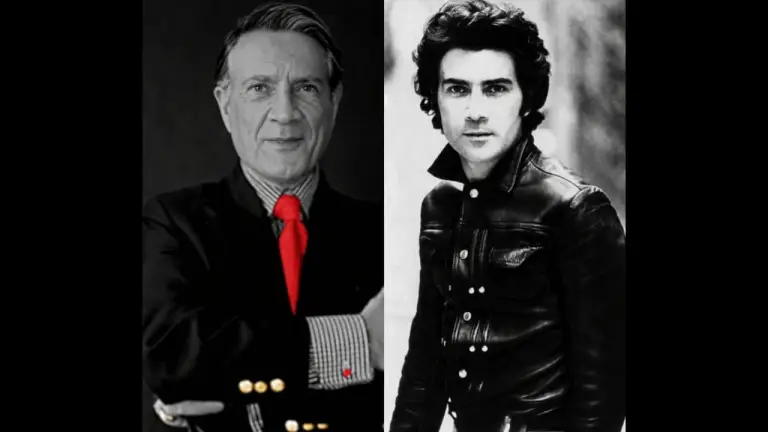
Born: August 29, 1938, Tehran – Died by suicide: September 3, 2026, Paris – Keyvan Khosravani was one of the hundreds of distinguished Iranian artists who loved the culture and art of their homeland. Yet he spent only forty years of his life in Iran, living the final forty-eight years of his life abroad before passing away in Paris at the age of 88. He is an artist who cannot be defined in a few words or sentences. One might describe him as an architect, fashion and costume designer, painter, lighting designer, and interior designer. But he cannot be contained within these labels.
If you visit Keyvan Khosravani’s personal and artistic website, alongside an old black-and-white photograph of him as a young man—looking almost like an Italian film star from the 1950s or 1960s—you will also find a note about his personal life. It is a text that could even be regarded as his artistic testament. After reading it, one realizes that behind all that beauty, fashion, architecture, and splendor was a man marked by a profound sense of alienation, rebellion, suffering, and loneliness. He was full of contradictions. He was born into a wealthy family close to the centers of power, with a father who was a military officer wearing three stars on his shoulders. Yet he himself held left-wing views, was an atheist and a liberal, and was a staunch opponent of the death penalty.
Another dimension of Keyvan Khosravani’s personality can be understood through the clothes he designed: through the zari-doozi embroidery resting on the body of an elegant and dignified woman; through the Baluchi suzan-doozi, suddenly transported from the geographical margins to the center of a formal royal gathering; through Isfahan’s qalamkar textiles, which became more than merely traditional fabrics; and through garments that sought to be both Iranian and universal. But to understand him more deeply, one has to look beyond the fabrics. Behind all those colors, patterns, and textiles stood a man whose relationship with his “homeland” was extraordinarily complex and contradictory. He loved his country, understood its heritage, and fought to preserve its arts, yet he found neither comfort nor peace in that very homeland. In his personal note, he described Iran as a place where he had suffered greatly but had not been appreciated, while describing Paris as a city that had felt more familiar and comprehensible to him since childhood. He was an artist who fled his homeland, yet spent his entire youth trying to save its arts and buildings from destruction and oblivion.
In 1957, at the age of nineteen, Keyvan Khosravani entered the architecture program at the University of California, Berkeley, but left soon afterward and returned to Iran to continue his education. At the University of Tehran, he earned a master’s degree in architecture under the late Houshang Seyhoun, one of Iran’s great architects. Perhaps this is why architecture also occupies such a prominent place in his clothing designs. For him, the body was volume; fabric was material; and cutting was a set of lines of profound importance. Clothing, for him, was architecture—not built upon the earth, but constructed upon the human body. A body that possesses a soul, that is alive, and whose life clothing should expand. Perhaps this was why he paid particular attention to the handwoven and traditional textiles of different regions of Iran and incorporated them into his designs. A fabric made by hand carries within it the stories of the lives and experiences of its makers; those stories flow through the textile and give it a soul. There were the embroidered fabrics produced by the hands of hardworking Baluchi women in southeastern Iran, in Sistan and Baluchestan; the qalamkar textiles printed by craftsmen in Isfahan and Yazd; and fabrics woven from strands of zar, or gold, an Iranian craft with a history stretching back seven thousand years. During the reign of Reza Shah, this delicate and valuable Iranian art experienced a revival in Kashan, thanks to his particular attention to the craft, and the textiles were even exported abroad. But following the Islamic Revolution, the craft disappeared almost entirely. There were also the silk and kalaghi fabrics of Osku in East Azerbaijan, woven by hand and decorated with traditional designs using bitumen—a form of batik printing—which have long since fallen out of use.
Keyvan Khosravani’s name became widely known before the Revolution through the garments he designed for the former Queen of Iran using these traditional fabrics. He served for thirteen years as the personal designer to Empress Farah Pahlavi. Although Khosravani repeatedly said in interviews that he never received a single penny for these designs, he himself acknowledged that without Farah Pahlavi’s attention to these authentic Iranian arts, he would not have been able to bring them into the public eye or help stimulate the production, trade, and even export of traditional Iranian textiles. In interviews, Khosravani also spoke of his dream of establishing schools where traditional Iranian textile weaving could be taught. It was a dream that not only failed to materialize because of the Revolution, but was followed by the disappearance of some of these traditional weaving techniques altogether.
What makes Keyvan Khosravani’s designs unique is not simply the clothes themselves, but the idea behind them. Although he had studied in the United States, Italy, and France, he had come to understand that the past should not be discarded. Instead, the dust of age should be removed from it and it should be brought into contemporary life. In his view, Baluchi women’s embroidery should not exist only in museums; it should appear on the clothes of women and men today. Clothing should be alive and belong to the present. On one side of his life, Khosravani was rescuing the past; on the other, he was designing the appearance of the future. This contradiction is the key to understanding his singular personality. He was neither a traditionalist nor an unquestioning admirer of Western art. What mattered to him was translating Iran’s heritage and Iranian identity into the language of his own time.
He was not only an architect of buildings and bodies; he was also an architect of light. At the first Shiraz Arts Festival in 1967, Khosravani was responsible for lighting the monuments of Persepolis and Hafezieh, as well as the festival’s performance spaces. Perhaps in his mind, light falling upon the stones of thousand-year-old Persepolis and the needlework adorning a fabric on the human body served the same purpose: revealing beauty from beneath the darkness of oblivion.
One of the most beautiful and influential projects of Keyvan Khosravani’s life was his attempt to save the Oudlajan neighborhood in southern Tehran. In the summer of 1977, protesting the planned destruction of Tehran’s historic Oudlajan district, he hung some of his sketches of demolished historic neighborhoods and buildings in Iran on the walls and doors of the impoverished neighborhood. He also asked Faramarz Aslani to perform a solo concert there. The action ultimately helped prevent the neighborhood’s destruction. Oudlajan was a large neighborhood with a predominantly Jewish population and today encompasses several other districts, including Imamzadeh Yahya, Pamenar, and Naserkhosrow. Imagine the beauty of such a scene for a moment: an architect and haute couture fashion designer who designed clothes for the Queen of the country, standing in the middle of an old neighborhood and fastening his designs to its walls and doors. For me, this is one of the most magnificent images of Keyvan Khosravani’s artistic and personal life.
During his years in Iran, he also designed three buildings. The Na’in Guesthouse, commissioned by the Ministry of Tourism and built in the city of Na’in in 1967; the library of the Institute for the Intellectual Development of Children and Young Adults, once again in the impoverished southern Tehran neighborhood of Gowd-e Zamborak-Khaneh; and his family’s villa in the Farmanieh district of Tehran, which was confiscated and demolished after the Revolution.
Keyvan Khosravani never married and had no children. In his writings, he refers to a woman named Cassandra as his girlfriend, describing her as a French model for the Pierre Balmain brand and writing that Cassandra was responsible for connecting Khosravani with Pierre Balmain and introducing him to the world of haute couture. Yet in artistic circles before the Revolution, Khosravani was also described as a gay man. He was also a close friend of the couple Bijan Saffari and Sohrab Mohvi, a same-sex couple who are said to have even held a wedding ceremony. Bijan Saffari was an important Iranian painter, architect, and intellectual who studied at the École des Beaux-Arts in Paris and, in Iran, served as a member of Empress Farah Pahlavi’s board of trustees. Tehran’s Student Park is among his architectural designs.
“I hope this unwanted journey called life comes to an end sooner. And I hope it ends far away from the land where not only was I never properly appreciated, but where I was continually subjected to fabricated and shameful rumors whose consequences I still feel with my entire being. The more I study the history of the world, the more disgusted I become by the cruelty and inhumanity with which human beings treat one another.”
Keyvan Khosravani’s personal note ends with these words. A man who added beauty to life, but did not necessarily experience life as something beautiful himself.
© 2026. Phoenix Review