



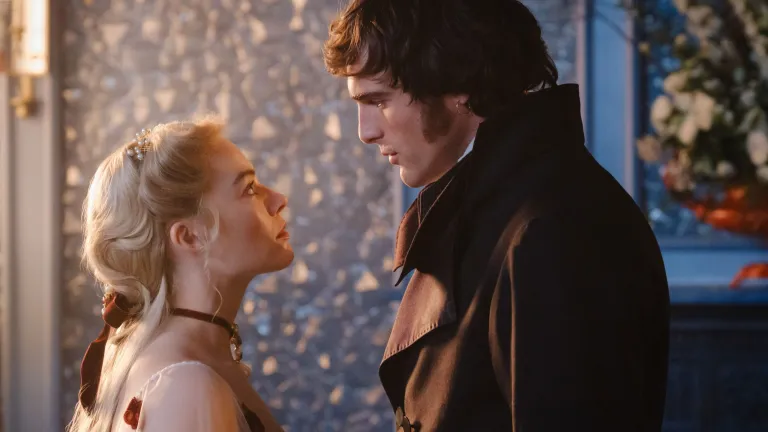
Watching certain films is an experience that goes beyond simply watching a movie. It is an experience that intensely stimulates the visual senses of viewers who are also familiar with and interested in painting, while satisfying those senses at the same time. It elevates the aesthetic sensibilities of a particular kind of viewer to the highest level, making the experience of watching all the more pleasurable. For me, watching Wuthering Heights, directed by the accomplished young English director, screenwriter, and actor Emerald Fennell, was like walking through a museum: strolling through a gallery where paintings by several great artists from around the world hang side by side. The frames may not be exact reproductions of any recognizable paintings, but there is no doubt that particular attention has been paid to the history of painting, especially Romanticism, the artistic movement that emerged in the eighteenth and early nineteenth centuries.
Wuthering Heights is a loose adaptation of the celebrated novel of the same name by the English writer Emily Brontë. It was the only novel written by a young, fragile woman who lived for just thirty years and never experienced love, marriage, or motherhood herself. Emily was the youngest of the three famous Brontë sisters, alongside Anne and Charlotte. The novel centers on Catherine, a beautiful and passionate young woman who, from childhood, feels a particular attachment to an orphan boy brought into her aristocratic family’s home. Heathcliff, the orphan, is equally captivated by Catherine’s personality and beauty from an early age. Their love is passionate and almost mad, and it ultimately ends in tragedy.
The Painterly Aesthetic of Emerald Fennell’s Wuthering Heights
Watching Wuthering Heights, released in 2026 and featuring brilliant performances by Margot Robbie and Jacob Elordi, both of whom are integral to the film’s painterly beauty, is not merely an encounter with a new adaptation of Emily Brontë’s novel. It is an encounter with a world that seems to have emerged from the history of painting before it ever belonged to cinema. Many of the film’s frames could be frozen and contemplated for countless minutes, like paintings in a gallery. Small figures set against immense skies; expanses of open land where the wind is not simply a natural phenomenon but a destructive emotional force; a red dress that appears against the green and gray landscape like a wound on a canvas; and interiors filled with fabric, flowers, bodies, hands, and light, where objects convey the eroticism permeating the film even before the characters’ bodies come into contact.
This painterly quality is, of course, no accident. Linus Sandgren, the film’s cinematographer, has cited Romantic painters, particularly the late eighteenth-century German artist Caspar David Friedrich and the Norwegian painter Johan Christian Dahl, a contemporary of Friedrich, as sources of inspiration for the film’s landscapes, cinematography, and production design. He has also specifically referred to The Swing, the celebrated painting by the French Rococo artist Jean-Honoré Fragonard. Sandgren describes the film’s aesthetic as “painterly and expressionistic.” In this world, the image is not simply meant to record reality; it must also convey the characters’ inner states through carefully constructed visuals. The key to entering the visual world of Wuthering Heights lies here: the landscape is not the story’s background. It is the psychology of the narrative.
One of the features the film emphasizes most strongly is the smallness of human beings in relation to the vastness of the nature surrounding them. To understand many of its exterior shots, one need only look at Friedrich’s paintings, such as his famous Wanderer above the Sea of Fog or Monk by the Sea. In Friedrich’s work, human figures are often small while the world around them is immense. The sky, fog, mountains, sea, and distant horizon occupy most of the canvas, leaving the human figure looking utterly fragile in comparison. Yet this smallness does not mean that humanity is insignificant. Rather, the immensity of nature reflects the human interior. We look at a landscape, but what we really see is human loneliness, wonder, fear, joy, anxiety, or longing.
In the exterior shots of Wuthering Heights, Fennell and Sandgren bring this same logic into cinema. Catherine and Heathcliff sometimes become no more than two tiny points against the vast expanse of earth and sky. The wind tosses their clothes and hair, clouds drift above them, and the horizon, rather than offering security and peace, intensifies the restlessness of both the image and the characters. In these frames, nature speaks about the characters. Such compositions are not simply intended to be beautiful; they also correspond to the film’s narrative and the psychological states of its characters.
If Catherine and Heathcliff’s love were tame, socially acceptable, and controllable, perhaps it could unfold in a warm, brightly lit room. But their love requires open moorland, wind, flowers, rain, sky, storms, and a space without walls or doors. The wild English landscape possesses the same qualities as their relationship: it is free, untamed, lawless, and, at the same time, destructive.
Beauty Without Peace
In eighteenth- and nineteenth-century aesthetics, particularly within the Romantic tradition, an important distinction exists between the beautiful and the sublime. Beauty can be pleasurable, harmonious, and soothing. The sublime, however, often emerges from an encounter with something greater than us in scale and power: a storm, a mountain, a turbulent sea, darkness, or an abyss. These are things we fear yet cannot take our eyes away from.
Cathy and Heathcliff’s relationship grows out of precisely this source. It is terrifying, yet impossible to turn away from. Neither can escape this love, even though both know that no happy ending awaits them. In fact, rather than simply depicting Catherine and Heathcliff’s mad, intensely earthly, physical passion, the film presents love as an independent force that, like nature, can be as destructive and devastating as it is natural and beautiful.
For this reason, the immense skies, muddy earth, rain, and wind are not merely elements of the film’s magnificent production design. They are the visual forms taken by the grand passion of these two beautiful, powerful young people. In other words, love in this world is not something the characters possess. It is something that happens to them.
From Friedrich to Turner: The Atmosphere as a Material of the Image
Although Friedrich is one of the film’s acknowledged sources of inspiration, certain frames also invite an aesthetic comparison with the British landscape-painting tradition, particularly the work of J. M. W. Turner, the eighteenth-century British painter. In Turner’s later paintings, rain, vapor, mist, light, clouds, and storms sometimes dominate the image so completely that the boundaries between objects dissolve. It becomes impossible to say precisely where the sky ends and the earth or sea begins. The atmosphere itself becomes the material of the painting.
In Wuthering Heights, too, the atmosphere seems to exist as an independent character. We do not simply see the actors outdoors; we can almost feel the cold, the dampness, the wind, and the weight of the sky. This sensory quality distances the landscape from the purely postcard-like image. Nature’s beauty in this film is not flawless, pristine, or immaculate. It is full of flowers, mud, dirt, sweat, disorder, and the smell of bodies. It is filled with wet bodies, wounded skin, hair clinging to flesh, and outlines swallowed by the mist.
Here, the film’s aesthetic becomes intertwined with its eroticism. Nature is in constant contact with the body, even when the two characters are not yet free to touch one another and can do little to relieve the perpetual thirst of their bodies.
Catherine’s Red World
While the film is immersed in the vast, windswept moors and torrential rains of Wuthering Heights, its palette shifts toward pink and red when Catherine moves into Edgar’s home and marries him. These frames recall the work of painters such as Jean-Honoré Fragonard, particularly his celebrated painting The Swing, which Sandgren himself has identified as one of the film’s visual sources.
In The Swing, everything revolves around pleasure: the woman’s pink dress, the shoe suspended in midair, the dense garden, the movement of the swing, the man’s furtive gaze, and an eroticism that permeates the entire painting without directly depicting sexual intercourse. A similar world confronts Catherine in Edgar’s aristocratic, luxurious home: color, fabric, flowers, ornamentation, translucent skin, and wealth.
This world stands in complete contrast to Catherine’s childhood home in the Wuthering Heights region. On one side are earth and wind; on the other, fabric and perfume. On one side, the body is released into nature; on the other, it is clothed, adorned, and socialized. On one side is Heathcliff, the lover; on the other, Edgar, the husband. These spaces are not simply two homes for Catherine. They offer two different ways of living. Yet Cathy cannot choose between the two worlds, between the two men. She remains suspended between two worlds, two classes, two conceptions of the body, and two definitions of beauty.
And this is where the color red enters. In this film, however, color is not used merely to make the image more beautiful. At certain moments, especially when Cathy appears in her red dress, color assumes a narrative function. Against the gray sky, the dark green moors, and the brown earth, Cathy’s red figure functions like a patch of pure color on a canvas, irresistibly drawing the eye toward her.
Red is a color with many meanings: anger, lust, life, danger, sex, and death. This multiplicity is also present in Catherine’s love for Heathcliff. Her love for him, and his love for her, have never been simply love. Desire and violence, possession and liberation, life and destruction coexist within them.
These red lines and patches of color also recall Cries and Whispers, the film by the late Swedish filmmaker Ingmar Bergman, with its breathtaking cinematography by Sven Nykvist. In that film, red is not a decorative color but a psychological state. In Fennell’s film, too, we sometimes feel that color has detached itself from the object and become an emotion. When Catherine wears that mesmerizing red dress, she has, in a sense, become red herself. Her dress ceases to be merely a physical object and becomes a psychological state through which her feelings are expressed.
Distrusting Beauty
Through the style she has chosen for Wuthering Heights, Fennell reminds viewers that beauty is not entirely trustworthy; it has an ugly side. The images may be magnificent, but the film constantly introduces something into the frame that disrupts their beauty: mud, sweat, violence, beating, exaggerated desire, wounds, death, or a kind of sensory excess, even in scenes of lovemaking.
From this perspective, although it would be difficult to claim a direct influence, we might think of Francisco Goya, the eighteenth-century Spanish painter, through the lens of art history. In Goya’s world, beauty and darkness coexist uneasily. Human beings can be both attractive and monstrous; the body can be a site of pleasure and a battleground of suffering.
This affinity matters to Fennell’s worldview because her film does not seek to create a beautiful postcard of nineteenth-century England. Even at its most beautiful, it leaves something unsettling within the image. In effect, the director pushes beauty to the point where it begins to decay. And it is precisely at that point that the image becomes more compelling, moving beyond the evocation of a beautiful erotic sensation.
The Landscape as Body, the Body as Landscape
This engagement with the world of painting is not confined to the film’s distant landscapes. It is also evident in its close-ups. In these shots, skin, lips, hair, eyes, fabric, and sweat sometimes acquire the same significance as the clouds, earth, and rain and wind in the shots of the moors.
This shift in scale is fascinating. One moment, human beings appear small in comparison with nature; the next, the camera moves so close to the body that the body itself becomes a landscape. Skin resembles the surface of the earth. Hair moves like vegetation. Fabric folds and takes on the shape of ocean waves. In this way, the boundary between nature and the body is continually dissolving.
This is hardly foreign to the world of Emily Brontë’s novel, either. Cathy’s relationship with Heathcliff has always been something more than a conventional romantic choice. It is as though Heathcliff is part of the same untamed nature in which she grew up. The film expresses this idea not through exposition or dialogue placed in the actors’ mouths, but through images.
In painting, an artist must decide what belongs within the frame, where the light should enter, where the body should be placed, which color should dominate another, and how much empty space the composition should contain. Wuthering Heights repeatedly draws us out of the narrative flow and compels us simply to look. At many moments, the film pauses its story for a few seconds, allowing the image to accomplish something that dialogue cannot. This is remarkable, opening up space for the imagination to roam freely.
Emerald Fennell and Linus Sandgren have fashioned a kind of visual grammar out of the history of painting. Perhaps this is why some of the film’s most beautiful moments are not necessarily those in which anything important happens. Sometimes Catherine and Heathcliff are simply standing on the moors. The wind blows. Their clothes move. A cloud passes overhead, and a distance remains between their bodies. At other times, all these distances disappear, and human beings and nature become one.
In Wuthering Heights, the frame is not merely a vessel for the story. Perhaps this is also the secret behind the beauty of the film’s images.
© 2026. Phoenix Review