



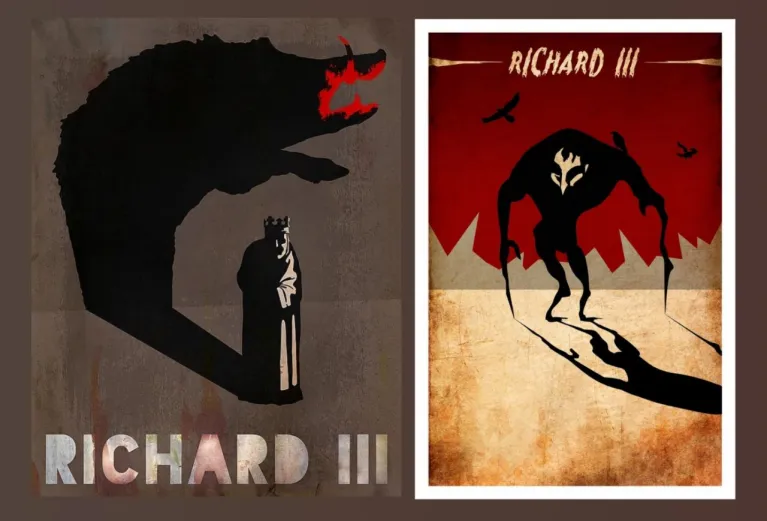
One of the bloodiest and most reviled dictators in literature is Richard III. A king whose every twisted, vicious, and inhuman trait is reflected in his physical appearance as well. He is famously said to have been born with teeth. The direct and indirect descriptions of him throughout the play, including those offered by other characters, inevitably remind us, as Iranians, of Zahhak the Arab in our national epic, the Shahnameh.
In Shakespeare’s play, Richard III rises to power through bloodshed, fratricide, and even the murder of children; much like Zahhak, who kills his own father in order to seize power and then has two young Iranians killed every day to feed the two serpents growing from his shoulders. After attaining power, Richard gradually becomes more and more deranged, eventually killing even his closest supporters. Zahhak, too, descends into madness after dreaming of Fereydun, going so far as to bathe in blood in the hope of somehow changing his fate.
But the most important similarity between the rule of Zahhak and that of Richard III is that some of the highest moral and human values gradually become worthless. Ferdowsi describes the destruction of these values in the opening verses of the account of Zahhak’s reign:
“The deeds of the wise were hidden away; the desires of the mad were scattered everywhere.
Art was brought low, and sorcery was held in high esteem; truth was concealed, while harm was made manifest.
The hands of the demons were stretched out toward evil; no word of goodness could be spoken except in secret.”
We can see that the most important human values destroyed during the age of Zahhak include the withdrawal of the wise and knowledgeable from action; the domination of society by the deeds and thoughts of the mad; the devaluation of art—in both its broader sense and, more specifically within the Shahnameh, the acquired virtues—in favor of ugliness and depravity; the empowerment of evildoers and demons to commit atrocities; and, finally, the severe censorship of every good and virtuous word.
But what happens in Shakespeare’s Richard III, and which values are destroyed there? Shakespeare devotes an entire scene to this question, and I believe that taking another look at Act Four, Scene Four of the play can be particularly revealing. It may be worthwhile, then, to focus more closely on this scene.
Richard comes to Elizabeth in this scene and seeks to marry her daughter for entirely political purposes. Elizabeth, who knows Richard’s murderous nature, refuses. Richard begins swearing that he truly loves her daughter. But what value does an oath have in the mouth of a bloodthirsty tyrant? What value remains in his age that has not already been contaminated by corruption? Let us see what he swears by. In directly quoted dialogue, I have used Abdollah Kowsari’s Persian translation.
“Richard: [I swear] By George, by my Garter, and by my crown.
Elizabeth: You have violated the first, disgraced the second, and seized the third by force.”
In Richard’s oath, “George” refers to Saint George, the patron saint of England. He is the figure who fought the dragon and became a symbol of English national identity. In Elizabeth’s view, Richard has stained the national identity of England. In the Shahnameh, this contamination of national identity is represented differently: Zahhak is not Iranian, but Arab.
Richard immediately swears by his Garter, which is in fact the highest order of chivalry in England. And then he swears by the crown upon his head, the symbol of his rule. The tyrant has emptied national identity of its value, as well as courage and honor, and political legitimacy and the crown itself. Richard repeats his oath, and Elizabeth responds even more explicitly this time: “If you must swear by something that men will believe, then swear by something that your tyranny has left untouched.”
Richard now swears by himself. Let us look at Elizabeth’s response:
“Richard: Then I swear by myself.
Elizabeth: You have violated your own honor.
Richard: Then, by the world…
Elizabeth: Which is filled with your tyranny.
Richard: By my father’s death…
Elizabeth: Which your life has made a disgrace.”
The tyrant has therefore destroyed the value of the “self” as well, stripping it of its dignity. The world ruled by an unjust tyrant contains no intrinsic value by which one can swear, and even the honors of the past and of one’s family have lost their validity, because the tyrant has stained those too.
Richard—who, even before coming to power, had already invoked religion in order to legitimize himself—now swears by God. Elizabeth tells him that if he truly believed in God, he would have obeyed the command given in the Old Testament: Thou shalt not kill. Thus, the tyrant empties religion itself of its value.
And now we come to Richard’s strangest oath, and, in my view, his most significant one. Having found nothing else left to swear by, Richard performs a bizarre act: he swears by “the time to come,” by the future itself. Elizabeth’s response is particularly striking:
“Elizabeth: [You swear] by a future that you have already tainted in the past. For I myself have tears enough to shed from now on, in remembrance of the wrongs I have suffered at your hands. And there are children still alive whose fathers you sent to the slaughter. Yes, abandoned youths who tomorrow will lament their own condition. And there are parents left behind whose children you have sent to the slaughter; withered, barren trees that tomorrow will cry out over their own fate. Do not swear by the future, for you have so thoroughly corrupted the past with tyranny that the future has already been ruined.”
And perhaps this is the tyrant’s most devastating crime: contaminating and destroying the future, and destroying hope for the future. Rendering meaningless and without a future all the human efforts and projects that were meant to bear fruit in time—and what future are we talking about? A future whose very arrival is uncertain, because even the simple act of breathing beneath the tyrant’s blade is not guaranteed.
The future in which Zahhak and Richard rule over human societies has therefore been emptied of so much value and meaning that it cannot even serve as the object of a false oath.
© 2026. Phoenix Review