



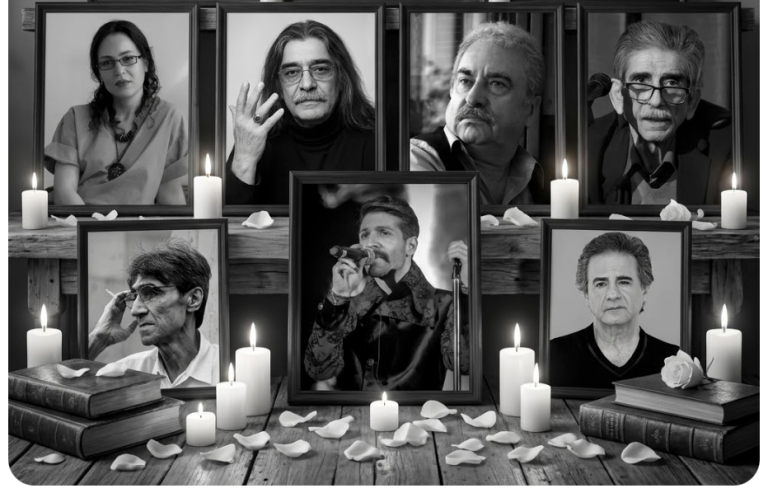
On the 29th of Esfand, 1404, only hours after our strange New Year’s moment in exile — amid grief, shock, mourning, and the lingering terror of what many called the Iranian Holocaust, together with fear for the future of both war and homeland — another piece of news arrived like a final bullet aimed directly at my happiest childhood memories. A childhood that had barely begun discovering the world when the 1979 Revolution exploded like a bomb inside our home, turning what should have been the safest place for a child into a hellscape of arguments, political shouting, distant gunfire, the ugly cry of “Allahu Akbar” from the neighbor upstairs, and the nauseating smell of burning tires. Aref was no longer breathing in this world.
Aref had been present in every corner of my childhood: every birthday celebration, every family gathering large or small, at my grandmother’s house, at my uncles’ and aunt’s homes, among family friends and schoolmates. I danced endlessly to his song Koochooloo, and to the songs from Soltan-e Ghalbha, always imagining myself as the child version of Leila Forouhar in the film, dancing in front of the television. I replayed that VHS tape so many times that scratches eventually covered the film, but I still refused to let it go. In my imagination I searched for the rich, famous man who would arrive in a luxurious car and take me around the world.
Aref was the beloved man of my childhood fantasies. He had a face made for cinema yet carried an unmistakable gentleness. His voice was truly velvety — soothing, elegant, calm. Everything about him radiated grace and sophistication, without ever slipping into arrogance or vanity. During the twenty years I have lived outside Iran, I always wanted to attend one of his concerts, but somehow it never happened.
Aref Arefkia, whose mother was from Baku and worked as a dentist and whose grandmother had been an opera singer, began singing as a child. He trained his ear by listening to Azerbaijani classical and folk music. Perhaps that is why he so quickly reached a rare place within Iranian pop music, achieving a level of popularity comparable to Vigen’s. After the Revolution he remained in Iran for six months, but fearing arrest — or even death — he first fled to London and then emigrated to the United States.
Even in recent years, at eighty-four years old, Aref remained energetic and creatively alive. In his final interviews he spoke about the hope that had begun growing inside him: the hope of returning to Iran. But cancer gave this beloved star of hearts no chance to fulfill that lifelong dream. Still, he lives on in his unforgettable songs and in that magical velvet voice, forever preserved in the historical memory of Iranians. As long as Iran exists, his songs will continue to flow through it. Aref was one of those rare singers through whom generations of Iranians built memories: at weddings and funerals, birthdays and deaths, in moments of falling in love and moments of collapse and humiliation. And even after his death, they will continue to do so.
Bahram Beyzaie and Nasser Taghvai: The Black Year of Independent Iranian Cinema
Independent filmmakers have always inspired in me not only respect, but admiration and even reverence. The year 1404 became one of the darkest years in the history of Iran’s auteur and independent cinema — though in truth, that darkness had begun much earlier.
It began around 2002 and 2003, when two cinematic projects by Nasser Taghvai remained unfinished, especially Bitter Tea, whose screenplay I had read — a brilliant love story unfolding during the Iran-Iraq War. It began the year after Paper Without Lines, when he stopped making films altogether, refused to participate in the state-controlled Fajr Film Festival, and after being awarded the jury’s special prize, neither attended the ceremony nor accepted the Crystal Simorgh nor even the voucher for purchasing a Pride automobile. He famously said: “I have neither the money to buy a car, nor space in my tiny apartment for grand prizes — especially special ones.”
From 2001 until Mehr 1404, when he passed away, Nasser Taghvai did not make a single film for twenty-four long years. Most of the time he remained confined to his home, writing constantly — works that, except for the screenplay of Koochak Khan Jangali, were never published and instead gathered dust in the drawers of one of the most important figures of Iranian independent cinema. A loss not only for cinema, but for Iranian literature and contemporary art as a whole.
A similar tragedy unfolded with Bahram Beyzaie, another giant of Iranian independent cinema, who died on the fifth of Dey, 1404. Beyzaie belonged neither to the political left nor the right. He belonged only to his own intellectual universe and singular artistic vision. With those striking blue eyes, he created some of the most unique films in Iranian cinema: from The Downpour to Killing Mad Dogs, from Death of Yazdgerd to The Travelers, from The Ballad of Tara to Bashu, the Little Stranger.
Beyzaie himself was as unconventional as his films. Born into a Baha’i family, he dropped out of university and, from a young age, devoted himself to writing plays, screenplays, children’s stories, performance recitations, and scholarly essays. Though he possessed only a high school diploma, he knew more than many university professors and PhDs combined, and generously shared his knowledge through dozens of books devoted to cinema and theater.
Before the Revolution he taught at university, but afterward, because he had been “born Baha’i,” he was barred from academic life. Despite censorship and endless obstacles, he managed to make eight films. Eventually, in 2010, he emigrated first to Europe and later to California after an invitation from Stanford University’s Iranian Studies program, where he remained until the end of his life.
Perhaps one could say Beyzaie was fortunate in at least one respect: after arriving in America, he finally gained the freedom to stage several of his plays and publish numerous scripts and dramatic works without the mutilations of censorship. He also trained a new generation of students in Northern California. Although most admirers of Beyzaie never had the chance to witness those stage productions in person, recordings of the performances became available online, and his books remained accessible.
Bahram Beyzaie continued working until the very last night of his richly creative life. In the end, he too died of cancer — on his birthday, the fifth of Dey — and was returned to earth, wind, water, and fire in the same land that had allowed him to continue creating freely. Nasser Taghvai died at eighty-four. Bahram Beyzaie at eighty-seven.
Shiva Arastoui, A Beauty That Was Stolen
For me, however, the year 1404 began bitterly from its very spring, from the month of Ordibehesht. Shiva Arastoui, only sixty-four years old, had taken her own life. I had shared years of memories with her—most of them happy, shaped by writing, stories, and literature.
I was still a university student in playwriting when I first met Shiva Arastoui. From that very first encounter, I was captivated by her beauty and her witty personality. She told me she taught classes on literary movements, and since I had already begun studying short-story writing with Jamal Mirsadeghi and through four creative writing units at the Art and Architecture University, I joined Shiva Arastoui’s literary theory classes, held every Tuesday evening in a small suite in Shahrak-e Gharb.
Shiva was not only highly educated, but also a teacher with remarkable presence of mind—blunt, honest, and direct. And I have always admired bluntness; it has always been one of my favorite qualities. If you wrote a bad story, she would look straight into your eyes and say without hesitation: “It’s bad. It’s garbage.” And then she would explain exactly why. I never once saw her praise a writer insincerely or tear one down out of spite or favoritism.
These classes date back to the Iranian year 1376. What a pity that even back then—when she was still so young, so beautiful, and so enchanting—she was already burdened with profound emotional and psychological complexities. She was extraordinarily sensitive and thin-skinned, and those limitless emotions and sensitivities had drawn her toward thoughts of suicide from those very years.
Shiva Arastoui had begun writing under the influence of Reza Baraheni and Ghazaleh Alizadeh. She would often say that Ghazaleh was so beautiful and so talented that those very qualities became her downfall and eventually drove her to hang herself. For Ghazaleh, the theft of beauty was unbearable—and for Shiva Arastoui as well.
Younes Tarakemeh, The Modest Man of Literary Criticism and Short Fiction
I had also met Younes Tarakemeh during the story-reading gatherings at Shiva’s house. Shiva would usually invite established writers to read short stories or excerpts from their novels to us young aspiring writers. Mr. Tarakemeh, kind and respected as he was, accepted one of Shiva’s invitations.
That evening, I found him to be a dignified and humble man with a powerful pen. Although over the past twenty years I have encountered his words mostly through the windows of social media, I still deeply enjoy the warmth and sincerity of his writing. He belonged to the circle of the famous “Jang-e Esfahan” literary movement, alongside Houshang Golshiri and Ahmad Miralaii, a group that cultivated a form of modern literature that privileged form over ideology.
Although Tarakemeh was not an unproductive writer, he published only a small number of works. He believed it was better for his stories to gather dust at home than pass beneath the blade of censorship. He also deeply believed in diasporic literature and once said in an interview: “Somewhere in this world, a writer is creating a masterpiece for Iranian literature, and one day it will reach us through these new pathways.”
Both of his children, Bahar and Ardeshir, were arrested during the protests of the Green Movement in 2009 and spent time in prison—an immensely painful experience for this modest man of criticism, research, and short fiction in Iranian literature. He passed away on March 14, 2026, at the age of seventy-eight.
Hadi Marzban, Akbar Radi’s Lifelong Loyalist
For serious theatergoers, Hadi Marzban is inseparable from the works of Akbar Radi. A theater director who began his professional stage career after the Iranian Revolution, Marzban turned to Radi’s plays from the very beginning and remained faithful to them until just two years ago, when he was still actively working.
Every decade, he restaged some of Radi’s plays, and in total he brought ten works by the late Iranian playwright to the stage. More broadly, he had a special devotion to Iranian playwrights and staged works by Bahram Beyzaie, Ali Nassirian, Mohammad Rahmanian, and Amir Dezhakam over the course of five decades. Marzban rendered an immense service to serious audiences of Iranian theater by introducing them to major Iranian playwrights.
In Azar 1404, at the age of eighty-one, he passed away after an illness, leaving behind his wife, Farzaneh Kaboli—a celebrated pre-revolutionary performer of Iranian folk and traditional dance and a gifted stage actress—as well as countless admirers.
The Year Great Actors Fell Silent, and the Singer of “Iran, Iran, Iran…”
The year 1404 was also a year of farewell to several distinguished actors of Iranian cinema. Enayat Bakhshi, the veteran actor of pre- and post-revolutionary cinema and television—most often cast in villainous roles—left behind unforgettable performances, including the one-legged father in Parvaz dar Ghafas by Habib Kavoush and the wretched truck driver in The Travelers, Bahram Beyzaie’s masterpiece.
Homayoun Ershadi, an architect discovered by the late Abbas Kiarostami for a role in Taste of Cherry, went on to establish himself in Iranian cinema and television as the archetype of the defeated intellectual, later revealing even greater range in more than seventy films and television series.
Reza Rooygari, actor of theater, cinema, and television, first became famous during the Revolution for singing the anthem “Iran, Iran, Iran.” He later rose to prominence as an actor through films such as Ejareh-Neshinha and Boutique. During the past decade, after suffering a stroke, he had become housebound and, due to poverty, had been placed in a care facility in Kahrizak. Mohammad Kasbi, Jamal Ejmali, Shirin Yazdanbakhsh, and Saeed Pirdoust were among the other actors who passed away in 1404.
A Bitter Year for the Folk Music of Gilan
Iranian music also lost two of its renowned figures: Naser Masoudi, one of the great masters of Gilan’s folk music, and Hamid Hiraad, the pop singer-songwriter.
Naser Masoudi, one of the veteran singers of northern Iranian music, was barred from performing for many years after the Revolution. But after singing for the soundtrack of the television series Koochak Jangali in the 1980s, he was finally able to resume his artistic career. Over the course of his precious ninety years, Mr. Masoudi performed hundreds of local and non-local songs, and his warm voice and sweet Gilaki accent became part of the cultural treasury of Gilan and Iran itself.
His admirers in Gilan probably believe that the great Naser Masoudi was fortunate to depart this world before witnessing the burning of Rasht’s beautiful bazaar by security forces and the massacre of people in Rasht and other cities of Gilan and Mazandaran—for had he seen it, he could not have endured so much mourning.
Hamid Hiraad, the lyricist and pop singer, also passed away in the final days of Esfand 1404 at only thirty-four years old, after battling cancer. He had begun his singing career with the group Puzzle Band in 2016 and rose to fame very quickly. Although his reputation was later tarnished by accusations of plagiarism and lip-syncing during live concerts, he ultimately left behind his fans after years of struggling with cancer.