



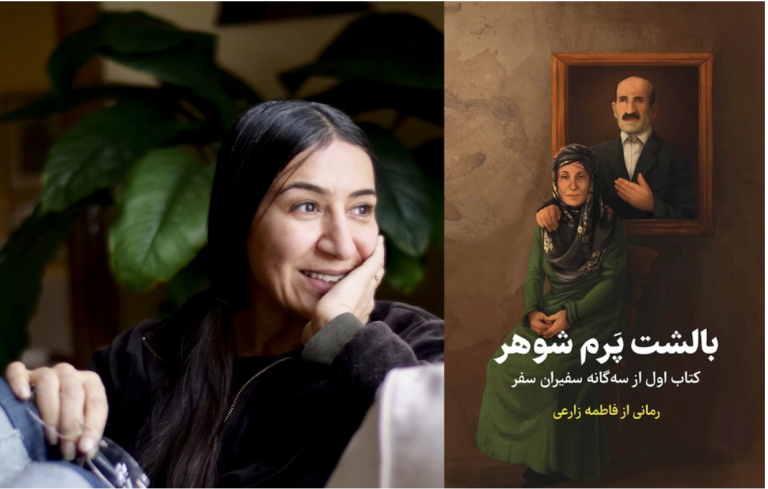
My Husband’s Down Pillow is a novel by Fatemeh Zarei, an Iranian author based in Washington, D.C., published in recent months by Asemana Publishing in Toronto. This 196-page work is her first full-length novel following the short story collection Dreaming Is My Profession, published in 2009 by Nashr-e Cheshmeh in Iran, and the novella Ey Yar Jani Yar Jani, released in 2013 by H&S Media in London.
In this novel, Zarei succeeds in drawing from the rich folklore of the Taleqan region of Iran, borrowing from its traditions, rituals, religious superstitions, and ancient legends, and weaving them together with elements of her own personal life to create a deeply autobiographical yet singularly original work. With honesty and remarkable courage, she dissects the hidden layers of her inner world through a sharp and biting sense of humor, guiding the reader from the labyrinth of profoundly traditional and archaic narratives toward a distinctly modern reading of experience and identity.
The novel—which can easily be situated within the genre of confessional literature—is as bold and emotionally devastating as The Lover, the masterpiece by Marguerite Duras, and as magical, surreal, and haunting as Love in the Time of Cholera by Gabriel García Márquez. My Husband’s Down Pillow announces the arrival of a voice in contemporary Iranian literature that writes beyond social convention, beyond written and unwritten rules, beyond censorship and even self-censorship. Zarei creates a fictional universe that is intensely personal and, at the same time, unmistakably universal.
The language of the novel is polished, fluid, and intimate, pulling the reader in from the very first pages. Although both narrators—the grandmother and granddaughter—are unreliable, the primary and secondary narratives are rendered with such creativity that by the end, distinguishing truth from fabrication becomes impossible—and perhaps beside the point. Because the beauty of literature lies precisely in the inseparability of imagination and truth.
Ms. Zarei, one of the first things that comes to mind after reading your novel is how profoundly local folklore across different regions of Iran can serve as a source of narrators and stories, and how inspiring it can be for fiction. Did you consciously turn toward the narratives emerging from the culture, traditions, religion, and myths of that particular region of Iran—Taleqan in this case—or did the process of writing itself reconnect you with the magical world of folklore?
— My goal in writing this book was to express certain concepts about human relationships in the way I had personally experienced and understood them. In general, I place immense value on personal experience and individual perception. I do not deny broader, collective definitions of things; after all, they too are the product of human thought and accumulated experience, and in some sense emerge from individual experiences themselves. That is why autobiography seemed to me the most fitting form for portraying a personal worldview.
Another reason I chose this form was that I felt incredibly rich in material. Having a grandmother like mine—someone who alone could have carried the weight of an entire ethnographic museum—is not something one simply lets go of. She was a personality capable of naturally carrying the thematic burden of what I wanted to explore. My ideas about love and human agency found a perfect embodiment in her.
If the central character of the story is an old woman narrating nearly a century of life in an obscure rural village, folklore inevitably demands a great deal of narrative space. Without giving that world sufficient attention, the emotional and cultural impact of the story would suffer.
The second reason for focusing so heavily on local and cultural details was that the novel is infused with magic. Magic is a delicate thing; it has to be woven into reality so seamlessly that no contradiction emerges between the two. When magic carries significant weight within a narrative, you cannot simply place it upon a thin or fragile reality. The world of the story has to be believable, precise, and full of coherent details so that magic can quietly perform its function beneath the surface and the reader can accept it without resistance.
In addition, one of the defining characteristics of Taleqan culture is its use of language and verbal playfulness. People there are extravagantly generous when it comes to irony, sarcasm, proverbs, and teasing expressions.
At its core, this book is about agency—the ability to have some degree of control over one’s own life. Even in the smallest possible way, it is about refusing to be crushed beneath life’s compulsions; about still finding a way, however slight, to dance. Love and its magic simply became the vehicle through which I explored that idea.
The grandmother narrator, Golzar, sometimes feels familiar to the reader, like a recognizable grandmother figure, but for most of the novel she remains unconventional and utterly unique. The relationship between grandmother and granddaughter is also unusual and distinctive. Since the novel is autobiographical and rooted in your personal life, how much of this characterization comes from reality and how much is fictionalized?
— Honestly, this is an incredibly difficult question to answer. I built the story so thoroughly around her personality that I no longer remember which words actually came out of her mouth and which ones I myself placed there. Of course, the novel contains so many magical tales and outrageous lies that it is obvious much of it is invented. But nearly all of the smaller side stories—which form the dominant pattern of the book—are not entirely detached from reality.
For example, the word shoharnamayi (“husband-showing off”) was genuinely hers; she invented that expression herself. Yet I cannot even remember the context in which she originally used it. The poor woman uttered just this one phrase, and I ended up constructing half the novel around it. All her rivalry with old women whose husbands were still alive, and many other episodes built around that theme, were entirely my own inventions—though inspired by the concept of shohernamayi. But to be fair, that single word of hers outweighs everything I later wrote around it. Readers may eventually forget me, but I’m certain they will never forget shohernamayi.
He planted the seed in me, and I simply nurtured it. I can’t decide which fruits of the tree belong to me and which belong to him. In fact, I myself am a seed he planted. I’m an avatar through whom he wished to live — and as you can see, he did. This very book is the result. All those conflicts and tensions you mention, the ones that create this unusual relationship in the novel, come from exactly that. He longed to be educated — not because he wanted to read, but because he wanted to write. The day I finished the book, I printed out a copy for editing and placed his photograph on the first page. When I held the manuscript in my hands, I suddenly felt shocked. I realized he had achieved what he wanted. He had wanted to tell his story. He had wanted to travel to distant places, and now here was his book, with his name and photograph, published in America. So where exactly am I in all of this? What role do I even play? It feels as though I was merely his soldier. As if a spirit had possessed me. It terrified me.
Another reason the grandmother may appear unconventional — even slightly unsettling to the reader — is that, in our culture, a grandmother is expected to be a self-sacrificing woman. If she has personal or sexual desires and actually pursues them, if she places herself first, it almost feels like a betrayal. As though a grandmother sitting anywhere other than beside a prayer rug — and only to pray for her children and grandchildren — has somehow failed in her duty toward us. I intentionally pushed the atmosphere away from those familiar expectations.
There’s another reason the relationship between this grandmother and granddaughter may seem exaggerated: it’s demanded by the nature of the story itself. These two are mirrors of one another, bound together by both love and hatred. And if they truly resemble each other, then naturally both will fight for their own desires and refuse to surrender to the other out of tradition, custom, or social rules. Conflict between them becomes inevitable. At the same time, there is also tremendous affection between them — because what grandmother wouldn’t fall in love with the grandchild who turns out exactly like herself? Besides, the entire world of the book is almost paradisiacal, strangely untouched by evil. Every relationship in it is, in one way or another, rooted in love — though each expresses intimacy differently. Even in the middle of family feuds and conflicts over honor, tenderness still exists.
To tell the truth, the day my grandmother died, I didn’t cry very much. I may even have said, “Well… finally, some peace.” But not a single day of my adult life has passed without me remembering her. Sometimes I’ll catch myself using one of her little poems in conversation, or throwing one of her wonderfully filthy curses at the television news. I dream about her constantly. She appears in my dreams so vividly that it feels as though she never died at all. Though perhaps I can’t entirely blame that on her — I’m someone who lives heavily through dreams. Imagine it: I crossed seven mountains and seven seas to come here, yet she followed me like a genie trapped in a bottle, emerging again and again from inside my books.
Since your novel is such a successful work of autofiction, where exactly is the border between fiction and memoir? How do private memories become a novel? Technically speaking, where does that transformation happen?
—I remember the first time I brought my short story collection to a publisher. After reading it, the editor told me, “These are fascinating surreal stories.” I was genuinely startled. I said, “They’re not surreal.” He replied, “Maybe not all of them, but most are.” I asked which one he meant, and he mentioned Spring Socks and Gloves. I said, “If you had asked me to choose one story as autobiography, I would have picked that one. How could it seem surreal to you? For me, it was completely real.”
Now I’m revisiting those stories — some written thirty years ago — writing commentaries and explanations for them, hoping eventually to turn them into a podcast. Back then I truly believed they were straightforward, realistic stories. At that time I was still more connected to my inner world than to the world of literature itself. Today, rereading them after all these years, I’m amazed I even wrote them. And some critiques and reactions from readers eventually made me realize they were far less straightforward than I had imagined.
I say all this because, for me, magic is constantly present even in ordinary daily life. The mere fact that we can think — isn’t that magic? Even now, while I’m typing my answer to your question, another answer is simultaneously playing loudly inside my head. Isn’t that magical? Or imagine cooking in the kitchen while one song ends and another begins, and suddenly your entire emotional world shifts — as though one life stops and another starts. A person can become inexplicably sad or irrationally happy in an instant. Isn’t that magic too? Isn’t this exactly the quality of the mind that science fiction films exploit when they use machines to transport characters into parallel dimensions or alternate realities? I’m sure you’ve experienced it yourself. Thoughts beyond our control, dreams, emotions that completely transform us — if these aren’t forms of magic, then what are they?
There is already so much magical seasoning in my real life that I honestly don’t know, technically speaking, when magic enters the story. Magic is simply another way of seeing this dull, exhausting reality. What I do know is that it only works in fiction if reality is given equal weight — if both are woven together from the same material.
Personally, I see your work as belonging to the tradition of confessional literature. Decoding the elements of the story feels close to an act of confession. And your fearlessness in expressing emotional and sexual desires is also part of that tradition. Your creativity and courage seem inseparable. That’s something I’ve rarely seen among Iranian writers, especially women. Where does your interest in this style come from? Were you influenced by any particular writers?
—Thank you. It genuinely makes me happy that you read my work that way. If someone is going to write about themselves, then what’s visible on the surface is hardly worth mentioning. A person’s worldview isn’t shaped by the neat framed photograph sitting on their shelf. It begins forming deep inside the mind — in that hidden place where no one else exists and where we think freely, without censorship, assembling our thoughts like pieces of Lego until eventually we build the framework through which we confront life.
I can’t take the reader into that place and then say, “Close your eyes to certain things.” A worldview is the most private part of any human being. I cannot sincerely want to show it to someone without also exposing the deepest parts of myself. Besides, even if I wanted to hide myself, I wouldn’t know how. I simply don’t know how not to reveal too much. Sometimes it creates disasters. But overall, it has brought me satisfaction, so I never learned to change it.
Humor is a very powerful element in your writing, especially in this novel. That’s relatively rare among Iranian women writers. The humor begins even with the title itself, and it becomes one of the novel’s greatest charms. Does this playful humor — along with the endless witty proverbs scattered throughout the narrative — come from the culture of Taleqan? How did you collect all these expressions? Many of them could become a book on their own.
—Part of it comes from the character I chose for the story. She herself was witty — what she would call a “master talker.” But beyond that, proverb-making, teasing, verbal play, and elaborate speech are deeply rooted in Taleqan culture. If you strip away the funny accent and translate the words into standard Persian, you realize how refined and literary their speech actually is. They invent words. They curse poetically. Even the names they give places and villages reveal a special imagination.
For example, there’s a village called Roshanabdar — meaning “inside bright water.” Isn’t that beautiful? It feels almost like a haiku. Or Seyf Beneh, meaning “founded on apples.” It makes you want to go immediately to the refrigerator, bite into an apple, and from then on call apples “seyf.” I remember there was a tree in the village with such a difficult local name that I could never pronounce it properly in their dialect, but its meaning was something like “becomes a servant at night.” The name itself is madness — a tree whose behavior changes after dark. It was a huge walnut tree. Maybe the name came from old beliefs that you shouldn’t sleep beneath a tree at night. Or perhaps the tree looked so different under moonlight that it felt like another being entirely.
I actually wrote the book nine years ago, but last year, when it was finally going to be published, I started talking to every old man and woman I could find, collecting local proverbs and expressions during the editing process. I hung those words and sayings all over the novel like ornaments on a Christmas tree.
You were also a writer while living in Iran. What differences do you see in writing in an environment without censorship and without going through the “seven stages” of the Ministry of Guidance? And how do you view the absence of censorship in terms of a writer’s creativity? Some writers even argue that censorship can enhance creativity.
—I didn’t start writing fiction by writing fiction. For many years, I used to write down my dreams so I wouldn’t forget them. Gradually, I began to understand the symbols and meanings within my own dreams. Sometimes I discovered astonishing things in them, and I would intervene in them, almost as if I were rewriting my dreams for myself. Occasionally, I felt some of them were worth turning into stories, and I would write fiction based on them. So for a long time, writing for me was essentially personal notes — not meant for any audience, and not something that had anything to do with censorship or official approval.
After many years, when I eventually took some of those stories to a publisher, I encountered censorship and the issue of the Ministry of Guidance for the first time. I realized that some of my stories were not approved for publication. Before my book was even published, I had already moved to the United States, and after that I never attempted to publish anything in Iran again, so I no longer had any direct experience with censorship.
Of course, the idea that censorship sometimes forces writers to become more creative in order to express what they want to say is not entirely wrong. Necessity is the mother of invention. But that does not mean censorship helps creativity. Censorship is the enemy of creativity. Fundamentally, it is an instruction to kill creativity.
That said, censorship exists in many forms everywhere. Writing in the United States is not particularly easy either. No one stops you from writing whatever you want, but in the end the market dictates what gets published. Publishers decide which books are commercially viable, what kind of editing they require, or even whether a book should be shortened so that readers will not lose patience. The genre, subject matter, and even the length of a book are often determined by the market rather than the writer. In some ways, this is more troubling than an official censorship system, because it is invisible. For example, a book about Iran that is not political has little chance of being published, because publishers assume it will not sell, and therefore avoid the risk. What is guaranteed to make money gets published. That makes sense in a commercial world, but it is still discouraging from a cultural and artistic perspective.
What is your view on exile literature or migrant literature, especially in recent years with the expansion of publishing outside Iran? Has this body of literature influenced publishing inside Iran? Has it been more successful in producing stronger works or reaching audiences?
—The only obstacle to producing strong literary works is not censorship. Censorship is just one of many obstacles. And in order to reach an audience, having a good book alone is never enough. The publishing game has become extremely complex.
Regarding Persian literature and publishing outside Iran, I am actually glad that these two together have helped expand Persian-language production in recent years. The number of Persian-language writers — both those writing in Persian and those writing in English — outside Iran has grown significantly, which is encouraging. But at the same time, this also reflects a high level of migration, which is painful.
I don’t think diaspora Persian literature has had much direct impact on publishing inside Iran, because most of it simply does not reach readers inside the country. So it does not really participate in the same literary ecosystem. What foreign publishers do is allow these books to exist — and that is all. They do not grant access to the Iranian market.
What has had a major impact on both sides, in my view, is the internet. It has created access to a wide range of literature — both legal and illegal — for everyone. Whether inside or outside Iran, writers can publish without censorship online. Of course, this is not the same as traditional publishing with editors, marketing, and distribution. And even then, there remains a barrier between diaspora writers and readers inside Iran. That is why I am planning to publish all my stories as audio, with some commentary, in the form of a podcast — except for those I am contractually obliged to my publisher.
Tell us about your experience working with Asemana Publishing. It is a relatively new publishing house based in Toronto, but it has quickly entered the field with energy and hope, especially for writers who do not want to compromise with censorship. What is your opinion?
—Before talking about Asemana Publishing, I should say a bit about Persian publishing outside Iran in general. A few years ago, I think around 2017 or 2018, Amazon removed Persian-language publishing services, which created serious problems for publishers who relied on that platform and disrupted pricing and distribution of Persian books. Some publishers were completely pushed out of the market.
When books cannot be offered at a reasonable price, publishing becomes almost meaningless. The book may exist in a virtual sense, but it is not really accessible — or it is so expensive that it might as well not exist. And the main readership of Persian books is inside Iran, which adds another major barrier.
There were publishers who essentially offered only a “ghost” version of books on websites, at inflated prices, without real marketing, distribution, or visibility, and still called themselves publishers. One of the reasons it took nearly ten years for Ballast Pillow Husband to be published, and why I have other unpublished manuscripts sitting unused, is precisely these structural problems. I realized this more clearly when I published Oh Dear Soulmate in 2014, when Amazon’s Persian service was still available. After that, I kept writing and storing manuscripts in a drawer until last year, when I became acquainted with Asemana Publishing.
Mr. Mehdi Ganjavi, the founder of this publishing house, has a genuine passion — or even more than passion, a deep concern — for literature, poetry, and history, and when it comes to Persian-language work, that concern becomes even stronger. One reason is that he is himself a writer. Publishing Persian literature outside Iran is difficult and not very profitable work. His main profession is teaching at a university. It seems to me that he pursues publishing mainly out of dedication to Persian literature, and he does so with seriousness and effort.
My experience with him so far has been very sincere and responsible on both sides. Asemana Publishing, although relatively new, seems forward-looking and successful. As for whether my book has been successful through this publisher, I cannot really judge yet — more time is needed to gather feedback and data. It is still too early to evaluate it.