



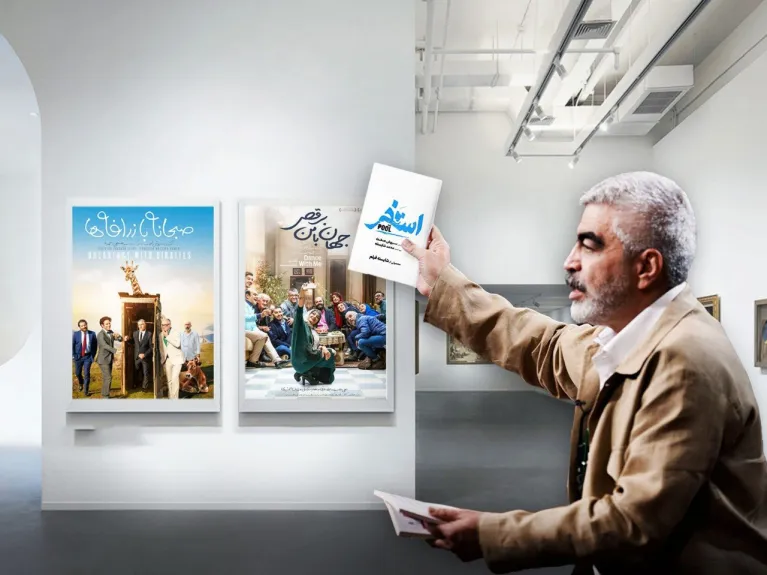
The release of The Pool, Soroush Sehat‘s third feature film, is more than simply the arrival of another title in Iranian cinemas. It provides an opportunity to reflect on the artistic trajectory he has forged over nearly two decades in television and film. Unlike many Iranian comedy filmmakers, Sehat is not interested in provoking laughter at any cost. Rather, he treats comedy as a way of thinking. In his work, humor is never the destination but the vehicle—a bridge leading to questions about loneliness, friendship, mortality, life itself, and the meaning of existence.
If World, Dance with Me marked the birth of Sehat’s distinctly authorial cinematic universe, and Breakfast with Giraffes sought to expand it, The Pool now occupies a pivotal position. It has the potential to reveal whether this cinematic world has reached artistic maturity or begun to repeat itself. Answering that question requires revisiting the career of a filmmaker who had already developed a recognizable artistic signature long before he entered cinema.
From Situation Comedy to an Anthropology of Everyday Life
It would be misleading to describe Soroush Sehat merely as a director. Before making films, he established himself as a writer whose creative world emerged from the lives of ordinary people. From his collaborations with Mehran Modiri to writing series such as Pejman, Doctors’ Building, and later The Bachelors, one characteristic remained remarkably consistent: his protagonists were neither heroes nor villains, but ordinary individuals burdened with modest dreams, profound disappointments, and an enduring inability to fully understand themselves.
In mainstream comedy, characters often function as caricatures—devices for generating humorous situations. In Sehat’s world, however, they are familiar before they are funny. The audience recognizes them in a neighbor, a friend, a sibling, or even in themselves. This familiarity elevates his humor beyond verbal jokes, transforming it into a deeply human experience. Comedy in Sehat’s work emerges from the tension between what people hope for and what life ultimately grants them. It is the kind of humor that invites a quiet smile rather than explosive laughter, and reflection rather than mere entertainment.
A World Belonging to Those Who Have Failed
One of the defining characteristics of Sehat’s cinema is his fascination with unsuccessful people—individuals whom society rarely considers successful, yet who continue to preserve a fragile sense of hope.
His protagonists are rarely wealthy, ambitious, or driven by grand plans for the future. Nor are they typically consumed by major political or social conflicts. Their central struggle is life itself: how to endure loneliness, preserve friendship, reconcile oneself with mortality, and continue finding reasons to laugh despite the overwhelming absurdity of existence.
This perspective places Sehat’s cinema firmly within the tradition of contemporary humanist filmmaking, where drama emerges not from spectacular events but from the quiet details of everyday experience.
Death: The Permanent Guest in Sehat’s Cinema
Few contemporary Iranian filmmakers have spoken about death with as much tenderness and restraint as Soroush Sehat. His films never reduce mortality to melodrama or moralizing. In World, Dance with Me, death becomes an occasion for celebrating life. The characters gather in anticipation of loss, only to rediscover the value of living together. In Breakfast with Giraffes, death assumes a more metaphorical presence, yet its shadow continues to shape the emotional lives of the characters.
Within Sehat’s cinematic universe, death is never simply an ending; it is a reminder of life’s fragility. Perhaps this is why his characters cling so fiercely to friendship, conversation, and companionship. They understand that time is painfully limited.
Friendship as the Last Refuge of Contemporary Humanity
If one were forced to summarize Sehat’s cinema in a single word, that word might well be friendship. Friendship in his films is not a secondary narrative element but the structural foundation of the story itself. However estranged his characters become from their families, society, or even themselves, they rediscover meaning within the company of friends.
Yet these friendships are never idealized. Misunderstandings, jealousy, resentment, and conflict inevitably arise. What ultimately survives, however, is the desire to remain together. At a historical moment when individualism has intensified human isolation, Sehat’s films offer a quietly poetic defense of intimate human communities.
Conversations Apparently About Nothing
Sehat’s dialogue possesses a remarkable quality. His characters spend long stretches discussing seemingly insignificant matters: food, childhood memories, travel, casual jokes, or trivial anecdotes. Yet within these conversations emerge the film’s most profound philosophical questions.
This narrative strategy recalls a broader tradition within world cinema in which meaning is discovered not through dramatic events but through conversation itself. Long after the plot has faded from memory, audiences often retain a single sentence—or even a brief silence.
Nature as a Silent Character
Nature in Sehat’s films functions as far more than a backdrop. Mountains, forests, roads, rain, and now even a swimming pool become active participants in the narrative. The farther his characters move away from the city, the closer they seem to come to themselves.
This use of landscape is fundamentally symbolic rather than merely aesthetic. The external world mirrors the internal lives of the characters. The silence of nature replaces the relentless noise of urban existence, creating space for contemplation.
A Comedy Born from Sadness
Unlike the dominant trend in contemporary Iranian comedy, Sehat avoids exaggerated slapstick and broad comic performance. His humor grows organically out of human situations rather than caricature or ridicule.
This explains why audiences often experience laughter and melancholy simultaneously while watching his films. In Sehat’s cinema, laughter does not deny life’s tragedies; it becomes a response to them. It is precisely this emotional complexity that distinguishes his work from much of Iran’s commercially driven comedy.
The Pool: Continuation or Turning Point?
With the release of The Pool, the central question inevitably becomes whether Sehat continues to expand his personal cinematic universe or has begun to repeat it. Every auteur eventually confronts the danger that a distinctive signature may harden into a formula. Friendship, mortality, philosophical humor, and emotionally adrift characters lose their vitality if they merely reappear unchanged. Yet when continually reimagined within new dramatic contexts, these recurring elements evolve from repetition into artistic identity.
Viewed from this perspective, The Pool represents a particularly significant entry in Sehat’s career—not solely because of its own artistic merits, but because it may determine the future direction of his cinema.
In Conversation with Other Auteurs: From Abbas Kiarostami to Alexander Payne
Placing Sehat alongside major international auteurs is not intended as a judgment of artistic stature but as an exploration of shared sensibilities. Although Sehat neither embraces Abbas Kiarostami’s radical minimalism nor shares his formal concerns, both filmmakers are united by a common conviction: that the truth of life resides within moments that appear insignificant. Just as Kiarostami transformed roads, trees, wind, and fleeting conversations into meditations on existence, Sehat discovers profound questions about living through shared meals, gatherings among friends, or short journeys. Rather than imposing meaning upon life, both allow meaning to emerge organically from ordinary experience.
In another sense, Sehat’s existential humor inevitably recalls the cinema of Woody Allen, where comedy functions as a defense against existential anxiety. Yet an important distinction separates the two. Allen’s characters are often trapped within labyrinths of intellectual neurosis, philosophical obsession, and psychological self-consciousness. Sehat’s characters, by contrast, are not theoreticians. They live philosophy rather than discuss it. Their anxieties arise directly from everyday experience—from loneliness, the passage of time, loss, and the deceptively simple question: What comes next?
Perhaps the closest affinity, however, exists between Sehat’s cinema and the films of Alexander Payne. Like Payne, Sehat has long been fascinated by marginalized, middle-aged, and quietly defeated individuals whose lives are simultaneously bittersweet and deeply humane. In the work of both filmmakers, failure does not conclude the narrative but becomes part of human identity itself. Their characters gradually learn to coexist with imperfection, discovering that the meaning of life lies not in external success but in the quality of their relationships with others. This resonates closely with what virtue ethicists describe as living well—a life whose value cannot be measured solely by worldly achievement.
The pauses and silences in Sehat’s films also evoke the cinema of Nuri Bilge Ceylan, another filmmaker who understands that silence often communicates more than dialogue. Yet unlike Ceylan, Sehat never allows melancholy to become overwhelming. Even in moments of profound sadness, he leaves room for humor. If Ceylan often portrays solitude as the inescapable destiny of modern humanity, Sehat continues to believe in the possibility of redemption through friendship. It is precisely this difference that gives his cinematic world its warmth and optimism.
At an even deeper level, Sehat’s films invite interpretation through the lens of existential philosophy. Without ever invoking Kierkegaard, Camus, or Heidegger by name, his Characters wrestle with the same fundamental questions: How does one construct a meaningful life in a world defined by mortality, loss, and instability?
Sehat’s answer lies neither in heroic idealism nor in grand philosophical systems. Instead, it is strikingly simple: friendship, conversation, humor, and the ability to cherish life’s smallest moments. Like Albert Camus, he seems to believe that human beings can continue choosing life despite their awareness of its absurdity—not because they are optimistic, but because life itself deserves that affirmation.
The Future of a Cinematic Universe
Today, Soroush Sehat is no longer merely a popular comedy filmmaker. He has become one of the few contemporary Iranian directors to create a genuinely recognizable cinematic universe—one that can be identified from only a handful of shots, a brief exchange of dialogue, or the rhythm of its storytelling.
This universe is not built upon spectacular events but upon small moments: pauses, silences, glances, friendships, and people who may appear entirely ordinary to society but possess undeniable cinematic significance.
At a time when Iranian cinema often seems caught between purely commercial comedies and relentlessly bleak social dramas, Sehat’s work proposes a compelling third path—a cinema capable of provoking laughter and reflection, entertainment and contemplation simultaneously.
Perhaps this is the true secret of its enduring appeal. Rather than judging his characters, Sehat stands beside them. Rather than prescribing solutions, he listens to their voices. Instead of presenting life in heroic terms, he discovers beauty within failure, imperfection, and the quiet rhythms of everyday existence.
If The Pool succeeds in carrying this cinematic world one step further, Soroush Sehat will move even closer to becoming precisely the kind of filmmaker Iranian cinema has long needed: one who is neither imprisoned by commercial formulas nor seduced by performative intellectualism, but who speaks in a simple, profoundly human language about the most complex experiences of being alive.
© 2026. Phoenix Review