



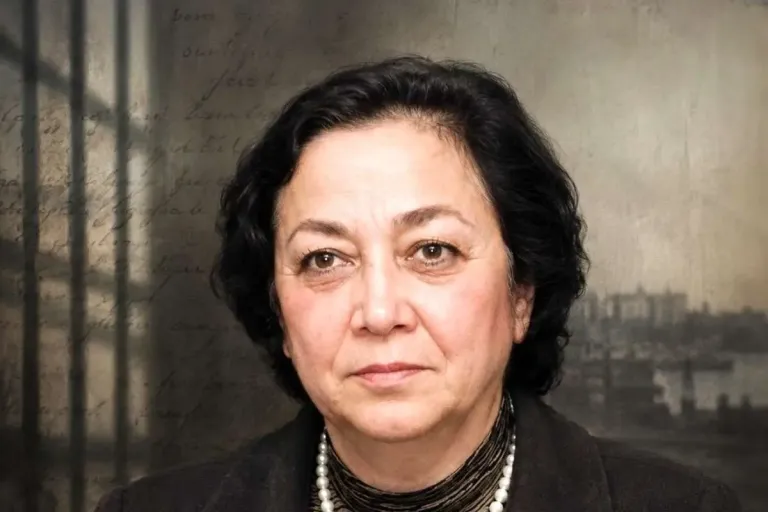
Now, in the days following the loss of the beloved Shahrnush Parsipur, perhaps the most fitting tribute is to reflect on the place she earned through six decades of creative writing—a place forged through hardship, isolation, defiance of censorship, and extraordinary perseverance. From the turbulent 1960s, when she first emerged as a literary voice, she seemed to be searching for a profound relationship between life, thought, and writing. Fortunately, the philosophical and archaeological questions that animated her essays also found their way into her novels. Her academic background resonated naturally with both her fiction and her translations, creating an internal logic that bound these different aspects of her work together.
Parsipur never regarded storytelling merely as a traditional Persian vehicle for conveying themes or moral lessons, yet she never lost sight of history or society either. She was, in other words, a writer engaged in the creative task of finding Persian equivalents for the techniques of the modern novel—a literary form fundamentally shaped within the Western tradition and governed by its own internal logic. Her achievement lay not in imitating European models but in adapting them through the resources of the Persian language, its mythological memory, its mystical heritage, its folk traditions, and the lived experience of Iranian women within a thoroughly modern narrative structure. Consequently, her novels became neither imitations of European fiction nor simple reproductions of traditional storytelling, but the creation of an entirely original literary universe.
From the very beginning, Parsipur demonstrated that her ambition extended far beyond telling stories. She sought to discover new expressive possibilities within the Persian language itself—possibilities capable of articulating the contradictions of Iranian society, particularly the experience of Iranian women. Even when her works adopt an overtly critical stance, as in The Dog and the Long Winter, protest is woven organically into the fabric of the narrative rather than delivered through slogans or political manifestos.
There are moments, particularly in Touba and the Meaning of Night, where lengthy philosophical digressions interrupt the novel’s dramatic momentum. More than anything, however, this reflects the absence of a strong editorial tradition in Persian fiction, where excessive expansion can occasionally overshadow a work’s thematic power rather than strengthen it.
Her characters are vividly alive. They make mistakes, fail, fantasize, and through their very humanity challenge existing structures of power, nowhere more memorably than in Women Without Men.
Fairness, however, may have found its finest expression in Prison Memoirs—my own favorite among her books. Its remarkable achievement lies not simply in the respect with which she refers even to Ayatollah Khomeini at the outset, acknowledging his humanity despite everything she endured. More importantly, she refuses to allow hatred to replace truth.
Here is an intellectual imprisoned by the newly established Islamic Republic, held under the most primitive conditions and without even being formally informed of the charges against her. Yet her attention remains focused on her surroundings, the individuality of the prisoners, the atmosphere of the prison, and even the personalities of her interrogators and torturers. This is where literary instinct reveals itself. At a time when so many narratives collapse into either absolute condemnation or unquestioning admiration, Parsipur demonstrates that one can simultaneously be a victim and preserve narrative distance. It is precisely for this reason that when she writes about human rights, freedom, and dignity, her words carry genuine moral authority rather than the appearance of ethical posturing.
What lingers most vividly after reading Prison Memoirs is not simply the brutality of the Islamic Republic’s detention centers, but the novelist’s extraordinary way of observing human beings. Even within an autobiographical account rooted in harsh realism, she repeatedly gravitates toward the methods of fiction. Prison is never reduced to a place of torture alone. She remains attentive to the smallest details: the sounds echoing through the prison at night, endless periods of waiting, heavy silences, fleeting anxieties, and brief moments of hope. Such writing reminds us that before anything else, Parsipur was a meticulous observer of life itself. She transforms suffering into literary material without diminishing its reality through excessive sentimentality.
This same perspective shapes her fiction. Again and again, she searches for a middle path between tradition and modernity. Mysticism blends effortlessly with irony, humor, and a thoroughly modern sensibility, producing an imaginative world unlike any other. Her characters sometimes approach mythic archetypes, while at other moments they become unmistakably ordinary people. They move between dream and waking life, only to return suddenly to the harsh realities of everyday existence.
Parsipur’s prose possesses a deceptive simplicity. At first glance, it may seem almost effortless, but closer reading reveals that its clarity is the product of extraordinary linguistic mastery rather than stylistic restraint. She writes without ornament while remaining capable of sustained philosophical reflection. This continual movement between ordinary narration and profound thought gives her work its distinctive depth.
Philosophy in her writing never appears as abstract terminology or scholarly quotation. Instead, it emerges naturally from human situations. Questions of freedom, the body, identity, love, death, and solitude all arise organically from everyday life. Her language remains agile, lucid, and free of pretension, while retaining remarkable capacities for irony, humor, and multiple layers of meaning. Reading her essays alongside her fiction only reinforces this impression. One can only hope that someone will eventually gather her critical writings into a single collected volume.
Perhaps her greatest achievement, however, lies in the way she represents womanhood. Here, it is worth acknowledging that she has at least one formidable counterpart in Mahshid Amirshahi. Parsipur never reduces women either to sacred beings or to perpetual victims. Her female characters are contradictory, courageous, fearful, loving, rebellious—complex human beings in every sense, no less complete than the men who surround them.
Yet insisting upon the simple humanity of women within a deeply patriarchal society is itself a profoundly radical act. Her challenge to male dominance unfolds not through slogans but through the quiet structures of narrative and characterization. Men are never excluded from her fictional universe; what she challenges is the monopoly of the masculine voice. Resistance in her work emerges not through dramatic declarations but through a steady transformation of language, storytelling, and imagination.
It is hardly surprising that her short but immensely influential novel Women Without Men eventually led to imprisonment and, later, exile after its publication was banned. Public recognition of genuinely innovative artistic achievements often arrives painfully late—and in some cases never arrives at all.
Seen from this perspective, it is only natural that Parsipur became one of the pioneers of women’s rights within contemporary Persian literature. She wrote about women’s bodies, freedom, desire, choice, motherhood, marriage, loneliness, and countless experiences that had either been ignored or narrated almost exclusively through masculine perspectives.
Yet she never falls into the trap of reducing every social problem to hostility between women and men. Fairness remains central to her vision of gender just as it does to her understanding of politics.
The evidence of how consistently Parsipur was neglected is overwhelming: decades of censorship, publication bans, imprisonment, exile, media indifference, and even the persistent failure to acknowledge her true place within modern Persian literature.
Perhaps most painful, however, has been the manner in which she has frequently been remembered in recent years. Even now, many continue to define her not as an independent literary figure but primarily through her relationship to others. How disheartening it is that one of the first facts so often mentioned about one of Iran’s greatest contemporary novelists is that she was once married to filmmaker Nasser Taghvai—as though her greatest distinction lay in her family connection to another artist. It is a striking example of precisely the patriarchal perspective against which she struggled throughout her life.
In one of her final interviews, Parsipur spoke candidly about this period, admitting that both she and Taghvai valued artistic freedom above all else, and that in retrospect she regarded both marriage and especially parenthood as mistakes for two people committed to such a way of life. It was an unusually honest acknowledgment of the personal costs of artistic existence.
The last public video many of us saw featured her speaking about Iran’s national football team. Regardless of one’s agreement or disagreement with her political position, watching that recording produced an unsettling feeling among many of her admirers. There seemed to be an almost painful distance between the formidable novelist of earlier decades and the elderly woman speaking in exile about television and football. Many of us may have found ourselves wondering whether she remained fully aware of the relationship between her own life’s work and the ideological preferences of those in power.
That lingering sadness extends far beyond Parsipur herself. It belongs equally to the countless Iranian intellectuals and artists whose lives have been consumed by censorship, migration, exile, imprisonment, or gradual cultural erasure.
Perhaps this is why mourning Parsipur means mourning not merely the death of an individual but the loss of part of our own cultural possibilities. She represented a generation determined to remain Iranian while embracing modernity; to learn from tradition while questioning it; to remain faithful to the Persian language while simultaneously transforming it.
Such an undertaking was never easy. It was almost destined to provoke misunderstanding, opposition, and neglect. Unlike journalism or politics, literature does not deliver hurried judgments. Sometimes decades must pass before a writer’s true place becomes visible.
Perhaps future generations, freed from the noise of political conflict and media distraction, will read Parsipur with greater clarity and recognize how remarkably she united mythology, mysticism, humor, philosophy, the body, gender, and history within prose that was at once lucid and profoundly modern.
Her death confronts us once more with an unsettling question: how many more writers, poets, translators, scholars, and artists will be worn down by censorship, exile, neglect, or misunderstanding before their work can fully flourish? And how many more will be forced to spend the finest years of their lives fighting not for artistic creation, but for the most elementary of human rights?
© 2026. Phoenix Review