



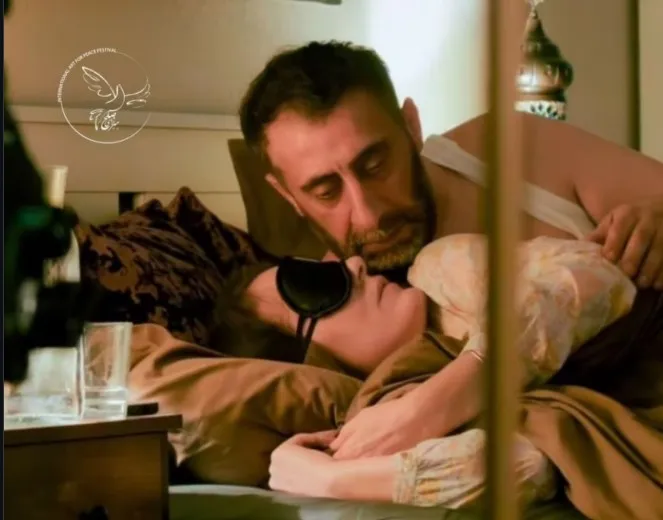
I had never seen a film by Nader Saeivar before, but he appears to be one of the leading figures of what is often described as Iran’s underground cinema. With the exception of his latest feature, Hijamat (Cupping), which was made in Germany, all of his previous films were reportedly shot clandestinely in Iran without official permission, screened at international festivals, and received several awards. Saeivar has also been a close collaborator of Jafar Panahi. Panahi is not only the producer of Hijamat, but also contributed to both its screenplay and editing.
Premiering in the main competition of the Karlovy Vary International Film Festival, Hijamat tells the story of two gay Turkish brothers growing up in a Muslim immigrant family in Germany, both struggling against the expectations of their family and the wider community. The film opens with Sinan’s circumcision ceremony, where a violent confrontation erupts between a group of religious zealots and a young gay man named Karam. From this opening sequence, the central conflict of the drama is clearly established.
Hijamat belongs to a category of films that attempt to address multiple social and political issues simultaneously. It explores sexual identity, religious oppression, immigration, family conflict, marital breakdown, and life on the margins, while at the same time presenting a product that feels perfectly calibrated for the tastes of Western audiences and international film festivals. On one hand, its formal control, carefully designed lighting, convincing performances, and meticulously composed mise-en-scène make it visually engaging. On the other, it becomes trapped by thematic overload and excessive exposition. Rather than emerging from a compelling dramatic necessity, the film seems determined to assemble every ingredient favored by the international festival circuit and the global market for politically and identity-driven cinema.
The film’s primary weakness lies not in its choice of subject matter but in the way it accumulates it. Hijamat attempts to speak simultaneously about homosexuality, religious guilt, the Turkish immigrant experience in Germany, Cold War paranoia, the Berlin Wall, the traumas of the Balkan wars, patriarchal family structures, religious authority, and even the emotional economy of a dysfunctional marriage. As a result, each narrative thread is abandoned before it can develop any real depth. Instead of centering on a single dramatic conflict, the film becomes a succession of themes and situations, each substantial enough to sustain an independent feature of its own.
Religion and religious fanaticism dominate the film from its opening scene. The imam’s sermon begins with a Qur’anic verse, while Sinan—the son of Murad, Karam’s brother—questions his father about the violent confrontation involving his uncle at the circumcision celebration, where Karam has been threatened with death. The child asks why his mother does not wear a hijab while his grandmother does. “Are we Muslims?” he asks. Murad attempts to reassure him, explaining that “your mother and your grandmother practice Islam differently.” Sinan then innocently asks, “So there are different ways of being Muslim?” After a brief pause, Murad simply answers, “Yes.”
At the mosque, Karam learns Qur’anic recitation from the imam, who advises him never to pray alone at home but to join communal prayers instead. The imam also urges Murad not to leave Karam by himself, warning that Satan may take possession of him. Sin, in its many forms—religious sin, sexual sin, familial guilt, and the guilt of being different—lies at the center of the narrative. Yet the filmmaker relies too heavily on direct explanation, particularly in the conversations between the imam and Karam, Murad, and their father. Rather than deepening the dramatic conflict, these scenes reduce it to moral instruction.
Even so, the film succeeds to some extent in portraying the psychological pressure weighing upon its characters. Karam’s encounters with the imam, Murad’s conversations with his conservative father and his gay friend, and the deterioration of his marriage all construct a world saturated with anxiety, guilt, and surveillance. Yet because of the film’s excessive discursiveness and its inability to focus on a central dramatic line, this world never fully coalesces into a convincing lived experience. The filmmaker seems constantly afraid of leaving anything unsaid, and that very anxiety ultimately undermines the film’s internal rhythm.
One of the film’s most unnecessary characters is a woman named Margot, Murad’s elderly neighbor. A survivor of East German communism and the Stasi secret police, she continues to suffer from severe paranoia, convinced that the Stasi are still pursuing her. The sequence in which Margot disappears and Murad finds her beside a symbolic remnant of the Berlin Wall is among the film’s most unintentionally absurd moments. In an attempt to reassure her, Murad theatrically reenacts the escape of East German refugees fleeing communism. Another scene, in which he gently leads Margot toward her bedroom, represents the emotional sentimentalism at its most superficial. The camera lingers on a youthful photograph of Nastassja Kinski, who plays Margot, as though reminding the audience that this elderly woman is, in fact, the once-iconic actress herself.
Nevertheless, the film occasionally reveals flashes of genuinely serious artistic cinema, moments that transcend superficiality and didacticism. Karam’s relationship with his reflection in the mirror, functioning as a signifier of his fractured identity, the darkness surrounding him, and his fearful gaze all create striking cinematic moments. Karam is not merely a victim but a subject caught in an ongoing oscillation between desire, fear, and denial.
The ritual of cupping itself functions as far more than a traditional therapeutic practice. It becomes a metaphor for Murad’s attempt at purification—for extracting contamination from both body and soul. The cupping ceremony, particularly the sequence in which a hippie healer massages Murad’s naked body, is overtly erotic, operating as a visual metaphor for his repressed homosexual desire.
The performances are generally convincing, although the actors portraying Murad and Leila carry the emotional weight of the film far more successfully than the others. Murad embodies a man suspended between denial and guilt, and the actor captures this internal contradiction with considerable subtlety. Leila, meanwhile, is one of the film’s richest and least stereotypical characters. A woman deeply wounded by her past, she is nevertheless forced to perform emotional stability simply to survive.
Having struggled with her religious identity since childhood, she empathizes with Karam and encourages him to defend his sexual identity. Recalling her traumatic experience during the Balkan War, she explains that when she was thirteen, Serbian forces murdered her parents before her eyes because they were Muslims. In order to survive, she was forced to live under a Christian identity, and even now, living in Germany, she lacks the courage to enter a mosque openly as a Muslim woman. The moments in which Leila silently stares into empty space or delivers her lines with her back turned to the camera become expressions of a quiet emotional collapse.
At home, Leila copes with the emptiness of her life by producing Kosovar cooking videos for YouTube. While the house is silent and emotionally barren, she forces herself to smile before the camera, performing happiness in sharp contrast to the reality of a marriage disintegrating because of her husband’s same-sex desires. Karam, by contrast, occasionally slips from being a fully realized character into becoming little more than a stereotype. His exaggerated gestures and facial expressions in certain scenes weaken the audience’s emotional connection and push the film toward theatricality and cliché. This weakness becomes especially problematic in a story centered on vulnerability and fragile identity, where nuanced acting is just as essential as a well-crafted screenplay.
Saeivar clearly demonstrates a strong command of visual language, spatial composition, and the construction of psychological tension. Visually, Hijamat is an accomplished film. Its careful use of light and shadow effectively reflects the characters’ divided identities and internal fractures. The editing also serves the narrative well, allowing tension to accumulate gradually. Yet this visual sophistication occasionally becomes overly conscious of its own impact, particularly in scenes intended to carry emotional or erotic weight. Instead of feeling organic, these moments often seem carefully engineered to impress festival programmers and juries. Perhaps the film’s central concern is ultimately not the cupping of the body, but the excessive cupping of ideas themselves. Every wound becomes another symbolic sign, and every sign appears calculated to function as another festival credential.
Within the framework of an international festival project, however, Hijamat is undeniably effective. Jafar Panahi’s presence behind the scenes lends the production considerable prestige, while its combination of taboo-breaking subject matter and politically resonant themes places it squarely within the programming priorities of contemporary European festivals. This inevitably raises an important question: did the film arrive at its final form out of genuine artistic necessity, or was it conceived from the outset with a clear awareness of the global market’s appetite for narratives centered on repression, transgression, and forbidden identities?
At its best, one may argue that Saeivar seeks to transform socially prohibited subjects into a cinematically persuasive form. At its weakest, however, Hijamat relies so heavily on familiar signifiers of migrant cinema, sexual repression, religious orthodoxy, and family dysfunction that it risks becoming a work whose meanings feel predetermined before the first frame has even begun.
© 2026. Phoenix Review