



I go over your words again—not today, not now, but through every waking hour and all these days when even our laughter hurts. Your voice comes to me even in my dreams, crying out, “Refuge in literature.” And strangely enough, even there I can smell your cigarettes. Those cigarettes you would light one after another, staring between puffs at the paper burning in a circle, then drawing the next one more deeply into your lungs, and only when you exhaled the smoke would you continue speaking. Like that day when you said that everyone has a god of their own, then laughed and added, “Not like Hubal, al-Lat, Manat, and al-Uzza, and the other idols of the Kaaba. They too were manifestations of their god, Allah.” And when invoking Him, they would say, “Bismika Allahumma”—“In Your name, O God”—which in Islam became “Bismillah al-Rahman al-Rahim.”
Where was your god? In the circular burn of your cigarette paper? Caught somewhere inside the landscapes you would stare at without blinking, so that I could never tell whether you were hearing me or not? Lost among the city’s endless sidewalks, every paving stone of which you had walked over in those tired shoes? Or perhaps somewhere in those soundless murmurs in which you talked to yourself, sometimes laughed, then turned the reason for your laughter into a joke and said it aloud, and “a storm of laughter” would break out among gatherings you came to reluctantly, stayed in for an hour, and in which, restless between staying and leaving, you would plant one foot firmly on the floor and balance the other on its toes, shifting it while sitting on a sofa or chair. It was clear that something inside you was slowly, patiently gnawing away at the fragile balance you had constructed for yourself with pills.
I remember that day standing amid the crowd in the subway, our hands gripping the overhead rail, with a woman sitting on the seat in front of us, rapidly running the beads of the rosary through her fingers and murmuring prayers under her breath. It was clear that she was a ruin trying to reconnect with her god, searching for a master architect who could rebuild that ruin brick by brick and turn it into a safe dwelling in which to live. Our destination was a station from which we could walk to the Artists’ Section of the cemetery, and you were going there with your restlessness to the grave of your teacher and friend, who, impatient with remaining in this world, had chosen between “to be or not to be” when he realized that being suspended in limbo meant nothing, and ended his own life. You said you knew that beneath the earth there was nothing left of Shiva but a few pieces of bone, yet the last place you had seen him was there, where you had laid his suffering body in the ground like a feather.
You whispered that it was not regret, but sometimes you envied that woman, wishing you too had some transcendent rope in your life, something like the rosary in her hands. Then you fell silent and, with a smile, said that you would become the god of the world you had created. You spoke of endurance, of the ability to bear, and said that in the dark night, amid the terror of the waves and such a mighty whirlpool, endurance only has meaning as long as the lighthouse’s blinking light is not a deceitful promise of arrival, and you know for certain that there is still hope. If you lose even that faint glimmer in the darkness, then you become a spinning compass whose wandering no longer means that you are on your way somewhere, but that you are simply lost.
Leaving fantasy aside, you called the desire to know and reach awareness the essential condition for the survival of a vibrant society. In the midst of suffering, you saw dialogue as the only way out of an inevitable collapse, and for you, dialogue was the balm for all wounds, the way out of darkness. You said that only dialogue—only, only, only dialogue—can make another person believe that you suffer as much as they do, and that this sharing of suffering itself becomes a balm, preventing the exhaustion of body and soul. You spoke of darkness, and your mind went to Arthur Koestler’s Darkness at Noon, where the only thing that flowed through Rubashov’s veins while he was in solitary confinement was precisely those conversations he carried on by tapping the wall, sending messages in Morse code to the neighboring cell and receiving replies. The passing of words and knocks from one person to another became news, hope, and a miracle. And without a doubt, dialogue is that “magic spell” that Shamloo was searching for in his poetry.
And it was right there, exactly there, that you said, “Refuge in literature,” and “Refuge in cinema.” Though I knew that, for you, the rope of literature was woven from more strands and offered a safer refuge. You said this when we were standing “in the middle of a crossroads with the wind blowing every which way,” unable to decide which direction to take, and you, staring transfixed at the ethereal beauty of a solitary woman crossing the street, saw her, distracted and unaware, suddenly pulled back from whatever world she was trapped in by the screech of a car’s brakes that stopped inches from her. And I, looking into your frightened eyes as you watched the woman, saw the atheist in you who nevertheless believed that “there are things you do not know.” And right there, my mind turned to all the stories you had written and read to me. When, a little later, I asked why they were all so bitter, you said with a vehemence I had rarely seen in you: “When pain comes, you say ouch. When there is war in your head, you cannot write peace.” Then, quoting Frank O’Connor, whose stories you loved, you said that the short story has no hero; a short story is held together by a group of crushed people. You swallowed your lump of emotion, took a drag from the cigarette between your fingers, and brought up Hannah Arendt, who said that all suffering becomes bearable when it is incorporated into a story. You continued, saying that the blinking light of the lighthouse that emerges from the lines of stories, narratives, and conversations becomes hope, preventing you from reaching that state of being lost and compelling you toward endurance and resilience. And woe to the generation for whom Lamartine’s words in his treatise on Les Misérables prove true: that the most terrifying and deadly form of madness that can be spread among the masses is the pursuit of the impossible. And the pursuit of the impossible is precisely the impossibility of escaping the banality of evil, which settles over society like a nightmare.
That was when you smiled and said you wanted to sit all the heroes from the stories and novels you loved in a row before you and show them the chaos in which we were trapped, and the absolute evil that would not leave us alone. You would stand face to face with each of them and tell them that you had walked beside them, line by line, through their stories; that you had suffered their suffering, been wounded by their wounds, wept their sorrows, and rejoiced in their victories. Now it would be their turn, having crossed the whole of history, to seize one end each of that absolute evil, that many-headed monster, tear it out by the roots, and make you victorious, so that you could share a single breath of joy with them.
You intertwined cinema and literature, saying that, since the beginning of time, lonely, isolated, wounded people from cinema and literature had become your favorite characters in films and stories. And there, without hesitation, you began listing your favorites: Brando in Elia Kazan’s On the Waterfront; Gary Cooper in Zinnemann’s High Noon; Oleg Yankovsky, the poet of Tarkovsky’s Nostalgia; the boy in Kieślowski’s A Short Film About Love; Hamid in Mehrjui’s Hamoun; Siavash and Esfandiyar in the Shahnameh; Santiago in Hemingway’s The Old Man and the Sea; Raskolnikov in Dostoevsky’s Crime and Punishment; Ferdinand in Céline’s trilogy; Jean Valjean in Hugo’s Les Misérables; Gregor Samsa in Kafka’s The Metamorphosis; Seymour Glass in Salinger’s “A Perfect Day for Bananafish”; Ayaz in Reza Baraheni; Meursault in Camus’s The Stranger; the narrator of Hedayat’s The Blind Owl; Aydin in Maroufi’s Symphony of the Dead; Shahrzad in Shiva Arastoui’s work; and Tarikh-e Beyhaqi, with its account of Hasan’s execution, after he was branded a Qarmatian and hanged through Busahl’s deception, his body remaining on the gallows for seven years amid the tears of the people of Nishapur. And, at their core, all those lonely figures in films and books who carry wounds, inside or out, that eat away at and strip their souls in isolation like a moth, with nothing anyone can do about it.
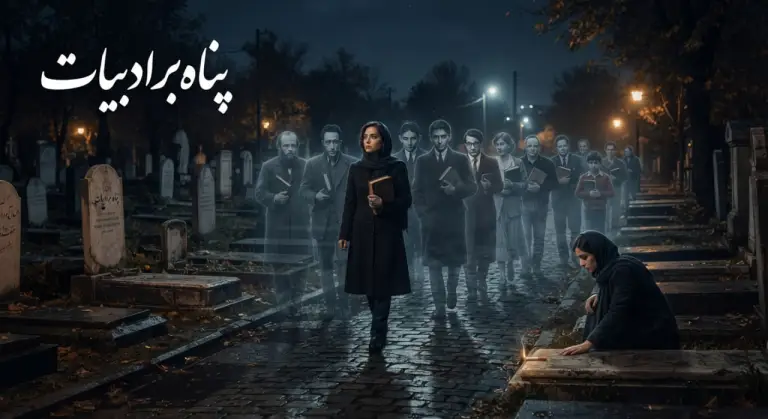
Now that you are gone, I put on my tired shoes too, leave the house at night, and walk along the sidewalk on the other side of the street, where there are fewer passersby and it is quiet, where I can surrender myself entirely to the aimless wandering of my feet, crossing all the paving stones I once walked with you, refusing to give in to exhaustion—not now, not ever, not ever. Now that you are gone, now that you lie beneath tons of earth, and from that nightmarish massacre of Dey 1404, a bullet rests in your throat like a flower, I hear your voice singing: “Ah, if freedom sang a song, small, smaller still, from the throat of a bird”—just like your own throat, for you were a knowing, restless bird trapped in a cage, and your song was always one and the same: the song of freedom.
I turn and look behind me, and I see all those people you wanted to line up before you, walking slowly behind me, one eye safely fixed on me and the other suspiciously, fearfully watching the street. And I know they are neither constrained by fatigue nor concerned with how far I will walk or where in this city I might eventually end up. Look! Dostoevsky comes first, with Chekhov beside him, followed by Hafez, Shamloo, and Nima. Virginia Woolf, Faulkner, Vargas Llosa, and Thomas Mann. Shakespeare, Joyce, Nietzsche, Kierkegaard, and Schopenhauer. Beckett, Chubak, and Maskub. Najdi, Arastoui, Fereshteh Ahmadi, Saedi, Golshiri, Zarrinkub, and so many others my eyes can no longer make out. Each of them has tucked one of their books beneath an arm, and the sound of their footsteps, marching in orderly harmony across the paving stones of the sidewalk, follows me. And it is here that I realize what an army we have become, marching to battle that banal evil, that many-headed monster. I turn my head toward the road ahead, a smile appearing on my lips, and arrive at your eternal refrain: “Refuge in literature.”
Among the fresh, unfamiliar graves, I search for you. Under my breath, I begin whispering to you the opening of Parviz Dovey’s story “Still…” from his collection The Green of the Fairy: “I am still mourning you. Still. Still, when it is so soon. I don’t know how long ‘still’ will last, until the end of which road, until the falling leaves of which tree, until the end of which season, when I will stand before your gravestone, long enough for the wind to scatter the leaves across the stone.”
© 2026. Phoenix Review