



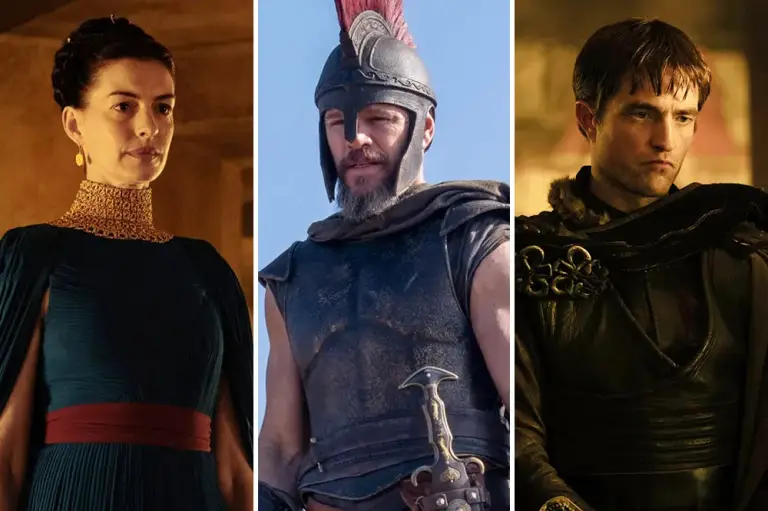
The first adjective Homer uses to introduce Odysseus is polytropos: the man of many turns, a man of twists, schemes, and transformations; a human being who cannot be contained within a simple moral definition. He is both a hero and a liar, both a cunning commander and a man who loses every one of his companions, both a victim of the gods’ anger and someone whose own pride and decisions bring about catastrophe. Odysseus’s greatness lies not in his goodness, but in his resistance to definitive judgment. Every time we think we have understood him, he reveals another face, forcing us to remain suspended between admiration, suspicion, sympathy, and disgust. In his new adaptation, Christopher Nolan has turned this man of many turns into a more familiar figure: a soldier traumatized by war, a father separated from his child, a husband longing for home, and a man burdened by guilt who must confront his past. This Odysseus is more comprehensible and easier for a contemporary audience to empathize with, but precisely this comprehensibility erases part of his moral and historical complexity. The central problem of the film lies in this distance: the distance between the hero whom Homer both admires and distrusts, and the hero Nolan asks us, above all, to understand through his suffering and explain through his psychology.
This is not to deny the film’s cinematic grandeur. The Odyssey is magnificent in its imagery, sound, scale, and world-building. The sea, cliffs, ships, caves, and tiny human bodies set against an endless natural world create a universe that is at once beautiful and terrifying. The film’s images do not merely depict the ancient world; they turn it into a physical experience. The viewer can feel the weight of the waves, the exhaustion of the journey, the violence of the human body colliding with nature, and the fear of becoming lost in a boundless space. The issue, then, is not why Nolan has failed to remain faithful to Homer’s text. No serious adaptation can or should simply be a visual reconstruction of an ancient work, and the classics have survived precisely because successive generations have reread them, altered them, and brought them into dialogue with the concerns of their own time. The real question is not what Nolan has omitted or added, but which essential force of the work he has preserved in this reinterpretation—and which part he has diminished or erased.
To answer this question, Mary Beard’s central argument about our relationship with the classical world is particularly illuminating. In her view, antiquity is founded on a dynamic contradiction: at one moment it becomes astonishingly familiar, tangible, and close to us; at the next, it appears so strange, distant, and inaccessible that we realize we can never fully enter that world. She uses the Greek word thauma, meaning wonder, to describe this experience—a wonder containing two seemingly opposing cores. The first is the wonder of familiarity: the moment when, from ancient ruins, objects, and writings, human beings emerge whose behavior is surprisingly similar to our own. The second is the wonder of alienness: the moment when we realize that these familiar people lived in a moral and intellectual world that we may never be able to fully understand. A powerful classical work must keep both of these cores alive at the same time. It must bring the past close enough for us to hear the voices of its people, while refusing to turn them into outdated versions of ourselves.
One of the most vivid examples of the wonder of familiarity is a wall painting discovered in the Salvius Caupona in Pompeii. The tavern’s owner had commissioned a series of images on the walls depicting, much like contemporary comic strips, the behavior of customers—from flirting and drinking to gambling and fighting. In one panel, two customers argue over which of them a drink belongs to. One shouts, “Bring it here!” while the other replies, “No, it’s mine!” An exasperated servant stands between them, trying to put an end to the quarrel. In the next panel, the same two men are playing dice. One claims to have won; the other accuses him of cheating. Insults follow, and eventually the tavern owner shouts, “If you want to fight, go outside!” The scene could take place tonight in a bar, coffeehouse, or café: drunk customers arguing over the outcome of a game, a frustrated server caught between them, and a proprietor who is more concerned about his furniture being broken than about morality. For a moment, two thousand years disappear. The people of Pompeii are no longer stiff, formal figures carved in stone; they make noise, cheat, swear, and get thrown out of taverns, just like people today. This is the moment when the past suddenly comes alive and we recognize ourselves in its faces.
Christopher Nolan preserves this core of familiarity with considerable force. His Odysseus is not a frozen king trapped inside an ancient text. His body is exhausted, he is afraid of war, he longs for his wife and child, and he suffers from memories of what he did at Troy. He is a man who appears to have left the war behind, while the war continues inside him. We understand his fear of returning home because he is not merely wondering how to get back; he fears that the person who left home may no longer exist, and that the violence he witnessed—and helped to inflict—will follow him home. This Odysseus is a soldier returning from the battlefield who cannot reenter ordinary life; his longing, shame, fear, and guilt are entirely legible to a contemporary audience. In this respect, the film does something similar to the painting from the Salvius tavern: it removes the ancient human being from historical distance and turns him into something living and tangible. Nolan brings the past to within inches of our faces, and succeeds in recreating the first core of thauma.
But the second core of thauma—the wonder of alienness—is an entirely different experience. Here, the past does not move closer to us; instead, it pushes us back and forces us to accept that ancient people, despite all their physical and emotional similarities to us, lived in a world whose moral and social assumptions could be fundamentally different from ours. A disturbing example of this alienness, as Mary Beard points out, is a letter written on a papyrus from the first century AD, in which a man writes to his pregnant wife that if the baby is a boy, she should keep him, but if it is a girl, she should cast her out. The most horrifying part of the letter is not simply the man’s decision, but its utterly ordinary, everyday tone. With the same calmness with which he might have written about money, food, or when he would return, he makes a decision about abandoning his newborn daughter. Faced with such a letter, we can no longer say that people in the past were exactly like us. Perhaps they too argued in taverns, fell in love, gambled, and feared death, but they lived within a different moral structure that cannot be translated into contemporary terms without distortion. The true power of the classics lies in the tension between these two experiences: one moment we say, “This person is completely like me,” and the next we are forced to admit, “I do not fully understand his world.”
The greatest weakness of Nolan’s The Odyssey is that it powerfully recreates the first core while largely taming the second—and this issue concerns not merely historical fidelity, but the fundamental function of the classics. The value of the classics does not lie in their offering ready-made moral lessons, timeless answers, or flawless models for contemporary life. The Greeks and Romans, too, committed profound moral wrongs, and their societies were built upon slavery, inequality, violence, and the exclusion of various groups. The value of these works lies in the questions they raise: How close can justice come to vengeance? What responsibility does a leader bear toward those who have been killed under his command? When does a commitment to one’s family come into conflict with the law of the wider community? And how should we judge between two moral claims when both contain part of the truth? A good classic does not give us easy answers; it teaches us to read difficult material, to understand how language can reveal truth or be used to deceive, to reason responsibly from insufficient evidence, and to sustain constructive dialogue about questions that have no definitive answers. A classic is not meant to reassure us in our intellectual comfort. It should challenge the beliefs and certainties of the present.
This historical distance has another important function: because the ancient past belongs to no contemporary party, nation, or political faction, it can become common ground for discussing some of the most difficult issues of the present. We can discuss slavery, tyranny, individual responsibility, gender, war, and freedom by turning to a three-thousand-year-old text without being forced from the outset to position ourselves within one of today’s political camps. But this possibility survives only as long as we resist turning the past into a manipulated version of ourselves. If we reconstruct ancient characters from the outset according to today’s moral and political categories, we are no longer engaging in a dialogue with the past; we are simply staging our own beliefs in Greek or Roman costume. The past is not a clear mirror in which we see only our own faces. It is a warped pane of glass through which both the ancient world and our own acquire an unfamiliar and unsettling shape. An adaptation that removes this distortion may make the past more accessible, but it also takes away one of the most important capacities of the classics: their ability to force us to reconsider ourselves.
A clear example of this problem can be found in many contemporary adaptations of Antigone. Sophocles’ play is often reduced to the simple story of a brave young woman who stands up to a tyrannical ruler; Antigone is presented as a representative of freedom, conscience, and resistance, while Creon becomes the embodiment of repressive power. But the original text is more complicated. Antigone is not simply a heroic freedom fighter; she is also stubborn, absolutist, and possessed of a certain moral self-centeredness. Nor is Creon merely an evil tyrant: he is defending the order of the city, the authority of the law, and the need to prevent political collapse. The tragedy arises not from a straightforward battle between right and wrong, but from the collision of two rights—or even two forms of error. Both characters have reasons on their side, and both destroy others by turning those reasons into absolutes. If we reduce the play to the story of a heroic woman confronting a tyrannical ruler, the audience is no longer forced to confront its difficult central question: when the law of the family, the law of the city, the command of the gods, and political necessity come into conflict, which should take precedence over the others? Such an adaptation turns a work that was meant to generate questions into a slogan whose answer is already obvious.
Nolan does something similar with Odysseus. A character who was meant to be, at once, a hero, a deceiver, a victim, and an agent of violence becomes a traumatized soldier whose mistakes can be explained through trauma and guilt. This interpretation is not, in itself, illegitimate. The problem begins when psychological injury becomes the ultimate explanation for everything Odysseus does. He lies, deceives, puts others in danger, and sometimes acts out of pride, yet before the film forces us to judge him morally, it places his inner suffering at the center. Gradually, moral complexity gives way to a familiar narrative of wounding and healing: a man who must recover his repressed memories, confront his guilt, and find a way to reconcile himself with who he is. In Homer’s poem, saying that Odysseus is traumatized does not settle the question of who he is, because his intelligence and his pride cannot be separated from one another. The very cunning that saves him sometimes puts his companions in danger, and the same desire for glory that makes him a hero leads him to shout his real name to the Cyclops, provoking Poseidon’s wrath. He is both a victim and a responsible agent, but the film gradually allows the former to eclipse the latter.
The diminishing presence of the gods is another part of this process of modernization. In Homer’s poem, the gods are real beings: they become angry, jealous, partisan, deceive humans, and alter the course of their lives. The Homeric human being inhabits a world in which forces beyond the self can overturn one’s destiny, with no guarantee that those forces will be just, moral, or even comprehensible. In the film, the gods become more like psychological embodiments: Athena can be understood as a memory, a conscience, or the image of a woman Odysseus failed to save, while Poseidon may amount to little more than a name for the storm. What was an independent, external force in the poem is transferred into the human mind in the film. This decision makes Homer’s world more intelligible to a contemporary audience, but it also makes that world smaller, because we are no longer required to imagine a universe in which the gods actually exist and human beings are caught in the grip of nonhuman, incomprehensible wills. It is enough to translate them into guilt, trauma, or natural phenomena. In this way, the part of the past that ought to resist our understanding is translated back into the familiar language of contemporary psychology.
The Cyclops episode offers the clearest example of the simplification of Odysseus’s character and the story’s moral world. To understand this episode, the contemporary reader must first become familiar with the concept of xenia: an unwritten but sacred code in the Homeric world governing the relationship between guest and host. Xenia was not merely hospitality in the modern sense; it was a religious and social bond under the protection of Zeus, guardian of strangers and travelers. A host was expected to provide a traveler with food, drink, shelter, and safety before even asking his name or identity, and ultimately to offer him a gift and send him safely on his way. In return, the guest was expected to respect the host’s home, property, and authority, not cause trouble, and not abuse his hospitality. Violating xenia was not simply rude behavior; it was considered a grave offense and a violation of a sacred order that marked the boundary between the civilized world and the wild. Many of the disasters in The Odyssey begin with precisely such a violation. The suitors, by remaining indefinitely in Odysseus’s house, consuming his wealth, and harassing his family, have violated xenia, which is why their punishment is not merely an act of personal revenge but is also understood as the restoration of a sacred order.
With this in mind, we can understand why Odysseus is not entirely an innocent guest in the Cyclops’s cave. He and his men enter the cave without permission while its owner is away, discover his food and cheese, and begin eating them. Odysseus’s companions suggest that they take the cheese and lambs and leave immediately, but he chooses to stay because he wants to meet the cave’s owner and receive a “guest-gift” from him. Within the logic of xenia, Odysseus sees himself as a traveler whom the host is obligated to receive and entertain. At the same time, however, he has entered the absent man’s home before any guest-host relationship has been established, consumed his property, and then expects a gift from him. From the very beginning, then, he has blurred the boundary between the rights of a guest and an intrusion upon the host’s domain.
The Cyclops, of course, violates xenia in a far more horrifying way: he neither offers the travelers food and safety nor permits them to leave; instead, he eats them. Yet the scene is not simply a battle between civilized humanity and a savage monster. It is a confrontation between two sides, each of whom has violated the sacred order of guest and host in their own way, even though the Cyclops’s violence and cannibalism are in no way comparable to Odysseus’s conduct. Through this, Homer forces us to ask where civilization actually begins—and whether the hero of the story is always on the side of law and morality.
In Homer’s poem, Odysseus saves himself by telling the giant that his name is “Nobody.” When he blinds the Cyclops and the creature cries out, “Nobody has blinded me,” the other Cyclopes do not come to his aid. This play on language is not merely an entertaining trick; it is the essence of Odysseus’s character. Language is his weapon, and he survives by changing names, concealing identities, and playing with the meanings of words. Nolan removes the entire idea of xenia’s unexpected complication from his film and renders the Cyclops almost entirely speechless. As a result, the encounter becomes primarily a physical battle for survival, and Odysseus, rather than being a man who triumphs through language and intelligence, becomes a resilient warrior. With the Cyclops silenced, the conflict surrounding xenia also fades into the background. We no longer ask with the same urgency who is the guest and who is the host, which of them first violated the sacred law, or exactly where the boundary between civilization and barbarism lies—questions that were foundational to the story for its Greek audience. Just as adaptations that reduce Creon to a one-dimensional figure make Antigone unquestionably heroic, the film deprives the Cyclops of his voice and his position as host, allowing Odysseus to occupy the position of victim with greater ease.
The film’s treatment of Calypso likewise reveals how the difficult relationships of Homer’s world have been translated into a language familiar to us today. In the poem, the relationship between Calypso and Odysseus is an uneasy mixture of desire, power, care, coercion, and captivity. Calypso cares for him while also keeping him against his will, making theirs a relationship that cannot easily be accommodated within contemporary moral categories. In the film, however, this relationship is translated more directly into the language of therapy and recovered memory, with Calypso becoming something like a therapist who forces Odysseus to confront his repressed memories. Once again, we encounter a familiar narrative: a man who has taken refuge in forgetfulness and psychological numbness in order to escape the memory of his crimes. This reading is emotionally effective, but it diminishes the moral and mythological alienness of Homer’s world, because a relationship that ought to resist our categories is transformed into familiar concepts such as trauma, repressed memory, and therapy. The film rewrites not only Odysseus but the entire world surrounding him in the language of contemporary psychology.
This difference reaches its culmination in the film’s ending. After killing the suitors, Odysseus is severely wounded and collapses into Penelope’s arms. We then see Odysseus and Penelope sailing westward, toward the setting sun. One reading is that he has survived, handed the throne over to Telemachus, and gone into exile. In the version I saw, however, the ending was not quite so definitive. The severity of his wounds, his collapse in Penelope’s arms, and the abrupt cut to the image of the ship leave open the possibility that he has died there and that the final voyage is his last dream. The movement westward, the setting sun, and the unknown sea can signify exile, but they can also be read as an image of the passage from life into death. This ambiguity is one of the film’s most compelling moments, because for a brief time the image resists explanation. Yet whether Odysseus survives or dies, the center of the ending remains his own suffering, guilt, and personal fate, while the victims, the families of the suitors, and the society that must somehow go on living after the massacre are pushed to the margins.
Homer’s ending is more difficult, because after the suitors are killed—and in light of their violation of xenia—their families come seeking revenge, and a new cycle of violence is about to begin. Athena is forced to impose a fragile peace upon both sides. This ending is neither a cure nor complete forgiveness, neither exile nor the hero’s glorious death. Odysseus must live among people whose children and relatives he has killed, and violence does not end with one man’s remorse or death; it remains within the memory of the community. Like the confrontation between Antigone and Creon, Homer’s ending offers no simple answer. It does not tell us that Odysseus was entirely justified or that the suitors’ families are merely evil enemies, because both sides have their reasons, and the continuation of either side’s logic could lead to another massacre. What remains is an imposed, exhausted, unfinished peace. Nolan turns this social and political knot into the personal fate of the hero: a guilty man pays the price for his actions by leaving or dying. This ending is easier for a contemporary audience to understand and more emotionally satisfying, but it sidesteps Homer’s more difficult question: after violence, how are we supposed to live alongside those whom we have harmed?
This is precisely where the adaptation’s central weakness lies. A good classic is not supposed to make its hero easier for us to forgive; it is supposed to expand our capacity to remain with contradiction. It should force us to see several incompatible truths at once: Odysseus has both suffered and caused suffering; he is both a leader and a man responsible for the deaths of his men; he longs for home and yet brings violence back home with him. Such a work does not tell us who is entirely in the right. It teaches us how to live with a question that has no neat or final answer, and how to keep a conversation going without retreating into slogans. The film, however, translates most of these contradictions into familiar terms: the gods become conscience, complex relationships become trauma, cunning becomes physical resilience, social violence becomes personal guilt, and moral contradiction becomes a personal journey toward redemption. The problem with Nolan’s The Odyssey is not that it changes Homer; the problem is that it makes the past too much like us. Instead of allowing Homer’s world to unsettle our beliefs and certainties, it places that world within frameworks we already know: the traumatized soldier, repressed memories, guilt, therapy, and the possibility of forgiveness.
Nolan’s The Odyssey shows us the Salvius tavern painting remarkably well: a familiar, boisterous, exhausted, angry, and vulnerable human being in whom we can recognize ourselves. But it pushes aside the horrifying papyrus—the part of the ancient world that we cannot easily understand, affirm, or translate into the language of contemporary psychology. The film is a major achievement in terms of image, sound, scale, and ambition, and it may well be regarded as one of the year’s most significant cinematic experiences. Yet its visual grandeur should not distract us from its central limitation: Nolan has powerfully preserved the wonder of familiarity, but he has tamed the wonder of alienness. Homer’s Odysseus was never meant to be completely like us. He was not meant to be someone we could love without reservation, cure, or forgive. He was meant to come close enough for us to feel his pain, and then move far enough away that we no longer knew how to judge him. It is precisely this movement between familiarity and alienness, empathy and judgment, question and the refusal of an easy answer, that keeps a work classical. Nolan has recreated only half of this movement with dazzling force. The other half—the part that should unsettle us, shake our certainties, and leave us alone with an unanswered question—has been lost in the process of transforming myth into a story about trauma and redemption.
© 2026. Phoenix Review