



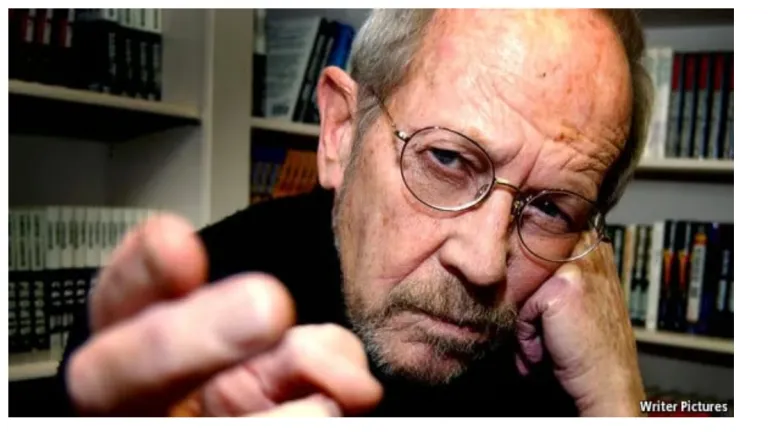
Elmore John Leonard, the American writer, was one of the most important writers of crime fiction and noir, as well as one of the most influential voices in American crime literature. A prolific writer, Leonard wrote more than 46 novels, most of which were later adapted for film and television. Saul Bellow, Martin Amis, and Stephen King admired his work, while Patricia Cornwell referred to him as one of the true icons of crime fiction. With his spare, dialogue-driven prose and jazz-like rhythm, Leonard blurred the boundary between popular fiction and serious literature, portraying a world of criminals, corrupt police officers, and morally ambiguous characters against the backdrop of cities such as Detroit and Miami.
Leonard was born in New Orleans, Louisiana, and spent most of his life in Detroit, a working-class city whose directness and unpretentious vernacular found their way into his prose. Before seriously embarking on a writing career, he served in the U.S. Navy and, after graduating from the University of Detroit, worked in advertising and screenwriting. Leonard began his fiction-writing career with Western stories about cowboys and gunslingers, including The Bounty Hunters and Three-Ten to Yuma, the latter of which was later adapted by Delmer Daves into a major and highly regarded Western. Beginning in the 1970s, as public tastes shifted toward crime fiction and noir, the subjects, settings, and characters of Leonard’s stories changed as well. He gradually moved away from the Western genre—with its cowboys, gunslingers, fearless sheriffs, outlaws, and Native Americans—and entered what would become his true territory: the underworld of criminals, gangsters, and urban lawbreakers. Through his Westerns and crime thrillers, Leonard elevated these genres beyond the level of popular entertainment and demonstrated that they could also possess literary, philosophical, and intellectual value.
Leonard’s Writing Style
Elmore Leonard was renowned for creating strong, believable characters, vivid settings, and exceptional dialogue. His characters, whether criminals or agents of the law, are rarely stereotypical; each is distinctive and unpredictable. Leonard developed a highly individual style: energetic and imaginative, marked by clear, economical prose and dialogue as sharp as glass. Because of its rhythm and improvisational quality, his writing has often been compared to jazz. He was influenced by Ernest Hemingway, from whom he learned economy, the elimination of unnecessary adjectives, and a reliance on dialogue. Yet unlike Hemingway and his often austere, self-serious characters, Leonard’s characters tend to possess a playful and humorous spirit. Leonard frequently criticized Hemingway for what he saw as a lack of a sense of humor in his work.
In Leonard’s novels, lengthy descriptions and direct psychological exposition are kept to a minimum. Instead, action and dialogue drive the narrative, while characters reveal themselves through their tone, choice of words, and rhythm of speech. Martin Amis once remarked that Raymond Chandler’s prose seemed “sloppy” next to Leonard’s. The compliment speaks to Leonard’s linguistic discipline and stylistic clarity. In his writing guide, 10 Rules of Writing, he likewise emphasizes avoiding purple prose and unnecessary adjectives, arguing that a writer should give a work depth through omission. His advice was simple: “Try to leave out the parts that readers skip.” According to British crime novelist Mark Billingham, no one skips even a single word when reading an Elmore Leonard novel.
Newsweek dubbed Elmore Leonard “the Dickens of Detroit” because of his precise depiction of the people of the city, although his style and subject matter had little in common with Dickens and were much closer to American writers such as Hemingway and Faulkner. Leonard’s criminal world is largely set in major cities and their suburbs; industrial Detroit and sunny, corrupt Miami form the two geographical poles of his fiction. In Leonard’s world, the boundary between law and crime is often blurred, while police officers, clever lawyers, small-time criminals, and figures from the worlds of culture and cinema become entangled in networks of mutual interests and betrayals. Unlike many classical crime writers, Leonard is less concerned with the police mystery and the discovery of a murderer. His focus is on action, pursuit, and razor-sharp dialogue through which the identities and motives of his characters emerge from between the lines.
His Relationship to American Crime Fiction and Noir
Leonard belongs to the tradition of American hard-boiled fiction and noir, a tradition shaped by writers such as Raymond Chandler, Dashiell Hammett, and James M. Cain, and characterized by bleak, pessimistic settings and morally ambiguous characters. Yet what distinguishes Leonard from other noir writers is that his noir is not necessarily built around a mystery. His primary concern is crime as a social ecosystem rather than the solving of a criminal case. In Leonard’s world, the boundary between law and criminality becomes blurred, while corrupt officers, shrewd lawyers, and cultural intermediaries find themselves caught in networks of mutual interests, conspiracies, and betrayals. He was a writer who, by depicting the details of urban life and its different layers, social groups, and classes, created a vivid portrait of the society around him. Leonard also enriched the language of crime fiction by bringing the tone and rhythm of colloquial speech into literary prose, paving the way for a new generation of crime writers.
The contrast between light and shadow, the opposition between open and enclosed spaces, darkness and brightness, and the use of setting and geography as reflections of the characters’ psychological states are among the noir elements found in Leonard’s work. Yet his characters, whether criminals or agents of the law, are never simply types. They are human beings with contradictions, fears, and modest desires. His novels are generally character-driven: he creates the characters first and then allows the story to emerge from their actions and conversations. As he put it, “I go along with my characters as I write.”
In novels such as Get Shorty, the protagonist, Chili Palmer, is a small-time loan shark in Miami who gradually enters the world of cinema. This transition not only creates comic situations but also intertwines the moral dimensions of the criminal underworld with those of show business.
In Get Shorty, Leonard reconstructs Miami not merely as a geographical setting but as a theatrical space in which the boundary between crime and entertainment disappears. The novel’s visual world is filled with the harsh Florida sunlight, nightclubs, and film studios—elements that were brought to the screen in Barry Sonnenfeld’s 1995 adaptation, starring John Travolta and Danny DeVito, which successfully transferred the novel’s humor and fast-paced action to cinema. At the heart of the novel is the tension between reality and illusion. Chili moves from the world of crime into the world of show business, only to discover that, ultimately, both worlds are built on performance and role-playing.
The novel Out of Sight begins with a prison escape in Florida before moving to Detroit, where Jack Foley, a bank robber, becomes entangled in a romantic-criminal relationship with Karen Sisco, a federal agent. Leonard makes use of spatial contrast, setting bright and warm Florida against dark and cold Detroit. This geographical shift mirrors the change in the story’s tone, from the excitement of the escape to urban violence and street-level pursuits. The visual elements of noir are unmistakable in the novel: nighttime chases, sudden confrontations in parking lots, and dialogue in which sexual tension and danger become intertwined. In his 1998 film adaptation, Steven Soderbergh, working in a neo-noir style, successfully brought this spatial contrast and the novel’s sharp, fast-paced dialogue to the screen, recreating Detroit through images of everyday life that are at once mundane and poetic.
Elmore Leonard’s novel LaBrava is set in South Miami and places Joseph LaBrava, a former police officer turned street photographer, in a situation where he must rescue a woman who was once a movie star. The novel’s visual world is filled with postcard images of Florida: narrow strips of parkland, palm trees, coral walls, and endless beaches. Yet beneath this apparent beauty lies a hidden network of crime, violence, and corruption. Leonard uses cinema as one of the novel’s central themes. The actress repeatedly recites lines from her old films, while the blackmail plot resembles a scene from an old movie. This overlap between reality and cinema destabilizes the boundary between life and performance. The noir elements in LaBrava emerge more strongly in its dark, enclosed spaces: hotel rooms, photography studios, and deserted nighttime streets where the characters wander between illusion and reality.
In City Primeval, Leonard portrays Detroit as an industrial and violent city in which crime is woven into the fabric of everyday life. The novel’s visual landscape is filled with abandoned factories, empty streets, and dark bars—elements rooted in the tradition of American noir and charged with a sense of despair and violence. The characters, from the deranged killer to the exhausted police officers, are trapped in a web of corruption and hopelessness. Through sharp dialogue and fast-paced action, Leonard gives the narrative a jazz-like rhythm that immerses the reader in the urban landscape of Detroit. In Leonard’s other works, his protagonists often come from the margins of society and survive through verbal intelligence and instinct; even his femme fatales are never one-dimensional, but act within complex networks of economic and emotional motivations.
Film Adaptations of Leonard’s Work
Leonard’s novels and stories, with their strong visual and dramatic qualities, attracted the attention of Hollywood producers, filmmakers, and television creators. To date, more than 26 of his short stories and novels have been adapted for the screen, and Leonard himself participated in writing the screenplays for some of them. Nevertheless, he was often dissatisfied with the cinematic adaptations of his work. Speaking about the films based on his books, he once said: “I always wished good movies would be made from my novels, but for some reason, the adaptations have all been rather loose. At first I was disappointed, but eventually I learned to live with them… When you adapt something for the screen, even if it’s your own work, you’re still writing for someone else, and for the money, you have to deliver what they want. But when I write a novel, I do exactly what gives me pleasure.”
Leonard’s straightforward language, his use of familiar and popular genres such as the Western and the crime thriller, tightly constructed plots, compelling and powerful characters, and striking settings were among the qualities that could attract virtually any filmmaker and made his work particularly appealing for cinematic adaptation. The first of his stories to be adapted for the screen was Three-Ten to Yuma (1953), which was filmed twice. The first adaptation, directed by Delmer Daves in 1957 and starring Glenn Ford, is now regarded as a major classic of the Western genre. The second was made in 2007 by James Mangold, starring Russell Crowe and Christian Bale. In addition to Three-Ten to Yuma, Tall T was another Western by Leonard that was adapted for the screen in 1957, directed by Budd Boetticher.
In 1967, Martin Ritt adapted Leonard’s Western novel Hombre into a film about the oppression of Native Americans. Paul Newman played a young man who had been raised among the Apache and becomes a victim of greedy white settlers.
In 1966, Leonard wrote The Big Bounce, which was adapted twice. The first adaptation, directed by Alex March in 1967 and starring Ryan O’Neal in the central role, was followed by another version directed by George Armitage in 2004. Leonard, however, was satisfied with neither adaptation. Among the more contemporary adaptations of Leonard’s novels, Get Shorty (1995), directed by Barry Sonnenfeld and starring John Travolta, Gene Hackman, and Danny DeVito, was the first film based on one of Leonard’s best-known and bestselling novels that he genuinely approved of. Like many of Leonard’s crime and gangster thrillers, the novel delves into the world of criminals and the drug mafia.
In 1997, Quentin Tarantino made Jackie Brown, based on Leonard’s novel Rum Punch. The adaptation remained remarkably close to the novel and attracted considerable critical attention. Tarantino recreated Leonard’s bleak world and his collection of ill-fated characters through his own distinctive cinematic style. Then came Out of Sight (1998), one of Leonard’s finest noir and gangster thrillers, which caught the attention of Steven Soderbergh. Soderbergh made a film of the same name, starring George Clooney as the criminal Jack Foley and Jennifer Lopez as Karen Sisco, a femme fatale. With its neo-noir style, the film effectively captured the spatial contrast between sunny Florida and cold Detroit.
Elmore Leonard created the character of Raylan Givens in 1993, a combination of the honorable, strong-willed sheriffs of Western films and the cool, incorruptible detectives of film noir. The character appeared in several of Leonard’s novels, including Pronto, as well as in the short story “Fire in the Hole.” In 2010, the television network FX produced Justified, one of the most successful American crime and detective series, based on Leonard’s stories and the character of Raylan Givens. The series follows an introspective, cool-headed U.S. Marshal, brilliantly played by Timothy Olyphant, who is assigned to the small town of Lexington, Kentucky, and enforces the law in his own distinctive way.
In addition to having his novels adapted for the screen, Leonard also wrote original screenplays for several films. Among them were the Western Joe Kidd, directed by John Sturges and starring Clint Eastwood; The Moonshine War, directed by Richard Quine and starring Richard Widmark; Stick, directed by and starring Burt Reynolds; and Cat Chaser, directed by Abel Ferrara. Mr. Majestyk, Valdez Is Coming, The Last Stand at Saber River, Get Shorty, The Touch, Gold Coast, and Pronto are among the other films adapted from Leonard’s work. The last film based on one of Leonard’s novels was Life of Crime, adapted from his 1978 novel The Switch. The film follows the same characters later featured in Jackie Brown, but at a point in their lives before Leonard wrote Rum Punch.
Elmore Leonard’s death in 2013 marked the end of an era in American crime and noir literature. Yet his style has continued to live on, both in the writers who followed him and in the cinematic adaptations of his work, from Get Shorty to Jackie Brown and Out of Sight. He demonstrated that crime fiction could be fast-paced and entertaining while also being linguistically sophisticated and deeply human.
© 2026. Phoenix Review