



From a thematic perspective, the film is grounded in Malick’s ethical stance toward war and fascist ideology, a stance that manifests itself through its unwavering commitment to individual conscience. In A Hidden Life, nature, faith, conscience, and history are woven together through an intricate network of formal and narrative devices. Throughout his career, Malick has sought to represent lived human experience in relation to the transcendent—not through classical narratives driven by external action, but through silence, interior narration, fluid camera movements, and a sustained attention to the material and natural world. In this film, that poetic universe becomes intertwined with a concrete historical event: Franz Jägerstätter’s refusal to give the Hitler salute and swear allegiance to the Nazi regime. The result is a cinematic meditation on ethics in an age of evil.
The film’s central conflict is fundamentally internal; the true battle takes place not on the battlefield but within the realm of individual conscience. Malick depicts war not through combat sequences but through the ideological mechanisms that normalize evil. In the village, the Hitler salute has become an everyday ritual, a social gesture performed without reflection, while refusing it is treated as a crime punishable by death. Malick had already questioned war and violence from a moral perspective in The Thin Red Line, yet the two films approach the issues of war, evil, and faith from markedly different angles. Comparing them reveals how his poetic and metaphysical vision evolved over the course of two decades.
In both films, war is more than a historical or military event; it becomes the framework for exploring fundamental questions about evil, human nature, and the presence—or absence—of God. In The Thin Red Line, soldiers fighting on Guadalcanal continually reflect upon the meaning of violence and moral corruption. In A Hidden Life, the Second World War becomes the context for examining individual conscience and Christian faith in the face of fascist power.
Nature, meanwhile, occupies a spiritual role that is central to Malick’s cinema. In both films, it is not merely a backdrop but a mysterious and transcendent force. In The Thin Red Line, the tropical landscapes and jungles of Guadalcanal stand in stark contrast to human violence. In A Hidden Life, the mountains, fields, and skies of the Alpine village evoke a divine order set against the madness of war. Another defining feature of Malick’s style is his use of interior monologues and contemplative voiceovers. In both films, characters converse with themselves, with nature, and with God. These voices resemble prayers, meditations, or philosophical reflections far more than conventional cinematic dialogue.
While The Thin Red Line unfolds through a fragmented and polyphonic narrative told from the perspectives of multiple soldiers, presenting war as a collective and multilayered experience, A Hidden Life adopts a highly focused narrative centered on Franz, an Austrian farmer who refuses to swear loyalty to Hitler. Moreover, whereas The Thin Red Line confronts viewers with the physical brutality of war, A Hidden Life—apart from the scenes depicting Franz’s imprisonment by the Nazis—emphasizes moral and psychological violence. Torture, humiliation, social pressure, and the loneliness endured by Franz and Fani replace the battlefield itself.
At its core, the film is concerned with the resistance of conscience against what Hannah Arendt famously described as the “banality of evil.” Although The Thin Red Line is rich in spiritual reflection, A Hidden Life is more explicitly Christian and theological. Its prayers, letters, references to suffering and martyrdom, and emphasis on personal faith transform it into a cinematic meditation on belief and redemption. Put differently, The Thin Red Line asks, “Where does evil come from?” while A Hidden Life asks, “How can one resist evil?”
In A Hidden Life, Franz and Fani’s struggle is not confined to their opposition to the Nazi regime; it also involves their confrontation with their own village community. Through ridicule, reproach, and humiliation, the villagers ostracize and isolate both Franz and his wife. Franz’s mother tells him, “I know you are alone,” a statement that underscores his vulnerability and humanity. Loneliness becomes the condition of ethical choice—a choice that offers no social guarantees. This collective hysteria and social exclusion reveal that fascism is not merely a political structure but something that permeates everyday relationships and the gaze of one’s neighbors.
Formally, Franz’s social isolation is reinforced through his placement within the frame, often positioned at its margins or visually separated from others. Malick’s fluid camera contributes to this atmosphere through sudden close approaches to faces and characters passing unexpectedly before the lens, generating a sense of instability and threat. The village, once portrayed as harmonious and peaceful, gradually becomes hostile and oppressive. The very people who once benefited from the generosity and hospitality of Franz and Fani now ridicule and reject them and their children because of Franz’s decision. The state reinforces this punishment by cutting off his financial support and pension.
Yet Fani never retaliates, nor does she become bitter or resentful. On the contrary, she continues to help those who have wronged her, offering them bread and assistance. This ethical choice—the forgiveness of injustice and cruelty—becomes, within the film’s theological framework, a feminine form of redemption. She forgives with full awareness of the depth of the wrong committed against her, without ever forgetting it.
Malick’s ethical position toward war becomes especially clear in his treatment of Franz’s fate. When Franz is drafted, he reports for duty out of necessity and compulsion. In the military camp, the handheld camera approaches his body with a trembling intimacy, visually separating him from the collective mass of soldiers. His refusal to perform the Hitler salute becomes an act of resistance against this process of collective transformation and conformity. His refusal marks the recovery of his individuality, but it also leads to interrogation, persecution, and torture.
Unlike many anti-fascist films or patriotic war dramas, Malick—much as he did in The Thin Red Line—has little interest in constructing a heroic myth. In The Thin Red Line, heroism is an ambiguous and almost meaningless concept; soldiers are largely victims of the machinery of war, and heroism disappears amid chaos. In A Hidden Life, however, Malick’s emphasis on conscience, faith, and moral resistance elevates Franz into a different kind of hero: an ethical hero. Like Robert Bresson in A Man Escaped, he chooses not to glorify resistance through spectacle or acts of valor but instead through silence, endurance, and steadfastness. This ethical position reframes war not as a military conflict but as a test of human conscience.
The narrative of A Hidden Life is largely constructed through the letters and interior monologues exchanged between Franz and Fani. Their poetic and deeply affectionate voiceovers, presented in the form of correspondence, constitute the film’s narrative framework. The tone of these narrations is lyrical and melancholic, oscillating between prayer and confession. By minimizing explanatory dialogue and relying on interior monologue, Malick elevates the experience of imprisonment from the level of objective reality to that of ethical reflection.
Much of the film’s spoken language appears as voiceover layered over images of everyday labor, farming, prison life, and nature. Malick deliberately creates this separation in order to establish two parallel dimensions: a visual layer of bodies, work, and suffering, and an auditory-interior layer of prayer, doubt, and moral decision. The film’s narrative voice possesses an eschatological quality. It begins with Franz speaking in voiceover about his dream of building a home in the mountains and ascending to the heights, and it concludes with Fani’s promise that she will join him again in the mountains.
This circular structure transforms the mountainous landscape surrounding the village into a symbol of the promised land. Franz and Fani’s voices invest these vistas with an eschatological dimension, turning them into images of redemption and salvation. Without these voices, the mountains would remain merely beautiful scenery. Through them, however, they become part of Malick’s theological vision, a world in which nature, silence, and the inner voice are inseparably connected. Together they articulate the film’s central question: How can one continue to live by the faint voice of conscience—as though it were the voice of God—in a world where God appears absent?
Franz’s voice, emerging from his prison cell in a poetic and contemplative tone, is layered over images of stone walls and the narrow beam of light filtering through a small opening. In contrast, Fani’s voice accompanies scenes of daily labor on the farm, caring for the children, and sustaining ordinary life in her husband’s absence. This parallel montage links two opposing spaces: prison and home, the dark cell and the sunlit mountains. The theological significance of the voice-over lies in its opposition to the language of power and the machinery of evil. Malick draws a clear distinction between the language of authority—the shouts of soldiers, the insults of villagers, the commands of prison guards—and the language of conscience, prayer, and supplication. The voice-over becomes the voice of truth, set against a language of power that is corrupt, propagandistic, and ideological.
In effect, Malick takes his longstanding use of narration beyond the realm of abstract philosophical reflection—as in The Tree of Life—and brings it closer to what might be called a Pauline mode of discourse. Franz’s voice in prison resembles an epistle written to believers under persecution. As he endures beatings and humiliation, his words become filled with echoes of the Psalms and the Epistles of the New Testament, blending the language of prayer with a distinctly Pauline sensibility. Thus, the voice-over in A Hidden Life functions as far more than a representation of inner thought; it becomes a form of religious devotion, an experience of standing before God.
Fani’s voice, by contrast, which is often heard over images of working the land, drawing water from a drying well, or walking through the village streets, combines prayer with lamentation. Consequently, voice-over in A Hidden Life occupies a place analogous to prayer and confession in the Christian tradition: a space between silence and speech, where the film’s theological truth is revealed not through external dialogue but through the inward whisper that the audience is privileged to hear.
The visual and narrative style of A Hidden Life is deeply aligned with Malick’s philosophical and theological outlook. The film almost never adopts the perspective of a classical omniscient, “God-like” observer. Instead, its handheld camera remains close to bodies, employing wide-angle lenses and natural light to view the world through Franz, Fani, and their children. For Malick, the wind moving through a wheat field, the touch of a hand upon a face, the light streaming through the doorway of a barn, or the sound of church bells all become signs of divine grace within a world saturated by violence.
Within this vision, Franz’s perseverance becomes a form of redemption—a testimony that even within the darkest historical orders, a human being can remain faithful to a truth that transcends power. The camera, constantly breathing alongside the bodies of the characters, moves with them through fields, farms, villages, barns, homes, and prison cells. Behind them, darkness frequently dominates, while light lies before them, as though they stand perpetually on the threshold between darkness and illumination, evil and goodness.
The film’s signature visual motif is its recurring low-angle shots that frame human faces against the sky. This perspective places individuals before an infinite horizon and elevates ethical choice to a cosmic dimension. From the outset, with its expansive images of Alpine mountains and farmlands, the film depicts a rural, premodern order in which human beings, animals, water, and wind exist within an organic relationship. The fluid handheld camera, moving in circles and drawing close to bodies, creates an immediate physical presence and establishes a visual pattern that continues throughout the film.
The repeated low-angle shots of faces set against the sky forge a constant connection between the human and the transcendent. During the film’s first half, this visual strategy defines Franz through his relationship with the earth and with light. He works in the fields, cuts grain with a scythe, channels water through irrigation ditches, watches mill wheels turn, sees trees bend in the wind, and shares the frame with animals that possess a presence equal to that of human beings.
Malick’s emphasis on objects—doors, windows, farming tools, and natural elements—is not merely decorative. These objects belong to an ethical and premodern world threatened by a modern, anti-human ideology. Through this formal organization, Malick establishes the film’s worldview: a universe in which transcendence resides not primarily in ecclesiastical institutions but in lived experience and humanity’s relationship with nature.
With Franz’s arrest, the film’s spatial structure and rhythm undergo a profound transformation. The openness of nature and the expansiveness of rural life give way to the rigid architecture and towering stone walls of the prison. The frames become narrower, the movement of the camera more restrained, and Franz’s bodily mobility increasingly restricted. Yet even in absolute isolation, the narrow beam of light entering through the small prison window preserves his connection to the sky. The persistence of light within darkness serves an important structural function. Through these spatial contrasts, the film externalizes the moral journey of its protagonist.
Franz’s solitude in his cell, together with the contrast between darkness and the light entering through the window, evokes the tradition of European spiritual and transcendental cinema, particularly the works of Robert Bresson, Carl Theodor Dreyer, Andrei Tarkovsky, and Ingmar Bergman. Like Tarkovsky in Mirror, Malick stretches time and transforms moments into spaces for contemplation, where natural elements such as water, wind, and light become carriers of meaning. At the same time, the crisis of faith experienced by the village priest and his inability to openly support Franz recalls the spiritual uncertainty depicted in Bergman’s Winter Light. The crucial difference is that in Malick’s world, faith survives through individual action rather than institutional authority.
The torture scenes possess particular formal significance. When a prison guard attacks Franz with a baton, the camera adopts his perspective. The blows are experienced through a trembling, unstable frame; his body is dragged across the ground, and the image itself appears disrupted with each strike. This choice thrusts the viewer directly into the experience of suffering. Violence is conveyed not as spectacle but as a sensory and subjective reality.
Tight framing, harsh lighting, and symmetrical compositions visualize the power of the fascist system. Against this logic, Franz’s response is neither speech nor rhetoric but silence and refusal. This silence acquires a weight equal to that of the film’s poetic and melancholic voice-overs. Narratively, Franz’s refusal to swear allegiance to Hitler may seem like a small act, yet formally, through pauses, silence, and the sustained duration of the shot, it becomes a transcendent moment.
Images of flowing water, turning mill wheels, farm animals, and trees swaying in the wind form a network of recurring material motifs. Together they signify the continuity of life in Franz’s absence. By emphasizing objects and natural elements, Malick locates meaning within matter itself, deepening the experience of loss through visual repetition.
One of the film’s most moving moments occurs when Franz’s young daughter says before falling asleep that they should leave the door open so her father can return. Here, the door—which has repeatedly functioned as a boundary between inside and outside throughout the film—becomes a symbol of hope.
Equally significant is Franz’s dream, which he later recounts to Fani. The image shifts from color to black and white. Franz rides a train moving through a vast landscape. The film then cuts to archival footage of Hitler shaking hands with a little girl and walking among crowds. The boundary between dream, imagination, and history collapses. This ambiguity possesses a distinctly neoformalist quality. By disrupting narrative coherence, the film compels viewers to reconstruct the relationship between these images. Is this a prophetic nightmare? Or the merging of personal unconsciousness with collective history?
With the insertion of archival footage, private experience becomes connected to actual historical reality, and Franz’s decision is elevated from an individual ethical act to a historical tragedy. Through a network of formal repetitions—sky-oriented low-angle shots, the camera’s continuous floating movement, poetic voice-overs, and recurring motifs of objects and natural elements—A Hidden Life creates a sensory experience of individual conscience.
Within this aesthetic structure, Franz’s arrest, imprisonment, humiliation, and execution do not function as melodramatic climaxes but as stages of moral purification. The world continues: the mill wheel keeps turning, water continues to flow, and doors remain half-open. Yet within this continuity, the refusal of a single human being becomes a sign of the possibility of faith—a faith grounded not in victory, but in conscience, moral responsibility, and resistance to evil.
During the interrogation scenes, Franz endures the full force of humiliation and psychological pressure. In his final meeting before execution, the Nazi judge (played by Bruno Ganz) tells him in a cold yet seemingly sympathetic conversation that “nothing will change” and that “everything will continue as before.” This statement encapsulates the deterministic logic of power: the individual may be sacrificed, but the structure endures.
The judge goes on to advance a theological-nihilistic argument, insisting that “no one is innocent” and that “everyone shares in this evil. All of us have blood on our hands.” He then asks Franz, “Do you judge me?” Franz’s answer is brief and unequivocal: “No, I do not judge you.”
This refusal to judge complements Franz’s earlier refusal to pledge loyalty to Nazism. If Nazism is founded upon ideological judgment and the division of the world into the obedient and the traitorous, Franz refuses to reproduce that moral violence by assuming the role of judge himself. Even on the threshold of death, he does not summon another person before the tribunal of his own conscience. At this moment, the film reaches the culmination of its spiritual logic: redemption lies not in victory, but in refusing to become like the evil one resists.
Malick articulates this ethical opposition through language itself. The angry outbursts of Nazi officials in court are not fully translated into English and remain in German, just as the villagers who oppose Franz and Fani shout at them in German. By contrast, Franz and Fani’s interior voice-overs and intimate conversations remain fully accessible to the English-speaking audience. This linguistic distinction establishes an invisible boundary between the world of conscience and the world of ideology.
The language of power becomes an unintelligible noise, while the language of faith and love remains transparent and comprehensible. Thus, Malick highlights the divide between the ethical individual and the ideological collective not only through image and mise-en-scène but also through the organization of sound and language. Even language itself becomes a battleground where conscience confronts violence.
Although Fani in A Hidden Life appears, on the surface, as the wife of a “martyr,” within the film’s internal logic she possesses her own path of redemption and endurance—a distinctly feminine form of salvation that unfolds not in the courtroom or prison cell, but on the farm, in the village, and through her daily encounters with suffering, humiliation, and loneliness.
The film’s opening sequence, which shows the young couple working in the fields, laughing among the grass, embracing, kissing, and intertwining their bodies, establishes an image of a successful and loving marriage. From the very beginning, Fani stands beside Franz as his companion in love and as someone deeply attuned to his moral convictions. Their relationship forms the emotional foundation of the film. Fani is not merely a wife but Franz’s ethical partner.
When Franz decides that he will not swear loyalty to Hitler, we see that this decision is not made in isolation. The two discuss it together, struggling with its implications. Yet despite her fears and anxieties, Fani ultimately arrives at a point where she understands Franz’s choice and stands by him. This support is neither simple nor sentimental; it is a form of participation in suffering. Fani’s endurance is equal to Franz’s endurance in prison.
After Franz’s arrest, the weight of the film shifts noticeably onto her shoulders. She is left alone to care for three young daughters, an elderly mother-in-law, and the demanding work of the farm, while the entire village turns against her and her husband. Scenes of Fani laboring in the fields, bent beneath bundles of wheat on steep hillsides, or enduring rejection, beatings, and spit from the villagers, reveal that, like Franz, she undergoes a slow and exhausting martyrdom within her own home—a martyrdom that occurs not beneath a guillotine but through the daily erosion of body and spirit in isolation.
Fani embodies a form of earthly faith, one marked by doubt. The letters and prayers heard in voice-over over images of her labor and waiting clearly demonstrate that her faith is neither absolute nor free from uncertainty. She praises God, yet in moments of anger she also questions Him. This duality elevates feminine endurance beyond passive submission to fate and transforms it into a loving struggle with God.
Within the Christian tradition, this kind of faith—wrestling with God in the manner of Job—is itself a sign of spiritual maturity. Malick incarnates this quality in Fani. She is not simply the obedient wife of a male hero; she is a subject in her own right, silently struggling with both God and a merciless world amid the solitude of the farm.
Fani’s conversation with Franz, in which she tells him, “You cannot change the world; the world is stronger than you,” serves as one of the film’s tragic turning points. Her statement is not a rejection of morality but an acknowledgment of a painful reality. Here Malick raises a fundamental question that lies at the heart of transcendental cinema: must an ethical act change the world in order to possess meaning?
The film’s answer is no. Meaning resides in the choice itself, not in its historical consequences. Through an existentialist approach and a close attention to the details of everyday life, the film demonstrates that although Franz’s resistance and eventual execution may appear politically ineffective—the world remains unchanged—they transform the meaning of his and Fani’s lives on an ontological level.
The culmination of Fani’s endurance occurs during her prison visit with Franz. The authorities and priests have effectively summoned her as an instrument of pressure, hoping she can persuade him to sign the oath. Yet in this profoundly moving and heartbreaking scene, Fani adopts a position that encapsulates the film’s ethics of love. She utters only one crucial sentence: “Whatever you do, whatever decision you make, I am with you.”
She knows perfectly well that Franz’s decision will lead to his execution, yet instead of breaking his resolve, she makes herself a full partner in his choice. Her words are not an encouragement toward death but a declaration of absolute solidarity—a solidarity that rescues ethical choice from total isolation and grounds it within a bond of love.
This moment may be understood as the highest expression of Fani’s feminine endurance: an endurance rooted not in blind obedience but in the conscious decision to accompany another person down a difficult path that offers no reward in this world.
In this sense, Fani represents a form of what might be called a “theology of shared suffering.” She embodies a hidden form of sainthood, yet Malick’s cinematic language elevates her beyond the cliché of the silent, self-sacrificing Catholic wife. In A Hidden Life, Fani is not merely Franz’s spouse but his fellow traveler and companion in struggle. She bears the tangible burden of his ethical decision, demonstrating that every supposedly heroic masculine conscience ultimately depends upon a feminine endurance that sustains the world from the shadows.
Franz could save his life simply by signing the oath and returning home, yet he regards such a compromise as equivalent to succumbing to what Hannah Arendt called the “banality of evil”—the normalization of falsehood and conformity that makes violence appear ordinary. He refuses to submit and chooses death over a life founded upon lies.
In light of Fani’s unconditional support, however, Franz’s decision becomes a shared act. His martyrdom is no longer merely the choice of an individual but the product of a faith sustained by two people who place love above survival and truth above security.
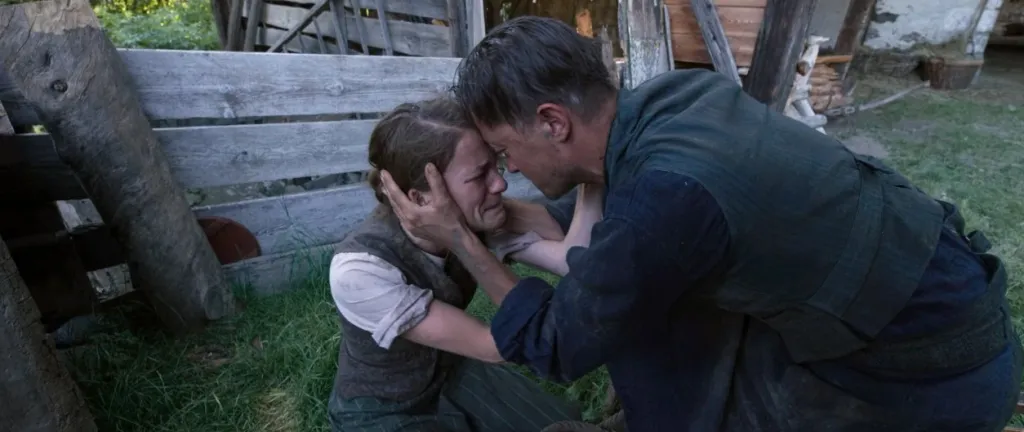
Fani’s deepest loneliness and inner collapse occur after her final prison visit. Having left the cold stone walls behind, her suppressed grief and rage suddenly erupt in nature. She falls to the ground in the field, claws at the soil with her hands, kicks at fences, and her body trembles with restless agitation. Malick’s fluid camera follows her relentlessly—not from a safe distance, but pressed close to her suffering body, as if the image itself were participating in her mourning.
This moment stands in stark contrast to the contemplative stillness of the prison scenes. If Franz internalizes suffering through silence and prayer, Fani experiences it physically and explosively. Yet her anger never becomes a curse; instead, it becomes a prayer: “God, give him courage and strength.” Thus, even at the height of her breakdown, the horizon of faith remains intact.
Malick presents this scene not merely as an emotional outburst but as a transcendental moment in which earth, body, and prayer merge together, transforming earthly suffering into a longing for a power beyond the human.
A Hidden Life can also be fruitfully understood through Paul Schrader’s theory of “transcendental style.” In his book Transcendental Style in Film, Schrader identifies three stages: the everyday, disparity, and stasis. In A Hidden Life, the first stage is established through the detailed depiction of rural life and daily labor—a world that is ordinary, repetitive, and unpretentious. Disparity emerges with Franz’s military summons and subsequent arrest, rupturing the established order of everyday life.
Most significant, however, is the stage of stasis—the transcendental moment itself. This appears in the silences of the prison cell, Franz’s composure during interrogation, his long pauses, and the sustained shots in which action is reduced to a minimum. According to Schrader, such moments create a space for the experience of transcendence, where drama subsides and the viewer confronts an emptiness that can become a site of spiritual reflection.
The spiritual and theological concerns that animate A Hidden Life clearly continue those explored in The Tree of Life. Franz becomes a Christ-like figure for the modern age. His body, like the suffering body of Christ on the way to crucifixion, passes through successive stages—from home and farm to detention center, prison cell, and finally the execution platform.
The repetitions of everyday life—journeys between village and mountain, plowing fields, harvesting wheat, children at play, and the tender gestures shared by Franz and Fani—serve as a prelude to the film’s Passion narrative, which reaches its culmination in the second half. Through this structure, Malick demonstrates that suffering and martyrdom do not descend suddenly from heaven but emerge from the very ordinary and hidden rural life that has already been infused with grace.
Theologically, A Hidden Life is not a simplistic sermon about a “good martyr” confronting “evil Nazis.” Malick repeatedly shows both Franz and Fani wrestling with temptation and doubt. We see Franz ringing the church bell before standing alone on a hill, staring into the forest. We hear Fani praying in the darkness of the barn while simultaneously asking God: “Why do you do nothing? Where are you? Why did you create us?”
These moments point toward one of the film’s central concerns: the apparent absence of God in a world where He seems silent. Franz calls upon God for light and guidance, yet encounters only the silence of heaven. A fellow prisoner claims that God has abandoned humanity. Fani asks why humanity was created. A prison interrogator speaks of the universality of evil.
Malick’s answer lies neither in miracles nor in divine intervention, but in endurance and resistance. Franz does not change the world. Yet through his refusal to sign the oath, his willingness to endure torture, and his acceptance of execution, he transforms the meaning of his own existence.
In a world where water continues to flow and the mill wheel continues to turn, this silent refusal becomes a sign of the possibility of redemption—a redemption grounded in fidelity to conscience, moral responsibility, and the search for light.
Throughout the film, Malick marshals every conceivable argument against Franz’s steadfast resistance to evil through the voices of priests, military judges, villagers, and even Franz’s friends: “It’s only a signature; think whatever you want in your heart,” “Think of your wife and children,” “Your heroics won’t change anything.” Yet the work of Malick’s camera, mise-en-scène, and editing reveals that, for Franz, the issue is far more than a political stance; it is an existential and theological matter. He cannot lie, even if the entire world presses him to do so. Malick’s vision of the world and of human life is rooted in a form of Christian existentialism. An “authentic life” is not found in conformity with the collective, but in fidelity to a truth discovered within oneself, in the depths of one’s conscience. Redemption, if it has any meaning at all, lies precisely in that fidelity. From this perspective, however, some critics have accused Malick of romanticizing suffering and martyrdom, arguing that transforming the story of an anti-fascist resister into a theological parable risks obscuring the political complexities of fascism and resistance.
In prison, Franz asks God for light: “O Lord, You are our light; grant us Your eternal light, O Lord, my shepherd.” Elsewhere he calls upon God: “Give me the strength to follow You. Guide me. Show me the way.” These passages turn faith into something profoundly inward. Faith here is not serene certainty, but a longing for guidance amid darkness. His cellmate tells him, “Your God abandoned us.” The remark exposes a fracture within the experience of faith, a fracture that Malick does not conceal. Faith in the film is always in tension with the feeling of abandonment. This crisis of faith is not confined to the prison. In her solitude, Fani also addresses God: “Why did You create us?” Her voice is heard over images of her exhausting labor on the farm; she must plough alone, harvest the wheat, thresh the grain, and carry the burden of life on her shoulders. The fluid camera follows her through the fields and among the villagers. Fani’s physical labor is not merely a sign of endurance but the embodiment of her participation in Franz’s moral suffering.
Malick’s theological approach might be described as a “theology of grace.” It is deeply Christian, yet it places its trust not in the Church or institutional religion but in conscience, nature, and the direct relationship between human beings and God. In A Hidden Life, authentic faith resides with Franz and Fani, not with priests or ecclesiastical structures. Malick suggests that religious institutions and the Church are often governed by expediency, fear, and the preservation of the existing order, whereas Franz, like Joan of Arc, follows an inner calling that stands against both the Church’s advice and the opinion of a spiritually compromised majority. This shift moves Malick’s theology away from institutional Christianity toward a more existential and transcendental form of faith.
At the same time, Malick never abandons Christianity. On the contrary, he critiques fascism and the official religion that collaborates with it from within Christianity’s own moral framework. The way of the Cross, fidelity to truth, the prioritization of conscience over worldly salvation, and resistance to evil remain central. The saint in this cinematic universe is an anonymous peasant who, without any institutional support, chooses the path of Christ and, like Him, embraces martyrdom.
Malick believes in God, grace, redemption, and the afterlife, yet he suggests that in an age of fascism and religion aligned with power, divine truth manifests itself more clearly on the margins and in hidden lives than at the official center of religion. The village priest remains passive before political authority, and the Church, through its silence and accommodation, effectively stands alongside fascism. Against this structure stands Franz’s personal faith, supported neither by the state nor by the Church.
Although Malick does not portray the Church and its priests as simplistic accomplices of fascism, he nevertheless depicts the historical complicity of parts of the Church with the fascist order with remarkable candor and subjects it to moral scrutiny, while maintaining a profound respect for Christian faith and the possibility of individual sainthood. The village priest, early in the film, during his conversations and confessions with Franz, embodies this very ambivalence. On the one hand, he listens to Franz’s concerns and takes them seriously; on the other, he urges him to cooperate with the system and avoid risking his life. In effect, he speaks from the position of preserving the existing order rather than remaining faithful to the truth.
In a close-up shot within the darkness of the church, the priest asks Franz: “Do you think what you are doing is better than what others are doing?” The film shows that he cannot transcend the framework of collective obedience and pragmatism. This is the language of the dominant institution, a churchly language aligned with the state that translates individual conscience into “humility” before power. Yet Malick never reduces him to a caricature. The priest is a frightened man under pressure, dimly aware of evil but lacking the courage to confront it. The film’s attitude toward him is more critical-tragic than accusatory. He represents a form of clergy that understands truth and goodness in theological terms but sides with evil in practice.
For this reason, when the priest disappears from the narrative and Franz is left alone in the hands of the judicial and military apparatus, it is as if Malick is emphasizing the silence of the Church as a structural sin. The Church becomes the great absence on Franz’s path toward execution.
In prison, however, we encounter another priest who urges the prisoners to “sign” and save themselves. He functions more as an agent of order than as a spiritual shepherd. His presence constitutes an even sharper critique of the Church’s complicity with fascism, showing how religion can become an instrument for soothing consciences and justifying surrender to evil. Yet the film again complicates this figure beyond that of a mere servant of the regime. He genuinely believes that saving Franz’s life would be an act of goodness. For Malick, the problem is less one of personal corruption than of theological blindness: an inability to recognize that faith is sometimes realized precisely through the refusal of apparent salvation.
Thus, Malick’s attitude toward priests and the Church operates on two levels. On the historical and institutional level, the film sharply criticizes the Church’s structural complicity with fascism and its silence before individual conscience. On the theological level, however, Malick entrusts Christian faith to Franz and Fani rather than to ecclesiastical institutions. The saint in this film emerges from the farm and the prison, not from the altar or the hierarchy of the Church.
In other words, A Hidden Life is not anti-Church, but it is opposed to every form of fearful, expedient religion. The priest in the film is less an enemy than a troubling mirror reflecting the central question the film poses: when historical evil arrives, where does faith lead you—to stand with power, or to stand with the solitary voice of conscience?
On a theological horizon, there exists a profound spiritual and transcendental affinity between Robert Bresson and Terrence Malick, even though their theological roots—French Jansenism in the case of Bresson and German/American Catholicism in the case of Malick—and their modes of expression are quite different. In Malick’s transcendental approach, his understanding of grace and human redemption comes strikingly close to the Bressonian tradition. In Bresson’s world, especially in Au Hasard Balthazar and Diary of a Country Priest, redemption is achieved not through outward victory but through the endurance of suffering and a silent fidelity to truth. In A Hidden Life, Franz similarly chooses a path that leads to historical defeat by refusing to sign the oath and by resisting evil; yet within the film’s spiritual logic, this apparent defeat becomes a form of inner liberation.
The formal signs of this affinity are equally significant. The donkey that works alongside Fani on the farm, silently bearing burdens and suffering without complaint, recalls Balthazar—an animal whose innocent presence and transcendental death stand in stark contrast to the violence of the human world. The recurring close-ups of hands—hands pressing into the soil, caressing stalks of wheat, or separating in the moment of Franz’s arrest and parting from Fani—evoke Bresson’s well-known motif of hands. Malick’s emphasis on animals, nature, and Fani’s arduous labor creates a vision of redemption grounded not in miracle but in the endurance of suffering and the perseverance of faith. The moments of stillness in prison, Franz’s prayers for light and guidance, and his prolonged silences during interrogations and beatings all contribute to a transcendental quality in which suffering becomes a possibility for meaning.
Both Bresson and Malick believe in grace and redemption, yet Bresson expresses this faith through austerity, silence, and absence, whereas Malick seeks it through nature, love, and faith. Both filmmakers locate redemption not in external triumph but in the midst of defeat, humiliation, and death. In Diary of a Country Priest and A Man Escaped, grace emerges precisely at the point of exhaustion and collapse; in A Hidden Life, the execution of Franz and the suffering of Fani become the very sites where grace manifests itself, rather than any moment in which the world vindicates them. Both directors are suspicious of historical “success.” Redemption belongs to a realm that cannot be measured by worldly calculations.
Likewise, both seek God beyond institutional religion and within the heart of the solitary individual. Bresson, shaped by a Jansenist sensibility, is deeply skeptical of the Church as an institution and of all outward and performative forms of religiosity. Authentic faith, for him, is hidden, interior, and often silent. Malick adopts a similar position in A Hidden Life (and to some extent in The Tree of Life). Living faith belongs to Franz, Fani, and their children, not to priests or religious institutions. Like Bresson, Malick uses the language of cinema to suggest that God often dwells outside institutions, in the margins of everyday life and among ordinary people.
Both filmmakers take individual conscience seriously, but they situate it within the horizon of grace rather than within the limits of secular ethics. Bresson’s protagonists are typically isolated individuals left alone against social structures—prisons, class systems, families, or wars—and their path toward redemption is forged through that solitude. Malick follows a similar pattern in A Hidden Life. Franz stands alone against the machinery of fascism and against a community incapable of understanding him. His solitude is not merely psychological; it is theological and sacred.
Yet Malick also departs from the Bressonian model in important ways. Bresson is more radical in stripping away ritual and external emotion, reducing them to a minimum, whereas Malick continues to work through nature, music, visual beauty, and emotional expression. If Bresson moves toward formal asceticism by eliminating overt emotion, Malick achieves an intensely sensory and overflowing experience through fluid camera movements, choral music, and poetic voice-over narration. In the scene of Franz and Fani’s farewell at the train station, the ecclesiastical choral music transforms their separation into a sacred ritual. The moment is tragic, yet it possesses a transcendental quality, as if suffering itself has been elevated to another plane. The train functions throughout the film as a dual motif: both a metaphor for inevitable fate and death, and a sign of an inward journey into the heart of a collective nightmare.
In Bresson, formal austerity—non-professional performers, the absence of emotional music, abrupt cuts, and formal minimalism—constitutes a kind of cinematic asceticism that corresponds to his Jansenist themes of poverty, fallenness, and grace. In Malick, by contrast, formal maximalism—natural light, fluid camera movement, associative montage, abundant music, and the beauty of landscapes and natural vistas—points toward a theology of pervasive grace. God is present everywhere: in the wind, the soil, the wheat, the body, and labor itself. Yet in both filmmakers, form ultimately serves grace. Bresson empties the world in order to make room for grace; Malick fills the world with signs so that everything becomes potentially infused with grace.
Bresson’s Jansenism is severe and pessimistic, understanding grace as rare, difficult to attain, and fundamentally tragic. Many of his characters collapse beneath the weight of sin and necessity, even if grace touches them for a fleeting moment. Malick, despite the darkness of A Hidden Life, remains more hopeful. His emphasis on the lush mountain landscapes, the vitality of nature, children, and light suggests that grace flows through a wider field than a single tragic instant.
In this sense, A Hidden Life may be regarded as one of the most concentrated expressions of Malick’s cinematic and philosophical concerns: a defense of individuality and independence against conformity, an exploration of the possibility of faith in a world contaminated by evil, and an affirmation of nature as a horizon of transcendence. With its visual grandeur, its juxtaposition of the verdant Alpine landscape and the darkness of prison cells, the film reaffirms a central conviction: that redemption, if it exists at all, is found not in the visible peaks of history but in the silent decisions and unseen sufferings of ordinary human beings.