



From the Communist Streets of Bucharest to the Free Fjords of Ålesund
A Look at 4 Months, 3 Weeks and 2 Days on the Occasion of Romanian Director Cristian Mungiu Winning the Palme d’Or Again in 2026
The Palme d’Or at the 79th Cannes Film Festival was awarded to Fjord, the latest film by Romanian director Cristian Mungiu. Mungiu, who had previously won his first Palme d’Or in 2007 with 4 Months, 3 Weeks and 2 Days, not only secured the highest prize at Cannes but also shook audiences around the world. It was a world that had rarely seen life under Nicolae Ceaușescu’s communist dictatorship through the eyes of a young woman seeking an abortion.
When I heard the news, I was instantly transported back to that year—the year when watching 4 Months, 3 Weeks and 2 Days became one of the most significant cinematic experiences of my life.
Those deserted streets, dimly lit old houses, battered cars, peeling walls, and worn-out sofas still in use were only a small part of the terrifying reality that the young Romanian filmmaker was thrusting in the faces of viewers who did not yet understand that life in such a society was not merely defined by shortages, weak lighting, crumbling buildings, and impoverished citizens. It was life in a country where those in power considered themselves rulers not only of people’s actions, but also of their thoughts, language, and bodies.
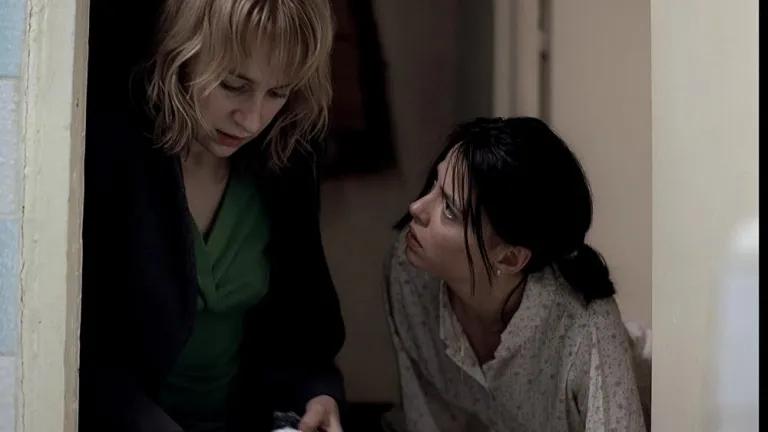
4 Months, 3 Weeks and 2 Days tells the story of two young female university students during the final years of communist Romania in the 1980s. One of them has become unintentionally pregnant and wants to terminate the pregnancy. At the time, however, abortion was illegal in Romania, and anyone involved—both the woman and the person performing the procedure—faced severe penalties, including lengthy prison sentences.
The film’s central character is Otilia, a quiet, responsible young woman willing to take risks. Her friend Găbița is pregnant and overwhelmed by fear, struggling to find a way out of her situation. The film follows only a single day in the lives of these two young women—a day of extraordinary tension and crisis.
Otilia must find money, arrange a meeting with the man who performs illegal abortions, and secure a hotel room where the procedure can take place in secret. Throughout the film she is constantly running—from one side of the city to the other—hailing taxis, boarding trams, climbing staircases, and even attending a family gathering with her boyfriend’s relatives.
The viewer follows her desperate efforts with mounting anxiety. What will happen if their secret is discovered? What if the police catch them? What if the man performing the abortion is incompetent? What if the hotel staff become suspicious? What if Găbița begins to hemorrhage? What if they are forced to go to a hospital? What if her beautiful young friend dies as a result of an unsafe and illegal procedure?
Otilia is haunted by questions for which there are no clear answers. So is the audience.
Mr. Bebe, whose qualifications remain ambiguous throughout the film, arrives at the hotel. It is never entirely clear whether he is a trained doctor or merely someone who has learned the trade because it is profitable. The sheets are changed. He examines Găbița and discovers that the fetus is more than four months old, making the procedure significantly more dangerous and potentially fatal.
Furious, he accuses the girls of deceiving him. Otilia herself had not known the pregnancy was that advanced. Bebe immediately transforms into a miniature dictator, threatening and humiliating the two young women. The psychological pressure on both them and the audience becomes almost unbearable.
Eventually, he lays out his instruments and proceeds with the abortion. Every tool placed on the table intensifies the horror of the situation. One of the most devastating scenes—one that remains etched in my memory nearly two decades later—is the sequence in which Otilia must dispose of the fetus, now fully formed and unmistakably resembling a newborn child, in order to avoid detection. She runs through dark streets searching for a garbage bin where it is least likely to be discovered.
In that sequence we descend the hotel’s staircases alongside the young Otilia, rushing through the back exit in a state of near-panic, wandering dark alleyways in search of a place to hide the evidence, our hearts racing with the same terror of being caught by the police. Yet the film’s final scene moves away from tension and suspense, becoming quiet and still—and equally bleak.
The two young women sit silently in a restaurant across from the very hotel where the abortion took place. Hunger and exhaustion weigh heavily on them. Only a single sentence is exchanged: “We must never speak of this again.”
The film is cold, dimly lit, and completely devoid of romantic embellishment. It contains almost no music. No one breaks down in tears. The characters remain largely silent, while the spaces they inhabit seem covered in a haze of stagnation and abandonment.
Everything feels utterly real. It depicts a reality that may feel strangely familiar to many Iranian viewers: life under the shadow of a cruel dictatorship concerned with nothing except its own survival.
What makes the film so powerful is that it demonstrates how a political system can transform even the most intimate aspects of human life into a nightmare. It is not merely a film about an illegal abortion. It is a film about what it means to live under a totalitarian regime, to exist in a permanent state of fear—fear of arrest, fear of imprisonment, fear of death.
It is about how a government can use its power to regulate bodies, thoughts, and language. It is about the profound loneliness of ordinary people, especially women, and about legal systems that often operate against them rather than for them. These are experiences that many Iranian viewers have not merely observed but have lived through firsthand. The exhaustion and suffocation imposed by authoritarian power strip people of their citizenship and reduce them to hostages in a prison the size of an entire country.
Cristian Mungiu is a filmmaker with a distinctive cinematic language: static camera setups, extended long takes, natural lighting, restrained and understated performances, and an extensive use of silence. That silence makes cinematic time feel almost more real than reality itself, allowing the audience to experience tension, crisis, and suffocation with extraordinary immediacy.
For the first time in his career, Mungiu has made his latest film in English. Its leading actors are Norwegian and Romanian-American. In Fjord, he turns his attention to a deeply religious Romanian family who migrate to a small village in Norway—a place where the legal and social order differs dramatically from the values and worldview they bring with them.
A fjord, of course, is a deep inlet of water between steep mountains, a landscape found throughout Norway. Now fifty-eight years old, Cristian Mungiu joins the distinguished group of filmmakers who have won the Palme d’Or twice during their careers—a group that includes Michael Haneke, Francis Ford Coppola, Emir Kusturica, Bille August, and Shōhei Imamura.
From the dark, claustrophobic streets of communist Bucharest to the vast open landscapes of Norway’s fjords, Mungiu’s cinema continues to explore what happens when individuals find themselves trapped between private conscience and public authority. If 4 Months, 3 Weeks and 2 Days exposed the violence of a state that sought control over women’s bodies, Fjord appears to ask a different but equally urgent question: what becomes of belief, identity, and freedom when people carry the certainties of one world into the freedoms of another?