



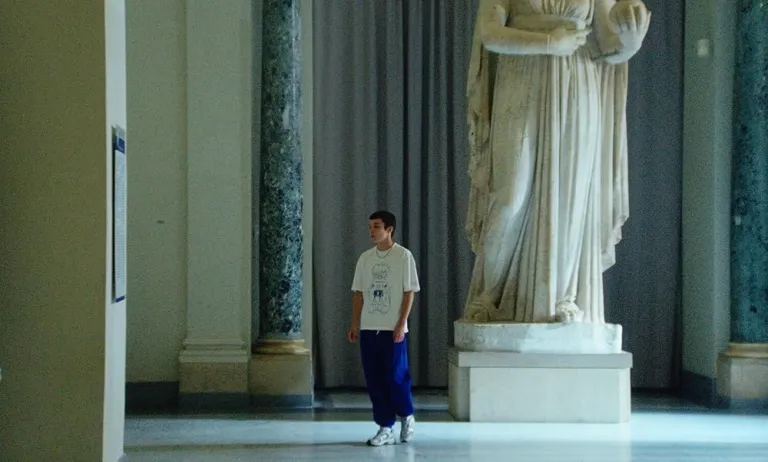
Before stepping into the role of director, Marine Atlan spent years as a cinematographer demonstrating her preoccupation with capturing the texture of light, the reflections of surfaces, and the materiality of the image. Her gaze has always been attuned to the tactile qualities of the optical world, an approach that also leaves its mark on the painterly frames and visual textures of her first film. In La Gradiva, Atlan does more than tell a story about a group of teenagers on an educational trip. She uses her camera as a surgical instrument for probing the psyche and excavating the unconscious. The film’s title draws directly on the history of art and literature: Gradiva (“the woman who walks forward”), a celebrated relief from ancient Rome and the title of Wilhelm Jensen’s 1903 novella. Sigmund Freud famously used Jensen’s text in his essay Delusions and Dreams in Jensen’s Gradiva to explore sexual repression, unconscious desire, and the concept of fantasy. The figure later became an inspiring icon for the Surrealists, from André Breton to Salvador Dalí. Atlan revives this historical archetype to show how the ghosts of the past and the fossils of repressed desire awaken once again within the bodies of adolescents on the threshold of puberty.
At its first level, the film is an unmistakable homage to cinematic modernism, particularly Roberto Rossellini’s Journey to Italy. In Rossellini’s masterpiece, a bourgeois couple in crisis confronts the existential nakedness of death and being when faced with the plaster casts of lovers locked in an embrace at Pompeii. Atlan’s teenagers arrive at a similarly shattering realization during the film’s remarkable museum sequence and their walks through the ruins of Pompeii. Their encounter with the statues and plaster casts of bodies frozen beneath the hot ash of Mount Vesuvius is, in effect, an encounter with the material permanence of trauma: a moment when chronological time breaks down and the buried past connects directly with the corporeal present. This journey through the ruins becomes a passage through art history via the unconscious, where two opposing deities from ancient mythology are summoned: Dionysus, god of intoxication, bodily chaos, ecstasy, and the eruption of primal instincts, and Fascinus, the apotropaic embodiment of masculine potency, fertility iconography, and the power of the gaze. In ancient Roman literature and culture, Fascinus served to ward off the evil eye and contain the terror of impotence. The film frames the hormonal tensions and inchoate desires of adolescence within this very divide between Dionysian Eros and the castration anxiety emanating from the Fascinian gaze.
The film’s psychoanalytic approach finds its fullest expression in its phenomenological exploration of the body, sexuality, and the crisis of identity. For Atlan, puberty is not a smooth, biological transition but an earthquake in the geological strata of the psyche: a fracturing of the plates of identity and an inundation by repressed desires. Two faces embody the visual and psychological poles of this excavation: James and Susan. James’s face combines vulnerability, unrestrained longing, and the raw violence of youth. His facial features seem to undergo minute muscular spasms beneath the pressure of awakening sexual desire and his inability to articulate it in words. Susan’s face, by contrast, embodies an enigmatic gaze and the continual redefinition of female agency. Her gaze resists objectification, asserts a search for bodily autonomy, and silently exposes the fragility of the boys around her. The dialectic between these two faces is not a romantic coming-of-age drama but a struggle between the anxiety of desire, the fear of rejection, and the recovery of sexual identity on the threshold of entry into the symbolic order.
Yet this psychoanalytic exploration does not unfold in a vacuum. Alongside her archaeology of desire, Atlan dissects French educational politics and class relations, undertaking an angry genealogy that directly invokes Pierre Bourdieu’s theories of the reproduction of social structures and “symbolic violence.” In the film, the school and its educational trip function as instruments of the very order designed to tame instinct and reproduce class distinctions. The political and ideological fault lines of contemporary France—from the frozen arrogance of the bourgeois elite to the exclusion and pent-up rage of the working class—surface in the relationships between the students and their everyday verbal exchanges.
This class critique reaches its tragic culmination in Tony’s storyline and family history. The city is a geography of earthquakes and volcanic eruptions, a land standing atop the forgotten lava flows of history. With a tone steeped in prejudice and pride, Tony speaks of his roots in this soil and recounts the mythic love story of his grandparents in this land. This romanticized narrative grants him a sense of authentic identity among his contemptuous classmates.
But historical truth, like the eruption of Vesuvius, turns this comforting illusion into a heap of ashes. Tony discovers that the ancestors he had revered were not the wronged, earthbound innocents he had imagined, but landowners whose hands were stained with the blood of the lower classes and the exploitation of the dispossessed. The collapse of this family narrative is accompanied by the group’s indifference to and rejection of Tony’s manuscripts and notes. This becomes a symbol of how the histories of the oppressed—and even the confessions of the defeated—are dismissed as worthless writing and trampled underfoot by an impersonal, bureaucratic educational system devoid of feeling.
Amid these sexual and class anxieties stands the teacher, an utterly exhausted, defeated, and fragile figure. He is not an enlightened guide but a metaphor for the very plaster casts of Pompeii: a rigid statue of a collapsed order and the chronic exhaustion of the educational institution. In the teacher’s lifeless eyes and heavy movements, we see the erosion of those charged with transmitting cultural heritage to a generation that no longer places any faith in institutional wisdom. He sits in the shadow of Pompeii’s cracked walls, powerless to contain the Dionysus awakening in his students’ veins.
Marine Atlan’s command of cinematography frees the film from the constraints of conventional realist imagery, transforming it into a tactile experience. Its images possess a dense, celluloid-like quality, reminiscent of the grainy texture of analog photographs, as though each frame had been inscribed on a surface sensitive to light and time, evoking the sensation of leafing through archaeological albums. Her obsessive use of extreme close-ups is a key formal device. Rather than recording postcard-perfect tourist vistas of Italy, the camera lingers millimeters away from breathing, beads of sweat on a neck, grooves in the plaster of statues, trembling lips, and skin touching porous stone. These radical close-ups destroy the emotional distance between screen and spectator, drawing viewers into the teenagers’ sensory and tactile world, where the weight of the past and the eruption of the body become dense, visible matter on the surface of the image.
[Spoilers]
Tony’s collapse is not confined to the destruction of his ancestral myth; its roots are also entangled with his mother’s painful, deteriorating condition at home. Afflicted, marginalized, and submerged in illness and exhaustion, she casts a psychological weight over Tony through her absence. These dense familial and class-related conflicts eventually drive him toward a catastrophic and tragic end, delivering a devastating blow to the structure of the drama. Yet the reactions of those around him, particularly his classmates, expose the cruelty of the bourgeoisie at its most extreme, along with the defense mechanisms of the collective unconscious. They respond to his death with frozen indifference, sadistic denial, and an eagerness to erase all traces of the catastrophe as quickly as possible—as though Tony were merely another pile of ash among the ancient ruins, to be swept away before the privileged classes’ carefree holiday could be disturbed. This final, horrifying act of exclusion delivers the coup de grâce to the illusion of social solidarity within the educational system.
[End of spoilers]
La Gradiva demonstrates that history persists not in museums and buried archives, but on the surface of human skin, in the trembling of uncertain gazes, and in the ashes of traumas that never truly go cold. By bringing Freudian psychoanalysis into dialogue with a sharp sociological critique, and by weaving mythological violence together with the institutional crises of modern education, Marine Atlan shows that adolescence is itself the inevitable earthquake that exposes the accumulated fossils of history. The woman who walks forward may herself be a spirit risen from the ruins of Pompeii, come to lay bare the fragility of the contemporary world.
© 2026. Phoenix Review