



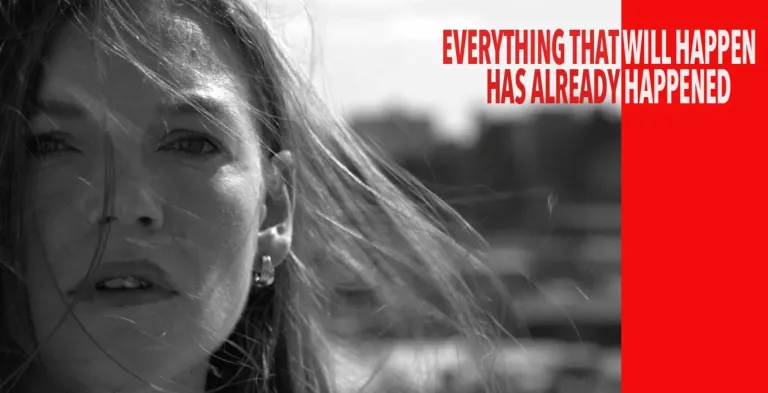
In Everything That Will Happen Has Already Happened (2024), Serbian-American filmmaker Vladan Nikolić has created a semi-experimental, avant-garde work that, through a collage of short stories, paints a picture of the post-pandemic world, the crises of capitalism, and the death of cinema. Employing a metacinematic language and a fragmented narrative, the film invites the viewer to reflect on the condition of contemporary humanity. Nikolić, a Serbian-American filmmaker and writer, is known for his innovations in digital cinema and multimedia storytelling. He is a professor of film and media at The New School in New York and is considered one of the pioneers of digital filmmaking in the 1990s. His films Love (2005) and Zenith (2010) are among his notable contributions to avant-garde cinema.
Everything That Will Happen Has Already Happened has a central narrative into which a series of subplots are woven. The main story revolves around a Ukrainian-born woman named Alice, who travels to New York to complete her doctoral dissertation and stays at a friend’s apartment. When the internet goes down, she heads to the rooftop, where she encounters a young man standing on the edge as if he is about to commit suicide. The young man, however, claims that he has no intention of killing himself and that he does this simply to feel alive.
Throughout the film, Alice and the young New Yorker engage in intellectual and philosophical discussions about current events and the political, economic, environmental, and military crises unfolding around the world. Gradually, a romantic relationship develops between them. The young New Yorker introduces himself by a different name each time and never reveals his true identity by the end of the film. He becomes a symbol of the fluid identity of the human being in the digital age—identities that are constructed and consumed on social media.
The main narrative is interrupted by fragmented subplots that are, in fact, segments from short films Alice has made for her doctoral dissertation. Each of these films has been directed by filmmakers from Lebanon, Belgium, Venezuela, Ukraine, and Pakistan. These shorts examine social upheavals, intertwining personal and global challenges while addressing themes of injustice, identity crisis, and the human experience in the post-pandemic world.
Everything That Will Happen Has Already Happened is a film that boldly critiques the state of the contemporary world. Drawing inspiration from the DIY (Do It Yourself) ethos and collaborating with a number of young filmmakers from different countries, Nikolić has created a film that, although narratively fragmented and incomplete, is visually and conceptually thought-provoking and powerful. The film is a striking example of self-reflexive cinema in the post-pandemic era. Through metacinematic devices, it not only speaks about cinema but also employs cinema as a tool for critiquing capitalism and the crisis of contemporary human identity. This avant-garde work, conscious of the “death of cinema” and the dominance of digital culture, uses the language of metacinema to challenge this condition.
The film opens with images from The Great Train Robbery (1903), beginning with the famous shot of a cowboy firing directly at the camera. This opening is both a tribute to the history of cinema and a metacinematic warning. Here, the camera is not merely a storytelling device but a weapon aimed at the viewer. The film then cuts to images from the silent films of Buster Keaton and Harold Lloyd, and especially Dziga Vertov’s Man with a Movie Camera (1929). These images create a chain of references that redefine cinema as “Kino-Eye” (Kino-glaz). In Vertov’s theory of “Kino-Eye,” the camera is an extension of the human eye and a means of reaching “cinematic truth” (Kino-Pravda). These references are not merely tributes to the pioneers of cinema; they also serve as a warning about the current state of cinema, which stands in stark contrast to that earlier golden age. By revisiting these images, Nikolić establishes a clear contradiction: while silent cinema, with its faith in the power of the image, sought truth, contemporary cinema is drowning in an overwhelming flood of digital images and social media and has become incapable of seeing. In the film, Nikolić explicitly critiques the capitalist system and its impact on culture and cinema. In one of the key lines of dialogue, Alice admits, “Cinema is dead… Kids today don’t care about cinema anymore.” The statement becomes a lament for the end of cinema’s golden age. The younger generation is interested only in sitcoms and social-media content—the kind of content capitalism throws in their direction. It is a lament for the death of art cinema and its replacement by a popular culture that is superficial and vulgar.
The scene in which Alice and the young New Yorker stand on the rooftop looking down recalls similar shots in classic New York films, often accompanied by a sense of longing and despair. The story of the bat that the young New Yorker tells Alice—a creature belonging neither to the sky nor to the earth, wandering through the night—is likewise a metaphor for the condition of contemporary humanity and independent cinema today: a wandering cinema that belongs neither to Hollywood nor to European art cinema. Aerial shots of New York, and the contrast between skyscrapers and abandoned rooftops, also point to the social contradictions of the American capitalist system. Alice and the young New Yorker’s conversations about capitalism, surveillance cameras, monitoring and control, inequality, war, refugees, and terrorism, juxtaposed with images of destroyed buildings in Ukraine, redefine cinema as a tool for political consciousness-raising.
Alice tells the young New Yorker that her dissertation is about the contemporary world: millions of people have died from COVID-19, and millions more are still ill. “Climate change, air pollution, plastic in our bodies—and we just keep going as if nothing happened.”
Yet the film simultaneously acknowledges the limitations of this emancipatory struggle. Alice tells the story of a woman named Cathy Change, a performance artist, writer, and political activist who fought against capitalism and eventually set herself on fire in front of Peace Plaza. From Alice’s perspective, Cathy represents the failure of politically committed and activist art in the age of capitalism. Her message against war and violence is sent to the media, but no one pays attention. Alice says, “We are suffering from a crisis of cognition, and we can’t change anything, just as Cathy Change couldn’t.”
Nikolić’s film rejects a linear, classical narrative structure and instead adopts an experimental, modernist form, repeatedly cutting to scenes from a silent film or one of the short films. The structure recalls the modernist cinema of the 1960s and 1970s, particularly the work of Jean-Luc Godard, in which narrative was often sacrificed in favor of form. But this structure is not merely aesthetic; it also constitutes a political and economic critique of globalization and inequality under capitalism. In one of Alice’s short films, we see a man who, every morning before going to work, gives his father his medication and prepares his breakfast. He is in contact with a woman who tells him that she loves him but cannot come to see him because she has to care for her sick sister. The man asks the woman about a film she watched the night before. She says it was an American comedy. The man replies, “I don’t like American movies because they show things we don’t have.” The woman then asks him for money to have her sister hospitalized. Unable to send her the money, and faced with her repeated insistence, the man is eventually forced to block her. This narrative stands in contrast to Alice’s intellectualized narrative in New York.
The visual device of presenting the main narrative—Alice and the young New Yorker—in black and white, while showing the short films in color, is not merely an aesthetic contrast but also a metacinematic signifier. Black and white evokes European modernist and intellectual cinema, while color becomes a symbol of popular Hollywood cinema. This opposition reflects the crisis of the cinematographic apparatus in the digital age.
Everything That Will Happen Has Already Happened is a film about cinema—a cinema that has taken shape within a crisis and, at the same time, reflects that crisis.
© 2026. Phoenix Review