



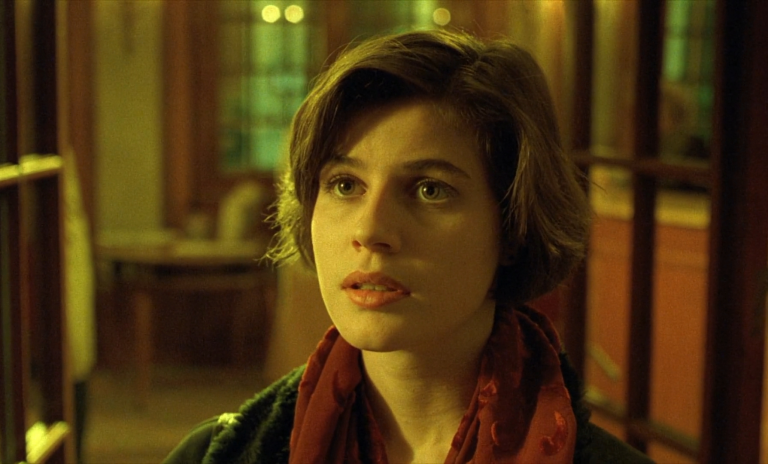
Krzysztof Kieślowski, the celebrated Polish filmmaker, once remarked that The Double Life of Véronique is not simply a film about two women who look so remarkably alike that they resemble identical twins. Rather, it is about humanity’s capacity for intuition—for arriving at a form of knowledge before reason can explain it. It is about that mysterious moment when a person suddenly feels connected, through pure intuition and emotion, to another place or another human being, and the conviction that such an experience is both genuine and possible. His film affirms precisely this idea.
Released in 1991, The Double Life of Véronique celebrates the thirty-fifth anniversary of its creation this year. It tells the story of two young women, Weronika and Véronique, who are physically indistinguishable from one another. They share the same height, the same face, the same build, and even a similar style of dress. Weronika lives in Kraków, Poland, while Véronique resides in Clermont-Ferrand, France.
The film begins with Weronika holding a small crystal sphere in her hands, observing the world through its curved surface. The image suggests that the external world is little more than an endless repetition of houses, streets, and lives—each destined to appear and eventually disappear. It is through this glass sphere that we first encounter Weronika: a beautiful young woman whose existence revolves entirely around music and singing. She suffers from a heart condition, yet possesses a remarkable gift. She is capable of listening to her inner voice. Her ear has been trained not only to extraordinary musical sensitivity but also to perceive something beyond the visible world, establishing an almost mystical connection with the unseen.
Early in the film, shortly after making love to her boyfriend, Weronika quietly says, “I feel I’m not alone.” Without knowing that another young woman in France shares her appearance, her passion for music, and her gift for singing, she somehow senses her presence.
Later, when a bus carrying French tourists is forced to leave Kraków’s central square because of clashes between security forces and demonstrators, Weronika notices Véronique photographing the unrest with her camera. She is stunned by the uncanny resemblance. At the same moment, Véronique unknowingly appears in one of Weronika’s photographs, preserved forever within its negative. When the photographs are later developed, Véronique herself becomes aware of the existence of her mysterious double. At precisely that moment, burdened by an inexplicable sorrow, she enters into an invisible, metaphysical relationship with Weronika—a woman who has already died during her very first public concert.
Kieślowski deliberately refuses to explain the precise relationship between Weronika and Véronique. Are they twins? Successive incarnations of the same soul? Two halves of a divided existence? None of these questions receives an answer. What matters is not explanation but the feeling itself. The experience of connection is more important than any logical or scientific account of its origin.
Anyone familiar with Kieślowski’s interviews and writings knows that he resisted symbolic interpretations of his films. Yet his cinema unmistakably encourages viewers to move beyond literal meaning and perceive realities that cannot be articulated through ordinary logic.
Véronique senses Weronika’s presence. She also feels the profound grief that seems to seep into her life following Weronika’s sudden death. From that point onward, Weronika becomes an invisible guide. Unlike Weronika—who ignored her physical limitations and the warnings of her own body—Véronique abandons her career as a singer and begins an intense romantic relationship with a middle-aged puppeteer. It is as though one life has transmitted its wisdom to another.
The film quietly asks: Do we truly listen to our intuition? Do we heed our fears, our inner warnings, our deepest instincts? These are questions capable of haunting anyone, regardless of profession, education, or culture—a philosopher, a teacher, a filmmaker, or even a shoemaker. As Kieślowski himself famously suggested near the end of his life, he wished he could stop making films and become a shoemaker instead—or at least imagined that such a life might have suited him.
Following Weronika’s death, Véronique experiences an overwhelming sense of loss, and it is precisely this awareness of absence that redirects her life toward a more meaningful path. In many ways, the first half of the film depicts a life coming to an end, while the second portrays another life beginning. Weronika continues through Véronique. She now speaks French, attends puppet performances, falls in love within another body, and continues living through another consciousness.
Music forms the invisible thread connecting these two intertwined existences. Throughout Kieślowski’s cinema, music occupies an indispensable role—one might almost call it a secondary protagonist. Silence, likewise, becomes equally significant. These two elements together allow the viewer’s imagination to wander freely through the film’s enchanted universe, creating space for contemplation rather than explanation. Every frame possesses a completeness that could itself become the subject of another film.
One could write endlessly about The Double Life of Véronique—its aesthetics, philosophy, political and social implications, its unique cinematic language and technical innovations. Yet beyond all these formal and thematic qualities, the film remains deeply personal for me. I have always felt an intimate connection to it, long before I spent fourteen years living in Eastern Europe.
Produced immediately after the collapse of the communist regimes across Eastern and Central Europe, the film vividly recalls the atmosphere shared by countries such as Poland and the Czech Republic. Grey apartment blocks, aging automobiles, cities drained of color, and populations weighed down by history all evoke a common post-communist sensibility.
Having lived in Prague for many years, I recognize in these images something far deeper than visual resemblance. In one sequence filmed in Kraków’s historic market square, demonstrators protesting social and economic conditions are suddenly attacked by security forces. The scene inevitably recalls the protests that once unfolded in Prague’s Old Town, where political and personal freedoms were brutally extinguished during the events now remembered as the Prague Spring.
Wenceslas Square, with its centuries-long history, shares remarkable similarities with Kraków’s medieval marketplace. The atmosphere Kieślowski creates closely resembles archival footage documenting the violent suppression of the Prague Spring in August 1968.
Later, Véronique falls in love with a writer and puppeteer who performs with traditional marionettes. Prague, of course, is famous for precisely this tradition of puppet theatre and marionette craftsmanship.
Anyone familiar with writers such as Milan Kundera, Ivan Klíma, or Václav Havel, or with the Czech New Wave cinema, will immediately recognize similar emotional landscapes in The Double Life of Véronique. It is a world where reality and dream, memory and forgetting, the individual and history become inseparably intertwined. In this sense, the film approaches Prague not geographically or historically, but through a shared cultural sensibility.
Emotionally, however, the film feels closer to certain novels by Kundera than to explicitly political accounts of the Prague Spring. Both Kieślowski and Kundera explore identity, coincidence, destiny, and the possibility of another life, though Kieślowski approaches these themes poetically and intuitively, while Kundera examines them through philosophy, history, and narrative reflection.
The unforgettable sequence in Kraków’s central square perfectly illustrates this intersection of history and metaphysics. Amid a sea of grey and black clothing, Weronika alone wears bright red. She notices Véronique hurrying toward the French tourist bus, attempting to escape the chaos unfolding around her. Walking against the movement of the crowd, Weronika suddenly realizes that Véronique has unknowingly captured her image in a photograph. At precisely that instant, the camera begins a dizzying circular movement—as though the entire world momentarily loses its balance.
The Slovenian philosopher Slavoj Žižek has argued that this movement marks the instant when two parallel universes almost intersect. They cannot truly meet, because such an encounter would collapse the internal order governing the film’s reality. For Žižek, The Double Life of Véronique is neither primarily a love story nor a supernatural tale, but a meditation on parallel lives and the choices we never experience—a theme central to his own philosophical work.
The extraordinary meeting of these two women during a political demonstration is therefore far more than a historical backdrop. It becomes the precise point where history, politics, and personal destiny briefly overlap before drifting apart once again. It is a moment of awakening, as though Weronika and Véronique are emerging from the sleep of ignorance simply to drink water and preserve, in Sohrab Sepehri’s words, “the luminous relationship between the window, the bird, and the breeze.”
Eventually, Weronika shatters the crystal sphere, allowing the artificial snow enclosed within it to fall across her face for a few fleeting seconds. That cool sensation upon her skin becomes the emotional residue the film leaves upon every viewer—a sensation that lingers long after the final frame has faded.
In its final moments, Véronique returns to her father’s house. She quietly places her hand upon the trunk of a tree and stands in silence. It is an ending that offers no answers, only deeper questions. For this is ultimately a film meant to be felt, not explained.
© 2026. Phoenix Review