



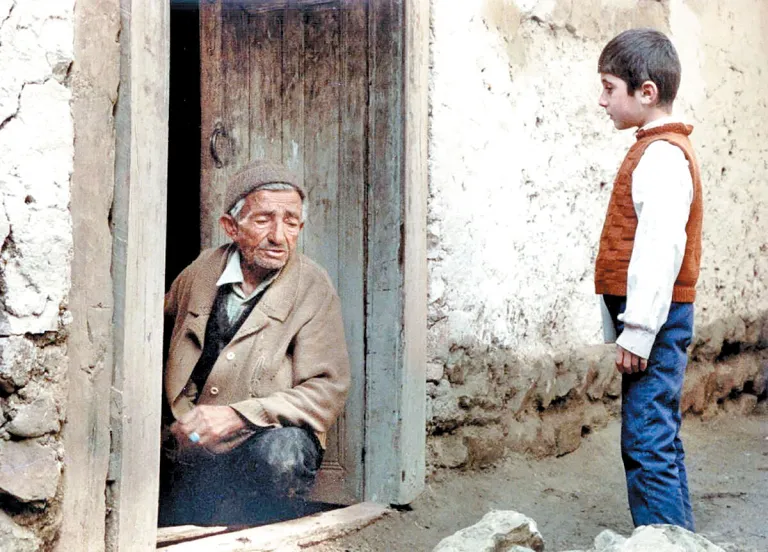
Revisiting the film through which our beloved Abbas Kiarostami first announced himself to world cinema is, on the tenth anniversary of his passing, both poignant and instructive. Forty years on, this simple, deeply humane, and profoundly philosophical film still bears the unmistakable mark of a singular artistic vision—one that countless imitators have tried to recreate by reproducing its atmosphere, dramatic structure, and point of view, yet none has truly succeeded. Even if returning to Where Is the Friend’s House? yields no entirely new revelations—it is difficult, after all, to discover an unexplored perspective on a filmmaker so extensively studied—it inevitably revives a sense of loss for one of Iran’s greatest artists. Decades after his most important works, and despite countless books, scholarly studies, and respected critical essays written about him around the world, Kiarostami continues to be rediscovered, while the path he opened still attracts devoted admirers and curious new audiences.
To speak exclusively of “cinema” when discussing someone whose vision extended far beyond any single medium seems almost inadequate. Kiarostami recognized in the smallest details of everyday life a latent potential for transcendence. Through film, photography, painting, poetry, essays, and conversation, he marked those ordinary moments with extraordinary significance. He left behind an abundance of observations, reflections, and insights on life, art in its broadest sense, and cinema in particular—ideas that function almost as companion pieces to one’s first encounter with his films. Binding them all together is an invisible thread: Kiarostami’s worldview. Again and again, he seeks to open a previously unseen perspective for the viewer.
His own playful claim that Where Is the Friend’s House? made many people his enemies was, characteristically, another of his deliberate misdirections—and perhaps wisely so. Artists are under no obligation to explain their own work. Kiarostami’s wit should never distract us from the extraordinary precision with which he constructs both narrative parallels—from the opening scene to the ending, even in the rhythm of Ahmad’s increasingly desperate search for his friend’s home—and visual motifs, above all that now-iconic winding hillside path.
The film’s stripped-down narrative—a young boy travels to his friend’s village in search of his house, going from home to home and neighborhood to neighborhood until he finds it—its carefully composed imagery, and its understated, naturalistic performances possess an authenticity that makes revisiting the film decades later an immense pleasure. At several moments, the child actors openly glance beyond the frame toward the director for guidance, yet these imperfections only deepen the film’s honesty.
Kiarostami’s spontaneous decisions during production also deserve attention. Although every element existed in his imagination beforehand, he understood that this represented only one layer of reality. Reality itself always remained elusive. Whatever ultimately appeared before the camera had to submit to the creative logic of the moment. In other words, meticulous preparation was acceptable only insofar as it did not violate the unpredictable essence of life itself.
One is reminded here of Kiumars Pourahmad—Kiarostami’s assistant director on Where Is the Friend’s House?—who, in his memoir of the production, describes Kiarostami as unexpectedly anxious and even uncertain during filming. This seems fundamentally at odds with the enduring public image of the calm, worldly-wise master. Yet therein lies the truth: for Kiarostami, artistic creation existed outside rigid rules and fixed methods, bound instead to an existential anxiety not unlike that embodied years later by Mr. Badii in Taste of Cherry.
A revealing example of possibility triumphing over preconceived design appears in the character of the grandfather, who confidently values punishment above every other educational principle. He deliberately sends Ahmad on a futile errand while lecturing about the necessity of disciplining children. Along the way, Ahmad encounters an elderly craftsman—a thoughtful, warm-hearted window maker—who casually laments the disappearance of traditional architecture as crude modern buildings replace old doors and windows, even in the beautiful villages of northern Iran.
Discovering philosophical insight within seemingly ordinary conversations had fascinated Kiarostami since The Report (1977), and remained one of his defining concerns throughout his career. Indeed, few films illustrate his creative process as clearly as Where Is the Friend’s House? complete artistic control accompanied by complete openness, disciplined precision coexisting with an almost effortless freedom.
Throughout his career, Kiarostami was frequently criticized for disregarding the conventional tools of cinematic storytelling. Many critics preferred cinema to remain faithful to classical narrative conventions. Often unwilling to admit that they simply grew impatient with his deliberate pacing, repetitions, and formal restraint, they accused him of lacking basic directorial skills: of postponing action, wasting screen time, misunderstanding découpage, or even ignoring editing altogether.
By that logic, nearly every Kiarostami film could be dramatically shortened.
The reality is quite different. Early in his filmmaking career, he transformed what were often perceived as weaknesses into the defining strengths of his cinema. Even if one chooses not to take his self-deprecating remarks about not knowing découpage entirely at face value, he gradually turned precisely that unconventional visual grammar into one of the defining characteristics of his films—a remarkable achievement for someone who entered filmmaking almost by accident.
How does this departure from conventional cinematic storytelling relate to Ahmad’s journey in Where Is the Friend’s House? Like the heroes of ancient folktales, the young boy pursues his self-imposed mission without fear of obstacles or concern for social convention. Yet the film refuses to frame his story through classical suspense, climactic confrontations, or carefully structured dramatic conflict. Kiarostami’s quiet defiance of audience expectations is one of the film’s greatest pleasures.
Ahmad returns home very late, yet we witness none of the expected scolding from his father, no reproaches from his grandfather, no complaints from his mother for forgetting to buy bread. Quite the opposite: only hours earlier she had treated him with affection. Likewise, when Ahmad arrives a few minutes late to school the next morning—having naturally overslept after his exhausting adventure—the moment quietly overturns the very notion of suspense in classical cinema. It is also a subtle rebuke to the convention of the perfectly timed heroic arrival so beloved by mainstream filmmaking.
This spirit of resistance runs throughout the film: a deliberate avoidance of spectacle, dramatic incident, explanatory dialogue, and even visually elegant mise-en-scène; a conscious redefinition of directing itself; an insistence on drawing attention to moments traditionally considered “uncinematic”; a commitment to postponement; and an extraordinary emphasis on sound.
The magnificent sound design of the nighttime sequence—the wind rustling through laundry hanging on clotheslines, the creaking door opening onto the courtyard, the boy’s silent gaze into the darkness—forms a poetic continuation of the terrifying barking dog that had earlier driven him away on the hillside. Once again, Kiarostami gently subverts our expectations: the boy’s nighttime return to the village is omitted entirely, cutting directly to the family preparing for bed.
When the camera patiently follows the elderly window maker as he slowly climbs the stairs before opening the window—presumably crafted by his own hands—onto the familiar landscape beyond, Kiarostami elevates his playful manipulation of dramatic expectation to another level. At this point, posing dramatic questions merely to resolve them no longer interests him. He understood that art occupies a realm far nobler than the mere provision of answers.
Another memorable example is the subtlety of his découpage in concealing the face of the boy working beside his father on the hillside. The longer Ahmad fails to recognize him, the longer both his hope—and ours—remains suspended. Morning arrives. Ahmad has quietly transformed something within himself. He has completed his friend’s homework. Yet when he hands over the notebook at school, there is remarkably little surprise on Mohammad Reza’s face. For him—and for those around him—such gestures belong naturally to the rhythm of everyday life.
The point is not simply to romanticize rural simplicity, celebrate childhood innocence, or indulge familiar clichés about nature’s purity. If there is praise here, it is directed instead toward perseverance, responsibility, and even a child’s quiet mischievousness. Read within the context of Kiarostami’s work for the Institute for the Intellectual Development of Children and Young Adults, and intended primarily for young audiences, the film acquires an entirely different resonance.
Ultimately, the greatness of Kiarostami’s cinema remains both immediately accessible and profoundly elusive. Long before turning his camera toward remote villages and rural landscapes, he had already demonstrated extraordinary sensitivity to urban life. His move into these seemingly simpler environments naturally created new expectations.
Surely it was never the rural settings alone, nor the reduced narrative, the use of non-professional actors, or the documentary-like realism that inspired so many of the world’s greatest filmmakers and critics to admire his work. One need only look beyond Iran to see the astonishing number of films shaped by his influence.
Consider the list of Palme d’Or winners over the past decades—the highest honor in international art-house cinema: Cristian Mungiu, Jean-Pierre and Luc Dardenne, Michael Haneke (twice), Laurent Cantet, and Nuri Bilge Ceylan. Many others likewise owe an undeniable debt to Kiarostami. Their work stands as enduring testimony that Abbas Kiarostami’s rich cinematic and cultural legacy remains vibrantly alive.
© 2026. Phoenix Review