



In an age when even naming the different kinds of human relationships seems to require an encyclopedia and years of academic study, romances like Richard Linklater’s Before Sunrise have—by Darwinian standards—gone extinct. Today, Linklater’s optimistic vision of love appears not poetic but naïve, even faintly absurd. Cinema, however, quickly recognized the vacuum left behind and discovered an unexpected way to fill it: the task of portraying twenty-first-century relationships gradually fell to the horror genre. And what genre could be better suited to capturing the grotesque circus we have come to call romantic love?
It is precisely at this intersection that Obsession was born—a remarkably low-budget horror film, produced for just $750,000, that stunned the box office, earning an extraordinary $377 million worldwide and even outperforming the latest Star Wars spin-off. Curry Barker’s journey with Obsession closely mirrors that of Danny and Michael Philippou with Talk to Me. Both emerged from YouTube, both made modestly budgeted horror films, both distanced themselves from the tired conventions of mainstream American horror, and, most importantly, both used horror not merely to frighten but as a vehicle for exploring profoundly human emotions—whether grief over losing a loved one or the anxiety of navigating intimacy in an increasingly confusing emotional landscape.
Obsession follows Bear (Michael Johnston), a shy young man incapable of confessing his feelings to his co-worker Nikki (Indy Navarrette). Desperate, he turns to a mystical artifact known as the “One Wish Willow Tree” to win her love. Against all expectations, the charm works. Yet the romance that follows resembles not the fulfillment of a dream but the slow unfolding of a nightmare, consuming the lives of Bear, Nikki, and everyone around them.
The film opens with one of the oldest clichés in teenage cinema: a young man awkwardly rehearsing the perfect confession of love. Surprisingly, the words he chooses are sincere, vulnerable, and genuinely touching. But almost immediately, Bear’s friends ridicule him.
Here, Obsession begins its quiet rebellion against the emotional condition of the present day—a world where love has been replaced by strategic maneuvering, and heartfelt declarations have given way to cynical dating tactics and mocking labels such as “weird Nikki.” The supernatural mythology surrounding the One Wish Willow Tree serves less as an elaborate fantasy than as a narrative lens through which modern relationships can be examined from an unfamiliar angle.
Wisely, Barker resists the temptation to over-explain the curse itself or its supernatural origins. Instead, he devotes his attention to the increasingly unsettling relationship between Bear and Nikki—a romance defined less by certainty than by ambiguity and fear. In one of the film’s strongest scenes, Bear, tormented by uncertainty over whether Nikki truly loves him or merely acts under the spell’s influence, finally asks her the obvious question: “Do you actually love me?” It is a question Obsession deliberately refuses to answer.
Ambiguity becomes the defining language of every relationship in the film. The friendship between Sarah (Megan Lawless) and Bear, the dynamic between Nikki and Ian (Cooper Tomlinson), even the relationship between Bear and Ian, all remain stubbornly resistant to definitive interpretation. Barker pushes this uncertainty even further through a series of deliberately unresolved questions. Why did Nikki lie about her father’s illness? Was Sarah truthful about her conversation with Nikki concerning Bear? Was there ever a romantic connection between Ian and Nikki? These mysteries, along with many others, are never resolved. Even the contradictory exchanges between Bear and Nikki early in the film contribute to this atmosphere of uncertainty.
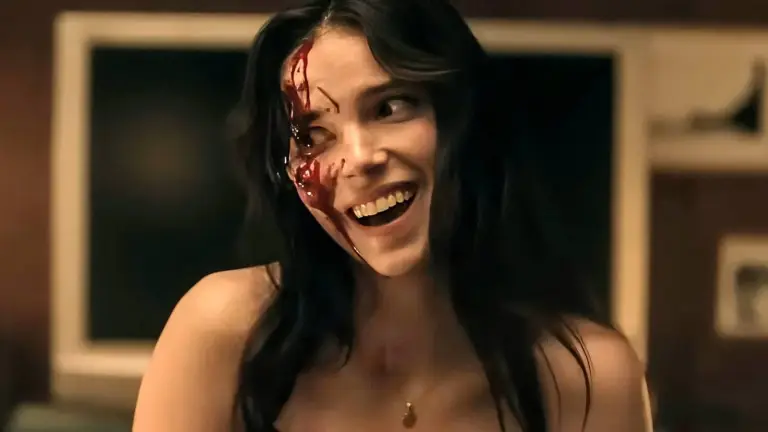
Viewed from a distance, the horrifying bloodshed that eventually erupts inside Bear’s home no longer appears grotesquely excessive but instead emerges as the natural consequence of such an emotionally poisoned world.
Obsession also gestures—though less successfully—toward another defining feature of contemporary relationships: our persistent tendency to fall in love with the wrong person.
The film deliberately contrasts the strained, emotionally exhausting encounters between Bear and Nikki with the effortless warmth of Bear’s scenes alongside Sarah. One relationship feels tense, artificial, and emotionally laborious; the other unfolds naturally and without pretense. Yet Bear chooses Nikki. Eventually, the chaos surrounding that choice overwhelms even the quiet comfort Sarah represents, culminating in the possessed Nikki eliminating the third corner of the love triangle with shocking brutality.
Her words at that moment are especially revealing: “It’s all your fault. Sarah’s death is your fault. This is what you wanted. This is what you wished for.” For all its daring, however, Obsession loses its nerve in its final act.
Just when the film appears ready to embrace the full implications of its own psychological madness, it retreats into safety. The ending stands in direct opposition to everything that precedes it—to the film’s persistent effort to cloak its characters’ emotional lives in uncertainty and fog. It feels as though the film slips on the final step just before reaching an entirely new level.
Another obstacle preventing the film from achieving genuine maturity lies in its underdeveloped supporting characters. Sarah and Ian function primarily as narrative devices rather than fully realized human beings. When Barker finally removes them from the story, he does so with the heavy hand of fate itself, engineering their deaths through implausibly foolish decisions. Sarah’s insistence on meeting Bear immediately after the blood-soaked party, and billionaire Ian’s inexplicable return to Bear’s house, occur less because the characters would plausibly behave that way than because the screenplay requires them to. Yet Barker’s accomplishments extend well beyond his screenplay.
Obsession is also a remarkably accomplished visual work. The cinematography and lighting are consistently striking. Nikki repeatedly appears framed within shadows or standing silently in doorways, darkness gradually swallowing her face and eyes, while the camera repeatedly emphasizes the blackness surrounding its characters. These visual strategies replace the overused mechanics of the jump scare with something far more effective, steering the audience toward psychological dread rather than cheap surprise.
The casting, too, is exceptionally well judged. Indy Navarrette’s performance, in particular, allows subtle shifts in facial expression to communicate the terrifying transformation of her character. Her nuanced performance enables the film to generate fear through suggestion rather than shock—a fitting achievement for a horror film far more interested in emotional unease than in startling its audience.
Ultimately, Obsession recalls the days when James Wan introduced Saw to horror audiences with little more than ingenuity and a shoestring budget. Whether Barker’s career will follow Wan’s trajectory—eventually disappearing into the machinery of blockbuster Hollywood—or whether he will return having overcome the weaknesses evident here remains to be seen.
© 2026. Phoenix Review