



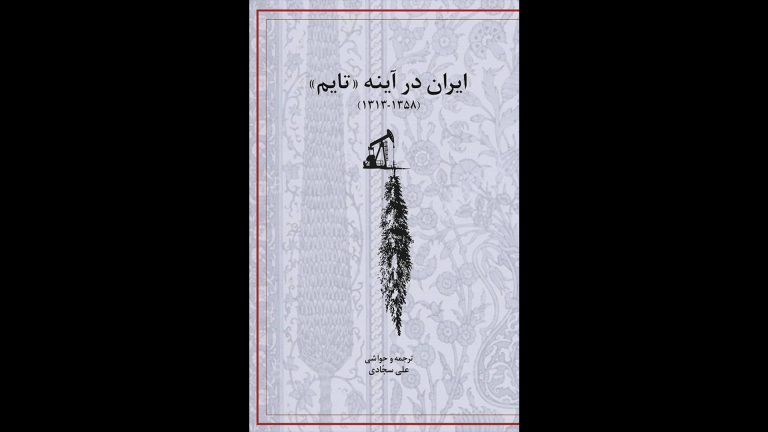
A book titled Iran in Time Magazine has recently been published in Washington, D.C. The book contains ten articles about Iran originally published in the prestigious Time magazine between 1934 and 1980 in the United States. These articles have been translated by Ali Sajadi, an Iranian-American journalist and researcher of modern Iranian history.
The collection focuses on four major political figures in modern Iranian history, each of whom appeared on the cover of Time magazine. Three articles are devoted to Reza Shah Pahlavi, five to Mohammad Reza Shah Pahlavi, one to Mohammad Mossadegh, and the final article to Ruhollah Khomeini. One of the book’s most valuable features is the extensive set of explanatory notes and commentaries provided by the translator, Ali Sajadi, in the footnotes, offering readers important historical context and clarification.
The articles included in Iran in Time Magazine, in chronological order, are as follows:
- Brothers in Islam — Cover title: King of Kings, featuring Reza Shah on his coronation day at Golestan Palace.
- Iran: Darius of the Twentieth Century — Cover title: Reza Shah Pahlavi, with a photograph of Reza Shah in military uniform.
- World War: Iran and the Iranian Paradox — Cover title: Reza Shah Pahlavi, featuring Reza Shah wearing a military cape and cap.
- Iran: The Rhythm Repeats — Cover title: The Shah of Iran, with a photograph of a very young Mohammad Reza Shah.
- Challenge of the East — Cover title: Man of the Year, featuring Dr. Mohammad Mossadegh.
- Iran: Reform in Military Uniform — Cover title: The Quest for Stability, with a close-up portrait of Mohammad Reza Shah.
- Iran: Oil, Grandeur, and a Challenge to the West — Cover title: The Oil Emperor: Shah of Iran, showing Mohammad Reza Shah with graying hair.
- Iran: The Shah’s Divided Land — Cover title: Iran in Turmoil, featuring a middle-aged Mohammad Reza Shah.
- Storm Over the Shah — Cover title: Eye of the Storm: The Deposed Shah of Iran, with a photograph of the elderly and ailing Shah.
- Man of the Year: The Mystic Who Lit the Fires of Hatred — Article title: Ayatollah Khomeini Captured His Nation and Shook All of Islam, accompanied by a photograph of a relatively younger Khomeini with his characteristic furrowed brow.
These articles are not only engaging and vividly written, but also offer readers a unique opportunity to view modern Iranian history and its leading figures through the lens of American journalists over nearly half a century. They reveal how American intellectuals and journalists of the time perceived Iran and its people, which issues they considered significant, and how they interpreted the major events of Iran’s modern history. Iran in Time Magazine is undoubtedly one of the most fascinating books published on this subject, offering valuable insights not only to scholars of modern Iranian history but also to anyone with an interest in the field.
Ali Sajadi, an Iranian-American journalist and researcher specializing in modern Iranian history and literature, was born in Tehran and has lived in the United States since the 1980s. Since 1980, he has collaborated with the Washington-based publications Iranshahr, Par, Iran Shenasi, and Elm va Jameh. He served for several years as News Editor at Radio Farda in Washington and later as Editor-in-Chief of the Persian Service at Voice of America. Over the past four decades, he has published numerous articles and books on Iran’s cultural, social, historical, and political affairs. His published works include Blue Pages: A Survey of Twenty Books on Contemporary Iran (2016); The Sunset of Sadegh (including the Iraqi travel notes of Sadegh Ghotbzadeh, 2017); The Cinema Rex Fire: The Beginning of Forty Years of Great Terror (2018); The Language of Poetry in the Age of Protest (with Hadi Bahar, 2022); the first volume of The Nationalization of the Oil Industry Based on the Proceedings of the National Consultative Assembly (2022); and The New Iran by James Vincent Sheean, translated and annotated with Maryam Ahmadi (2025).
I recently spoke with Mr. Ali Sajadi in Washington, D.C., about his latest book. I began by asking him:
In this book, you have translated ten Time magazine articles published between 1934 and 1979. These are the same articles that inspired the magazine covers. Three focus on Reza Shah Pahlavi, five on Mohammad Reza Shah Pahlavi, one on Mohammad Mossadegh, and one on Ruhollah Khomeini. What criteria did you use in selecting these particular articles?
Ali Sajadi: My primary criterion was that none of these articles had ever been published in the Iranian press at the time they originally appeared in Time. None of Iran’s leaders permitted their publication in Iran, which reflects the fact that none of them tolerated criticism. The absence of a free press has been one of the major factors contributing to Iran’s social and political backwardness. I discuss aspects of this issue in the book’s introduction.
One of the first things that strikes the reader in the opening article, “Brothers in Islam,” is that the author openly refers to Reza Shah as “the Iranian dictator” and to Atatürk as “the dictator of Turkey.” The word “dictator” is not buried in the text but appears from the very first reference to these leaders. For Iranian readers, this is quite startling, because even the independent Iranian press throughout modern history has rarely, if ever, used such direct language. How do you explain this difference?
Ali Sajadi: The Time cover stories are written by the magazine’s editorial board, and naturally the editors of a publication like Time, published in the United States, evaluate other countries according to the standards by which their own society is governed. From the perspective of an American, for whom freedom of religion and freedom of expression are fundamental social values, a leader such as Atatürk prohibiting religion from public life would be regarded as dictatorial.
Some may prefer to describe Atatürk or Reza Shah as “authoritarian” rather than “dictatorial.” However, the simple fact that Iran’s government censorship office prohibited the publication of Time‘s article in Iran is itself indicative of dictatorship. Under Iran’s Constitution at the time, there was actually no legal prohibition against publishing such articles.
It is true that Reza Shah came to power during a critical period in Iran’s history and, motivated by a deep love for his country, rendered many important services to Iran. Yet those accomplishments should not prevent us from acknowledging the shortcomings of his rule.
Several of the articles on Reza Shah emphasize his determination to reduce foreign influence in Iran. One quotation states, “Iran must learn to do without foreigners.” This clearly suggests that Reza Shah wanted the country to be administered by educated and capable Iranians. That objective would seemingly have run contrary to the interests of the country where Time was published. It also differs from the portrayal of Reza Shah by many Iranian intellectuals before and after the Revolution. Faced with such conflicting interpretations, how should readers approach them?
Ali Sajadi: Reza Shah was, to a very large extent, successful in reducing foreign influence over Iran’s internal affairs. Modern Iran owes a tremendous debt to his era. From compulsory education—which he regarded as his greatest achievement—to the construction of roads linking Iranian cities and villages, the building of the national railway, the establishment of Tehran University, and, perhaps most importantly, the creation of a modern judiciary, the abolition of capitulations, mandatory registration of property and legal documents, and the elimination of empty aristocratic titles such as “… al-Saltaneh” and “… al-Dowleh”—all were among his lasting contributions to Iran.
None of these reforms, however, ran contrary to the interests of the United States. At that time, the United States was widely regarded as a nation that supported weaker countries. Unlike Britain, the Netherlands, Belgium, Portugal, or Spain, it possessed no colonial empire and was not seeking one. Rather, it wished other nations to enjoy the same independence it had won through its own War of Independence.
A good example is the letter Reza Shah sent to President Franklin D. Roosevelt on the afternoon of September 3, 1941, immediately after British and Soviet forces invaded Iran. In that letter, Reza Shah appealed to Roosevelt for assistance in preserving Iran’s independence and territorial integrity. Roosevelt responded by establishing a committee within the U.S. State Department, which pressed Britain and the Soviet Union to publicly affirm their recognition of Iran’s sovereignty and territorial integrity and to commit themselves to withdrawing their forces immediately after the war.
After the war, President Harry Truman continued Roosevelt’s policy. Thanks to the efforts of Iranian statesmen such as Mohammad Reza Shah, Mohammad Ali Foroughi, Ahmad Qavam, Hassan Taqizadeh, and Hossein Ala, the Soviet Union was ultimately compelled to end its occupation of Azerbaijan. Contemporary U.S. foreign policy should neither be regarded as, nor taken to represent, the historical pattern of American policy throughout its history.
One of the features that makes this book so engaging is the elegant, almost novelistic style of the articles. The descriptions of the two Pahlavi monarchs—their appearance, personalities, behavior, and personal tastes—as well as the vivid portrayals of Tehran’s streets, Golestan Palace, the Peacock Throne, members of the royal court, and even ordinary people in the bazaars and neighborhoods, all draw the reader into the narrative. This stands in sharp contrast to much of today’s political and social writing, particularly in Persian, which often feels overly serious, dry, tedious, and almost entirely devoid of wit or humor. The writers of these Time articles, by contrast, write with remarkable wit and liveliness. Do you think the Persian language is capable of this style of writing? What accounts for such a striking difference?
Ali Sajadi: Time magazine has always been admired for the quality and elegance of its prose. That is one reason why I found it necessary, in many instances, to provide explanatory footnotes to clarify the text and convey its precise meaning.
Persian is certainly capable of the same richness and flexibility. Just read Ali Akbar Dehkhoda’s Charand-o Parand and see how masterfully he used satire to expose Iran’s political problems.
The real problem is that journalism has almost never been treated as a serious profession in Iran. It was only through the efforts of the late Mostafa Mesbahzadeh, the founder of the Kayhan publications, that Iran established its first School of Communications, whose primary mission was to train journalists according to international standards.
Barely sixty years have passed since then, and much of that time has been overshadowed by the turmoil following the Islamic Revolution and its destructive policies toward education, literature, society, history, politics, and the educational system. Despite all these hardships, however, today’s Iranian journalists cannot fairly be compared with those of seventy years ago.
Let me draw your attention back to your first question. In a society where freedom of expression and political parties do not exist, the press inevitably assumes some of the functions of political parties. This not only diminishes the press’s true role but also tends to blur the distinction between news, rumor, and opinion.
A look at both domestic and Persian-language media abroad shows that many outlets have ceased to function primarily as providers of news and information. Instead, they have become either businesses or opposition platforms serving as spokespeople for particular groups or governments.
One of the most valuable aspects of the book is your extensive annotation. Throughout the articles, you explain historical references, provide additional context, fact-check certain claims, and, in some cases, identify statements that are unsupported or simply false. As a result, reading the footnotes becomes an essential part of reading the book itself. How important are these annotations, and what purpose do they serve?
Ali Sajadi: For readers younger than myself, many of these historical references have no obvious context. I therefore felt compelled to explain, for example, what the phrase “Shadow of God” actually means and why it became one of the traditional titles of Persian monarchs; why the expression “the Moon and the Star” refers to a story in the Bible; what significance lies behind the comparison of a cartoon character mentioned in one of the articles; or why a particular historical figure or political official appears in a given context.
In some instances, I also found it necessary to correct factual errors presented in the articles as established truths. Some of these claims were nothing more than propaganda disseminated at the time—particularly by the BBC in London—to discredit Reza Shah and prepare public opinion for his removal from power. Unfortunately, many of those same myths continue to be repeated today by some of our compatriots, whose remarkable enthusiasm for not reading and not learning is, one might say, almost admirable.
In the article about Mohammad Mossadegh—who is described as “the George Washington of Iran”—the author writes that “Mossadegh represents the kind of statesman the West must expect to encounter in the Middle East.” Several of these articles seem to anticipate the future course of Iran’s relations with the West and even foreshadow some of the events that would later unfold. How were these journalists able to develop such remarkably forward-looking perspectives? How could they arrive at such an understanding of a country thousands of miles away?
Ali Sajadi: That is one of the questions that occurred to me after reading Time‘s coverage of Iran—especially these ten articles. In the introduction to the book, I have tried to offer an answer, although I must admit that I am not entirely convinced by my own explanation.
Perhaps part of the answer lies in the way journalists are educated in Iran compared with the United States and, more broadly, the West. In my opinion, American journalists possess certain strengths that distinguish them even from many of their counterparts elsewhere in the Western world.
Another reason may be that, as Iranians, our emotions often outweigh our reason. Many of us make decisions with our hearts rather than our minds—and, more often than not, we end up paying a heavy price for doing so.
The articles about Reza Shah portray his personality and performance in often contradictory ways. Yet they speak very highly of Farah Pahlavi, the former Queen of Iran, while describing Khomeini as a man who ignited the fires of hatred—a fire that would ultimately consume Iran. To what extent can the articles in this book be regarded as historical documents reflecting what actually happened in modern Iranian history?
Ali Sajadi: Politicians should not be judged solely by apparent contradictions in their behavior, because inconsistency is hardly unique to political figures; it is part of human nature. Examine any politician closely, and you will inevitably discover contradictions in both words and actions. Time, place, and circumstance influence human behavior, and politicians are no exception.
I do not regard Time‘s articles—or similar journalistic writings—as historical documents in the strict sense. Rather, I see value in comparing them with what Iranian journalists wrote about similar events. Such comparisons teach us how issues can be examined and analyzed in light of what actually happened, rather than through the lens of ideology or hindsight.
As for the praise the article offers to Empress Farah Pahlavi, we should remember that what she accomplished in advancing Iran’s cultural and social life during her years as Queen was not only unparalleled in Iranian history but remarkable even by international standards. Who could fail to admire such achievements? They were genuine, selfless contributions, inspired by love of country and concern for its people. Such service deserves nothing but praise. May God preserve her for Iran.
You have devoted many years to researching modern Iranian history. When did your interest in this period begin, and what inspired it?
Ali Sajadi: I became interested in Iranian history during my teenage years and read historical works extensively. My real passion for modern Iranian history, however, began after the 1979 Revolution.
I wanted to understand why and how the calamity of the Islamic Revolution descended upon Iran. How was it that so many of the country’s so-called intellectuals and graduates of Western universities suddenly became captivated by political Islam and religious government? This was despite the fact that throughout the entire history of Persian literature—which I consider our nation’s greatest cultural achievement—you will hardly find a single major poet or writer who did not, in one form or another, criticize the clergy for hypocrisy, fraud, dishonesty, moral corruption, or deceit. That question continues to trouble me to this day.
© 2026. Phoenix Review