



The most iconic characters in the history of cinema never became enduring symbols of the seventh art because they were flawless or ideal. Rather, it was their imperfections, scars, and tarnishes that transformed them into tangible human beings—figures we could love. The same holds true beyond cinema, in the ancient myths. Odin, the god of wisdom, war, magic, and poetry, sacrificed one of his eyes in pursuit of knowledge. Zeus, the father of the gods, turned himself into a shower of gold to reach Danaë. Rostam, the legendary hero of Sistan, as his body was torn apart by spears and he drew his final breaths at the bottom of the pit dug by his treacherous brother Shaghad, longed for the embrace of Sohrab—the son he himself had unknowingly slain. The men and women who shaped human history were equally multifaceted: neither immaculate angels nor terrifying demons. Human beings are, by nature, fallible. And so it is only natural that the flaws of these real and mythical figures elevate them in our eyes rather than diminish them. Hollywood, however, all too often—whether deliberately or inadvertently—forgets that a biopic is meant to portray the life of a human being, not the sanitized perfection of a superhuman icon.
At the same time, it feels necessary to remind Hollywood, along with its directors and screenwriters, that Wikipedia and artificial intelligence have existed for years. Crafting a film about the turbulent life of one of the greatest singers in history requires something far more substantial than a superficial retelling of familiar facts. For a twenty-first-century audience, the distance between curiosity and a basic overview of Michael Jackson’s biography is no more than a few clicks. There is little reason to endure a disjointed, lifeless, two-hour film that merely reiterates information readily available elsewhere. To be fair, Michael cannot even accomplish that modest task. Had the film been made with greater wisdom, it would have invited us into the silence and solitude of the man behind “Billie Jean,” rather than assembling a shapeless collage of concert footage.
The first step in making a successful biopic is neither exhaustive research nor the discovery of untold episodes from a subject’s life. It is courage—the courage to portray a historical figure through the filmmaker’s own perspective. Without that courage, or when Hollywood confines a director to producing an airbrushed version of a legend, the inevitable result is a hollow and directionless work like Richard Attenborough’s Chaplin. In that film, Attenborough becomes so overwhelmed by Charlie Chaplin’s legacy that he strips him of his humanity, replacing the man with an immaculately polished Robert Downey Jr. This conservatism reaches its peak in the handling of one of the most devastating moments of Chaplin’s life: his mother’s confinement to a psychiatric hospital and her haunting line, “If only you’d given me a cup of tea that afternoon, I would have been all right.” Rather than allowing the emotional weight of that moment to resonate, the film reduces it to a fleeting scene drowned out by empty dialogue and cinematic noise. Thirty-four years later, Antoine Fuqua—the director of the unforgettable Training Day—follows precisely the same fruitless path.
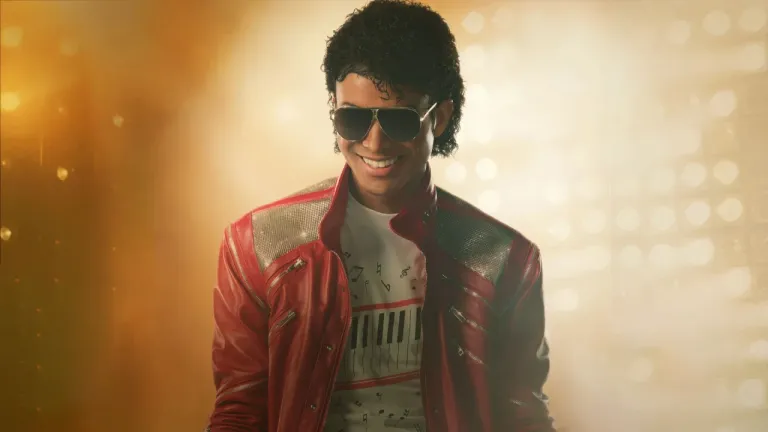
Fuqua‘s Michael can be summarized with a handful of predictable adjectives: gifted, lonely, wounded, and gentle. Such a superficial characterization makes it impossible for Jaafar Jackson to become the King of Pop in any meaningful dramatic sense. In truth, Michael never rises above the surface of its subject. Until its final shot, it remains as frail as an essay hastily scribbled moments before a literature teacher enters the classroom. This artificial Michael displays less humanity than Michael Jackson himself did in his famous interview with Oprah Winfrey, where his exhaustion and emotional vulnerability were unmistakably visible. Fuqua does not stop there. He persistently downplays—or simply ignores—the darkest chapters of Jackson’s life. His severe dependence on painkillers following the Pepsi commercial accident is omitted altogether, while the allegations against him are dismissed through a series of simplistic and dramatically empty scenes. And once the central figure of a biographical film is reduced to a mere type rather than a fully realized character, what purpose is served by dwelling on the production’s many other shortcomings?
Baz Luhrmann’s Elvis and Bryan Singer and Dexter Fletcher’s Bohemian Rhapsody, despite all their flaws, at least succeeded in recreating the unforgettable performances, concerts, and musical numbers of Elvis Presley and Freddie Mercury. Astonishingly, Antoine Fuqua cannot even accomplish something as straightforward as faithfully staging Michael Jackson’s iconic performances. The film’s emptiness becomes painfully obvious in the way Jackson’s legendary songs are handled: instead of serving as emotionally meaningful narrative moments, they are inserted abruptly and without dramatic purpose, appearing almost at random.
Ironically, the ending proves to be the film’s most mesmerizing moment—not because of what appears on screen, but because it leaves the audience staring at the blank television screen afterward, wondering how a film built around such an extraordinary subject could end up so astonishingly devoid of substance. More astonishing still is the knowledge that this painfully underwhelming spectacle is set to receive a sequel.
Ultimately, Antoine Fuqua’s latest film is nothing more than a collection of lifeless, unfinished fragments from Michael Jackson’s early years. It offers no distinction in form, no depth in its screenplay, no compelling characterization of either its principal or supporting cast, and no inspired casting choices. Nowhere does it reflect the boundless genius of its subject or the cinematic mastery Fuqua once displayed decades ago. It is fruitless—utterly, relentlessly fruitless. Perhaps the film’s only consolation is that Michael Jackson himself is no longer alive to witness Michael adding yet another wound to the countless scars he carried throughout his life.
© 2026. Phoenix Review