



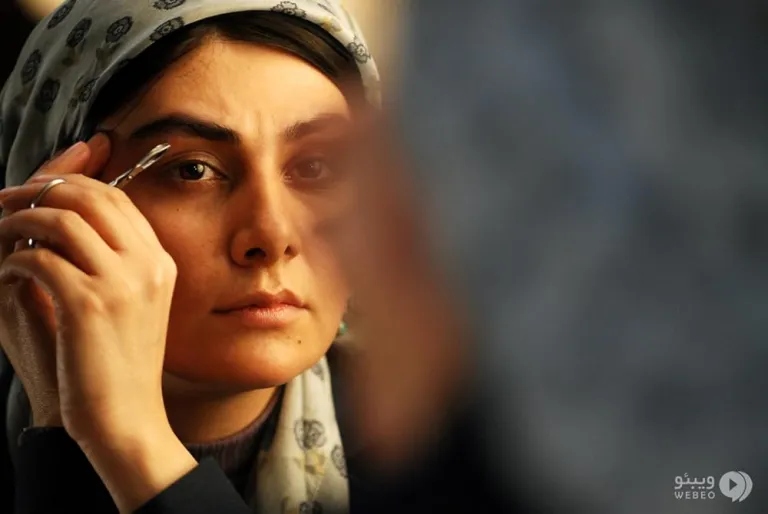
As Simple as That is a minimalist drama built upon the everyday life of a housewife who has, implicitly, lost her sense of place within her home, her family, and the small society around her—struggling like a drowning person to reclaim her sense of self: weary, yet impactful.
Reza Mirkarimi is a talented filmmaker who, after making two television series focused on children and teenagers, continued this thematic concern in his first feature film, The Child and the Soldier, which earned numerous awards at domestic and international festivals.
In Under the Moonlight, Here, a Shining Light, and So Close, So Far, he expanded the dramatic scope and central characters of his work to include underrepresented groups: the hesitant cleric, the naive/mentally disabled man, and the disillusioned surgeon. These films, too, captured the attention of festivals at home and abroad.
This consistent approach marked his thoughtful and experimental perspective on drama and directing, grounded in a personal style—making each of his films contain its own kind of surprise. Mirkarimi maintained this quality in his later works as well, becoming a filmmaker who avoids repeating even his own successes.
As Simple as That, released in 2007, was based on a screenplay by Mirkarimi and Shadmehr Rastin, shaped around the everyday life of a housewife. A seemingly simple, ordinary, and predictable character—one who, because of stereotypical readings of a wife/mother/homemaker—would hardly be any director’s first choice for a cinematic protagonist.
But with this film, Mirkarimi proved that it is the filmmaker’s angle and perspective that can draw drama from the deepest layers of even the most seemingly repetitive and undramatic of lives, bringing it before the audience and giving its story real highs, lows, pull, and appeal.
With such an approach, As Simple as That shone brightly in both domestic and international festivals and was widely appreciated by audiences. Its awards include the Crystal Simorgh for Best Film, Best Screenplay, and Best Director in the Asian Cinema section of the Fajr Film Festival; the Golden George for Best Film and the Russian Critics’ Prize at the Moscow International Film Festival; and Best Actress (Hengameh Ghaziani) at the Varna Film Festival in Bulgaria.
The film follows a single day in the life of Tahereh (Hengameh Ghaziani), a housewife who, early in the morning on the rooftop—amid satellite dishes, laundry lines, and towers piercing her horizon—whispers to herself… as if holding a secret, a pain in her chest, and a lost, unseen piece within.
This time, Mirkarimi portrays the recurring theme of doubt in his works through the eyes of a simple, ordinary woman who plays a crucial role in sustaining her family, yet finds herself lost in the exhausting cycles of daily routine—uncertain about her role and identity, struggling to find and rediscover herself.
This mood and sense of displacement pulse beneath the film’s surface over a single day and night—some moments stretched, some omitted—so that by highlighting the emotional peaks of this one day, the film fits the conventional 90-minute runtime.
Beneath Tahereh’s routine, her comings and goings, her brief interactions with neighbors and acquaintances—and especially in her solitude and silences—the internal sorrow is tied to sighs that never quite escape her chest. Even in the faint, bitter half-smiles that briefly lift the corners of her lips, revealing her cheek dimple—yet fade before becoming real smiles. This heart holds sorrow.
She is preparing for her own absence—testing her presence and absence, examining her family’s reactions, and trying to understand what she means to them… Who is she, and why has she fallen into this confusion, hesitation, and loss of identity?
This essential question—the character’s driving inquiry from beginning to end—is revealed not directly, but through careful, subtle setups drawn from her encounters with her children, Arezou and Ali; the neighbors; a friend; the shopkeeper; the office secretary; and her husband, Amir (Mehrān Kāshāni).
Through being pushed aside, overlooked, unseen; through the contrast with the lively child she once was—now with no trace of that spark remaining.
This deliberate arrangement—through a feminine, detail-oriented gaze—gradually discovers and reconnects the scattered pieces of Tahereh through her internal and external conflicts, forming the image of the woman in the final scene: suitcase packed, coat on, ready to leave.
From her strained relationship with her children and a husband who seems unable to see her beyond a stereotype; from her complaints to her shopkeeper friend; from the empathetic connections she attempts with neighbors and her small surrounding community; even from her attachment to poetry and the half-finished piece she seems to have written about herself.
The image that finally forms by the end of the day seems to reveal all the unspoken questions surrounding her character from morning to night. A woman who has been preparing to leave all day—yet no one has noticed.
A woman who, that very morning on the rooftop, was evaluating her decision; and throughout all the chores—cooking, tending to the children, helping neighbors, buying a suit for Amir—beneath it all she was packing her suitcase, searching for herself, searching for even the smallest reason not to leave. A reason as small as flipping a light switch and seeing the chandelier illuminate—so she might feel seen.
A reason that, through her belief, she perhaps finds in the final divination by estekhareh, under the pretext of helping a neighbor; and in her husband’s request inviting her into his private space. Standing between leaving and staying, between Amir’s invitation and the honk of her brother’s car waiting outside—Tahereh chooses to stay.
But who can say whether tomorrow she will find another reason to stay—or answer the inner call to leave, to overcome her doubts, to find herself beyond the roles of woman/mother/wife?
This is the very question Tahereh asks herself every morning atop that same rooftop—until the day she finds a solid reason to remain. On that day, she will surely be able to complete her unfinished poem… a day when womanhood, motherhood, and personhood find the same meaning.