



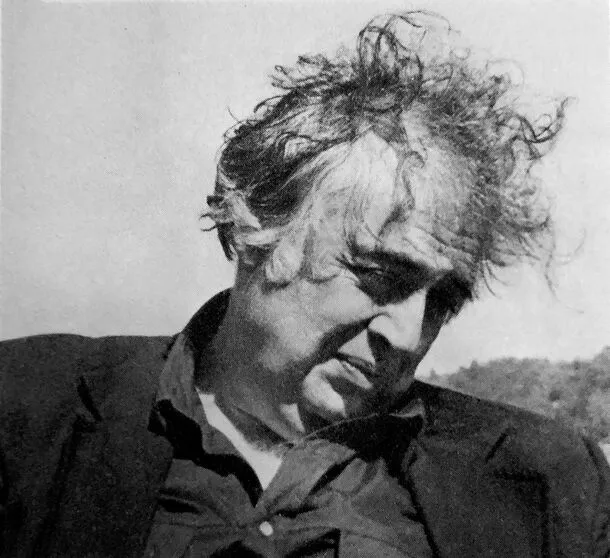
Harold Bloom may have been the only intellectual who dared to call the God of Israel “a mischievous, wayward boy.” This was Bloom’s unique mixture of audacity and sensitivity—the force that allowed him to reconstruct our understanding of the Bible with unflinching originality. He may not have been the most precise interpreter of the Tanakh, but he was surely one of its most intuitive and unsettling readers.
It is striking that the first book Bloom ever truly owned—a fact he often recalled with amusement—was the New Testament, in Yiddish. As he told it, one day a missionary knocked on the door and handed it to him. Years later, while studying classical literature at Cornell, he returned to that same book, spending a semester reading it closely. Yet even as a child he felt no kinship with it, later joking that it ought to be called the “Delayed Testament,” while the Hebrew Bible remained the “Original Testament.”
Describing the Yiddish spirit, Bloom once cited his favorite proverb: “Sleep faster—we need the pillows.” For him, this was the essence of Yiddish culture: compassionate, ironic, and forever locked in a quiet quarrel with God. One might recall Benya Krik in Babel’s How It Was Done in Odessa—when his henchmen kill a gentle Jewish clerk, and a mother complains, Benya answers grandly: “All right, I was wrong. Even God makes mistakes. He could have put us in Switzerland, surrounded by lakes and Frenchmen, but where did He put us? Here, in damned Russia!”
From adolescence, Bloom was a born Gnostic. Gnosticism—the ancient heresy that he adopted as a personal faith—was, to him, an extreme form of prophetic protest against the world’s injustice. “From the beginning,” he admitted, “I identified with Elisha ben Abuyah—the Acher, the Stranger—condemned in the Talmud.”
He was sixty when he wrote The Book of J, a work of unprecedented boldness that shook the world of biblical criticism. Bloom did not merely speculate—he declared with conviction that the author of the earliest portion of the Hebrew Bible, the writer scholars call “J,” was an educated woman at Solomon’s court. However fanciful that hypothesis seemed, The Book of J became both controversial and widely read.
Bloom delighted in asking questions beyond our capacity to answer them, savoring the contradictions and intricate ironies he uncovered:
“J, when writing the scrolls that became her legacy, was not thinking of sacred scripture. The stories of Creation, the Patriarchs, Joseph, and Moses were not holy tales to her. Perhaps the most astonishing paradox about J is that the source of Judaism, Christianity, and Islam was, at its origin, a writer who was not religious at all.”
In the mid-1960s, Bloom suffered a severe midlife crisis—months of insomnia during which he could not read. When he recovered, it was Ralph Waldo Emerson, the great voice of American Romanticism, who saved him. Emerson was, for Bloom, the prophet of the Self—a figure who, no matter how battered by fate, turns inward to the light and renews his strength.
Bloom’s darker rival was Sigmund Freud—the angel of pessimism—who taught that we can never truly know the motives of our own actions. Whether reckless or cautious in love, our passions never transform us enough; they only return us to the parents we once rebelled against and ultimately failed to overcome. From then on, Bloom lived in a painful yet fertile tension between Emerson and Freud.
At the height of that struggle, Bloom wrote his most influential work, The Anxiety of Influence. Dense, often obscure, and brimming with his own invented terminology, the book nonetheless gleamed with a radical insight: every strong writer misreads his precursors in order to clear imaginative space for himself. To become original, he must distort the truth of those who came before. As Bloom knew, this was a profoundly Freudian idea—the literary forebears as symbolic parents, whom the new writer must both deny and overthrow.
Some of Bloom’s deepest reflections concern the loneliness of literary heroes, explored in The Anatomy of Influence: Literature as a Way of Life. There, he revisited and clarified his earlier theory, showing how great poets first fall under the spell of their predecessors, then wrestle with them to forge their own creative identities.
When teaching poetry, Bloom entered the text as an actor inhabits a role—seeking, with full emotional force, to grasp and embody its hidden life. In this he followed Emerson’s injunction: “Read to shine.” And shine he did.
For Bloom, literary criticism was not an academic exercise but a way of being—a moral and imaginative discipline. He summed it up in a simple credo:
“Read. Reread. Describe. Evaluate. Appreciate.”
This, he believed, was the true essence of criticism in our time.
Bloom’s enduring significance lies in this: he remains the most inspiring critic of our age, a prophet who could awaken us with a single sentence—reminding us that we must read, think, and live as if revelation were still possible.