



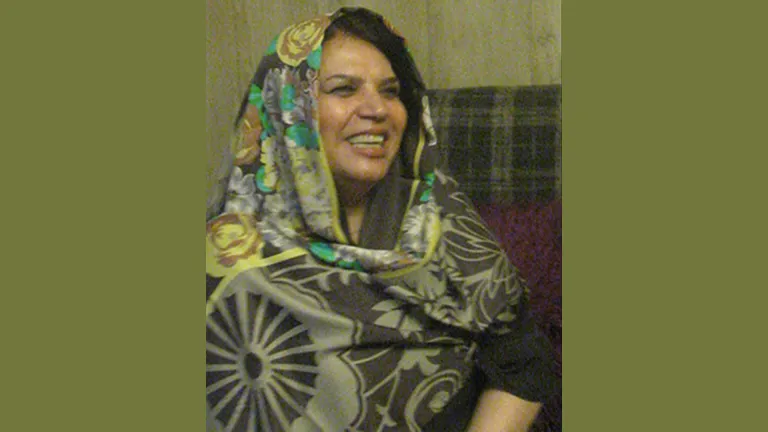
In the fourth installment of the series “Filicide in Modern Persian Short Fiction”, we turn to a story by one of the third-generation Iranian fiction writers: the short story “The Stoned House” by Shahla Parvin-Ruh. Born in 1956 in Shiraz, Parvin-Ruh is one of the post-revolution female authors in Iran. With the publication of three works—one novel and two short-story collections—she established herself among Iranian storytellers. In her early twenties, she happened, quite by accident and without prior intention, to attend the fiction-writing workshops of Shahryar Mandanipur, where she quickly impressed her teacher. This marked her entry into contemporary Persian fiction. She later met Houshang Golshiri and published a story under his supervision in the collection Shahrzad’s Stories.
Perhaps the most striking aspect of Parvin-Ruh’s literary career is that, despite publishing three successful books—Burnt Henna (1999), The Talisman (2001), and When I’m Left Alone (2004)—she withdrew from the literary scene very early. She has not published any further books, nor have her earlier works ever been reprinted. She may embody precisely the “early death of prose” in contemporary Persian literature that Golshiri once described:
“But by ‘juvenile death’ I mean death—whatever the cause—before the age of forty, and even younger, regardless of whether the poet or writer remains alive. That is, the writer or poet may still be physically alive, but there is no longer any sign of creation or innovation within them.”
In what follows, I explore “The Stoned House” and focus on this central question: does the theme of filicide appear in the story, and if so, how does the author approach it?
The events of the story unfold within a very short span of time—one of the narrative’s strengths. The plot is this: An unnamed woman doctor is called on the day of Ashura to help a pregnant woman. When she arrives at the shared household where the woman lives, she notices strange occurrences: blood spilled across the courtyard, tension among the residents. The pregnant woman—Akhtar—is in distress and on the verge of miscarriage. When the doctor asks about the bleeding and Akhtar’s condition, the residents claim that someone threw a stone at the pregnant woman, causing her to hemorrhage. No one knows who threw the stone; each neighbor blames the other. Some attribute it to jinn, giving the event a supernatural tone. Others, especially the landlord, hold different beliefs. Eventually, the fetus is lost and the doctor can do nothing to save it. The child is delivered stillborn; the doctor wraps the body in cloth and places it in a basin. As she leaves the house, a stone suddenly strikes her heel from nowhere. Alarmed, she flees the house.
The narrator is the doctor herself. As she tells the story in the present tense, she naturally knows none of the full background. She cannot enter the minds of the neighbors to uncover the truth. Thus, the author relies on the residents’ dialogues to present the various accounts of the stone-throwing incident, gradually informing both narrator and reader of the backstory simultaneously.
This narrative technique enhances the suspense: the reader’s knowledge is exactly equal to that of the first-person narrator, who enters the space as an outsider. Since the narration unfolds in the present tense, the audience constantly anticipates danger for the protagonist. The technique also heightens curiosity: the reader wants to know what actually happened in this mysterious house; whether the baby will survive; whether the protagonist will be harmed; and whether the true culprit behind the stone attack will ever be identified.
One of the most important analytical points concerns the story’s chosen time of events. Let us examine the opening lines:
“The sound of cymbals and lamentation rises and falls like waves. The narrow alleys are crowded with people who have walked from several streets away, pouring into the winding lanes to reach the area near the shrine, where they can better watch the procession of mourners beating their chests. I try hard not to lose the woman who introduced herself as Zeinat and dragged me out of the house.”
The author consciously sets the story on Ashura. Ashura is perhaps the most significant day on which Shi’a Muslims bring their collective belief system into the public sphere—onto the streets and into the city. These beliefs are so interwoven with rituals, ancient Iranian mythologies, and pre-Islamic superstitions that it is no longer possible to distinguish the religious core from the accumulated cultural layers. It is also notable that the narrator—the doctor, symbolizing rationalism and scientific thinking—has not joined the public rituals on this special day. She has been at home, and Zeinat has “pulled her out of the house.” The doctor would have preferred to remain in her private sphere and avoid the ceremonies.
This point bridges directly to the end of the story:
“Abbas comes forward and takes my bag to walk me home. I reach the middle of the courtyard when a stone hits the heel of my shoe hard. Terrified, I jump and look around the courtyard. It is empty, and the rooms are sunk in the silence and darkness of sleep… I run quickly through the hallway and leave the house. Abbas is waiting at the corner.”
The reader’s immediate question is: Who threw the stone? Was there even a stone at all, or has the doctor, after spending hours inside the “stoned house,” been overtaken by fear and hallucination? The story does not give a definitive answer; interpretation is left to the reader. But regardless of whether a stone was truly thrown, the crucial point is that the doctor feels it strike her. The same stone, earlier, struck Akhtar and killed her unborn child. Thus, the story moves from realism toward the uncanny. The doctor—who had insulated herself from outside superstition by staying home—was drawn out into the world, and superstition, in turn, penetrated her life in a physical way. Collective superstition has now entered the rational doctor’s reality.
Another notable detail is the presence of Abbas at the ending. Patriarchal culture—which is visible in other parts of the story—is reflected here as well: Abbas taking the doctor’s bag and escorting her home suggests that she is not allowed to return alone; a man must “protect” her.
What, then, can be said about filicide? In “The Stoned House,” no direct or intentional act of filicide occurs. One of the metaphorical meanings of filicide is the destruction of hope for the future—the crushing of the next generation’s potential. The older generation seeks to preserve its values at any cost, defending them against new beliefs. In this dynamic, parent stands against child. In Shahnameh, Rustam kills his son Sohrab—whether unknowingly or, as some scholars argue, knowingly. But in modern Persian fiction, this filicide often occurs indirectly, sometimes even without physical murder. One of these intermediating forces is ancient, superstitious belief. If we trace the parent/child dichotomy in literature, we arrive at another fundamental opposition: traditional-superstitious beliefs vs. new beliefs. This tension also appears in Bozorg Alavi’s “The Suitcase,” which I analyzed in the previous essay. In “The Stoned House,” the same dynamic resurfaces: collective superstitions infiltrate real life and lead to the destruction of the next generation.
Yet the key point here is that the “child” in this story never even enters the world—this patriarchal, superstitious world—in order to be killed later. He is killed in his mother’s womb. And had he lived, the story suggests, it is clear how he would have been shaped within such a social structure.