



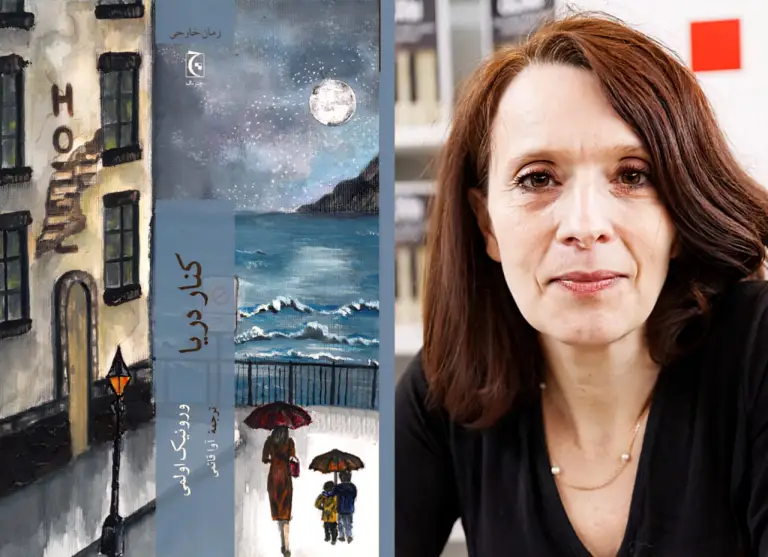
The novel Beside the Sea by French writer Véronique Olmi is an acclaimed work. Put simply, it is about a modern-day Medea and two boys who, after spending every last coin they have on a trip to a strange, rainy city, are destined to be killed by their mother. A low-budget journey, an inexpensive café, a crowded amusement park, and then suffocation with a pillow. That is how cold it is. That is how stark. Now, a question: if you were writing this book, to whom would you dedicate it? And what if you were translating it? Is it even possible to write a dedication for every book?
After finishing the novel, as I always do, I went back and leafed through it once more, from the cardboard cover to the final page, reading my marginal notes along the way. Then, after the copyright page, my eyes caught something I had not noticed before. On a plain, bare sheet of white paper, two words had been written: “To my mother.” I froze. There is no way of knowing whether this dedication was written by the translator or the author. I do not have access to the original edition to check. I turn both possibilities over in my mind. First, I imagine the author and the conflicting emotions she must have experienced when writing those two words. “To my mother.” So cold. Without a single qualification or adjective. No “my dear mother,” no “my loving mother.” I repeat the words under my breath: “To my mother.” Then I turn to the translator, Ava Ghaemi. I realize that, no, it makes no difference. It is just as cold, bitter, and biting. In my mind, the translator is the book’s second author. Her task is sometimes even more difficult than the original writer’s. She has every right to dedicate the book to whomever she wishes (or loves?). “To my mother.” No. Nothing has changed. It seems a mother is simply a mother, after all. And who could dedicate this particular book to their mother, and with what feelings? I leave the book on the table and go into the kitchen, where I find “my mother” frying eggplants. Once again, I repeat the words under my breath: “To my mother.” No. I could not have dedicated this book to my mother. Despite all the effort the author makes to portray the murderous mother in the novel as a wronged, tormented, helpless woman with no choices of her own; despite all the clues she plants for the reader to read between the lines and understand what drives a mother to kill her children, I still cannot do it. Dedications have stories of their own, and the dedication to this book tells a story in just two words. Perhaps even two stories.
But that is not where the matter ends. The novel’s beginnings, in general, are shrouded in mist and deserve closer examination. Following that curious dedication, we encounter this dramatically complete paragraph:
“We had boarded the bus, the last bus of the night, so that no one would see us. Before it departed, the children had eaten their afternoon snack. I noticed they hadn’t finished the jar of jam and thought that the jam would just be left there. What a shame.”
They say a good opening is one that establishes the point of view, makes a forceful impression, and contains the essence and heart of the entire novel. Above all, it should signal that something is not quite right. Why does the narrator want no one to see her and her children? Why does she say that the jam will simply be left there? Does that final “What a shame” refer to her boys or to the jar of jam? Once you have read the novel and return to its opening, you discover many things that were not apparent during your first reading.
When a novel has such a slender plot and relies on the atmosphere and melancholic monologue of its first-person narrator, it needs more than a strong emphasis on mood and sensory evocation to create meaning. Above all, it needs recurring motifs and elements. The words in such novels must be able to move beyond their dictionary definitions and acquire meanings that exceed their conventional ones. This is what poetry does with words, and novels of this kind are compelled to become “poetic.” In these novels, objects are no longer merely the ordinary things they appear to be. Jackets are not just jackets. The same goes for cigarettes, picture frames, bags, sounds, and smells. Beside the Sea is no exception. The clock that is repeatedly forgotten points to an inability to remember how to live in the present moment. The rain that falls incessantly takes on a hostile quality, as though it wants to wash away the filth and grime covering them; strangely enough, the narrator constantly feels that the rain has made them dirty. There is a window that always opens onto a bare concrete wall. Coins jingle, and we know that the more of them are spent, the closer the children come to their deaths.
But one of the novel’s recurring elements is the bed in the hotel room (if that purgatory can even be called a hotel). A bed the size of the entire room. There is no other furniture to speak of. Just a bed for sleeping. A large bed that can accommodate all three of them. A bed that, at the end of the novel, also becomes the site of the two children’s murder. It could have been a place for lovemaking and physical intimacy—something the first-person narrator is clearly burning with desire for—but instead it becomes a place of oblivion. A bed the size of a room.
Finally, it should be noted that the power and impact of the short novel Beside the Sea derive from three sources. The first is its poetic economy, as discussed above. The second is its subtle intertextual engagement with the grand narrative of Medea (whose finest dramatic realization may be found in Euripides’ play). The third, and perhaps most striking, is its emotional inversion of elements that conventionally evoke specific feelings in the reader. A mother, who is expected to love, kills her children. Children, who should bring joy to a household, become unwanted presences. An amusement park, where people are supposed to have fun, turns into an unsafe environment. A journey and a stay at a hotel, which should offer a chance to recover and renew one’s spirits, become instead deeply oppressive and depressing experiences.
Véronique Olmi published Beside the Sea in 2001 and received the Alain-Fournier Prize for the novel. This short work has been published in Persian by Chatrang Publishing, translated by Ava Ghaemi.
© 2026. Phoenix Review