



Over the past decade, Ryusuke Hamaguchi has undoubtedly emerged as one of the most pioneering and distinctive auteur voices in world cinema. Following the patient epic of Happy Hour and the miniatures of human relationships in Wheel of Fortune and Fantasy, he summoned the worlds of language, trauma, and Chekhovian redemption onto the international stage with his acclaimed masterpiece Drive My Car. He then brought the fury of nature and ecological colonization into view in the formidable form of Evil Does Not Exist. Now, with All of a Sudden (2026), Hamaguchi takes a further major step in the evolution of his visual and intellectual form. The film was met with an enthusiastic critical reception at the 2026 Cannes Film Festival and received the prestigious Best Actress Award jointly for the two actresses playing Marie and Marilou. This recognition affirmed both Hamaguchi’s skill in directing actors and his command of the tense chemistry between the two women.
In All of a Sudden, Hamaguchi takes the radical critique of capitalism that he had developed in Evil Does Not Exist—through the occupation of nature and the oppressive silence of the forest ecosystem—and carries it into a more formidable and complex domain: the colonization of the human body, emotions, old age, and psyche by the instrumental rationality of neoliberalism. If, in the tradition of modern cinema, filmmakers such as Éric Rohmer turned language into a means of revealing subjectivity, Hamaguchi uses extended, philosophical dialogues in this film not as dramatic embellishment, but as the action itself and the principal site of the event. This is a film that explores cinema as an act of “philosophizing” on the surface of the image, showing how language can function simultaneously as an instrument of repression and the only passageway to resistance.
The drama is centered on a symbolic institution: a private nursing home managed by Marilou, a place with a dark history that previously served as a psychiatric hospital and sanatorium. Marilou, who studied anthropology in Japan, is engaged in an exhausting struggle against the machinery of bureaucracy, profit-seeking, and the system’s mechanical protocols. In an effort to restore the dignity denied to the residents, she has developed training courses in “Humanité” for the care staff and nurses. These courses lay out precise principles that define the elderly not as “objects to be warehoused,” but as living subjects, and establish four fundamental pillars for their treatment: “vision” (a humane and equal gaze), “speech” (meaningful communication rather than bureaucratic instructions), “touch” (caressing and emotional contact as forms of recognition of the other’s body), and “verticality” (the ability to stand and walk, symbolizing the human being’s biological resistance to decline and horizontal collapse).
At the other pole of this conflict stands Marie, a Japanese theatre director who studied philosophy at the Sorbonne and regards directing as a form of “living philosophizing.” Accompanied by her grandson Goro, an autistic child who is also an actor, she arrives at the nursing home to stage an experimental performance bearing the provocative title Are Healthy People Really Alive? The mise-en-scène of Marie’s theatrical performance is conceived with radical ingenuity: two large full-length mirrors are placed facing the audience. This mirrored arrangement shatters the illusion of security. In encountering the performance, spectators—and residents—are forced to look not at a theatrical object, but at their own bodies, decline, and alienation within the mirror’s frame. The scene evokes a philosophy of breaking through assumptions: that “the impossible remains impossible only until it becomes possible.” The presence of an autistic child at the center of this rigid spatial geometry introduces a rupture through which the unpredictable enters, along with an innocence unburdened by the symbolic language of capital.
The filmmaker deciphers the theoretical foundations of this exploitation through two fundamental intellectual frameworks. The first is a direct reference to Marcel Mauss’s The Gift and his historical concept of “exchange.” Drawing on Mauss, Marilou argues that archaic societies were sustained by reciprocal gifts and moral solidarity, whereas the modern world has transformed the concept of exchange into a poisoned transaction. Is the retirement and elder-care support received by a worker who has devoted the best years of their youth, their blood, and their vital energy to the state and corporations a favor granted by the state, or the fulfillment of a fundamental moral exchange? Mauss located the roots of contemporary economic crises in the destruction of precisely these moral bonds—a connection now torn apart in the most ruthless way through the monetization of care in nursing homes.
The second dimension of this critique emerges in Marilou’s genealogy of the phenomenon of “population aging and declining birth rates”—a crisis at the forefront of which Japan stands, and which has now come to affect France and the entire modern world. Marilou’s analysis delivers a sharp blow to the illusion of progress. On the one hand, capitalism has increased life expectancy through advances in technology, nutrition, and medicine, enabling workers to eat three meals a day and remain in circulation as ideal consumers (the ostensibly positive side of capitalism). On the other hand, however, in order to maintain its competitive advantage, the system is compelled to keep wages low and reduce labor costs. As a result, workers begin to compensate for their expenses by “selling their leisure time and personal hours.” Leisure time, which was once devoted to physical recuperation, conversation, intimacy, and social life, has now been directly absorbed into working hours. Couples are consequently left with neither the energy nor the opportunity to have and raise children. Through references to Hayao Miyazaki’s anime and, in particular, Isao Takahata’s Pom Poko, Marilou evokes the colonization of habitats by neoliberal expansionism: the tragedy of nature and the human body disappearing beneath the monstrous advance of concrete and the market.
This exposure reaches its fullest coherence when, in a key scene, Marie draws the exploitative geometry of capitalism on a board. Her carefully conceived diagram shows how this mechanism devours geographical and biological boundaries one after another: from the plunder of the Global South and the marginalization of the dispossessed to the occupation of villages, nature, ecosystems, and, ultimately, the human body and lived time. Marie presents capitalism as an inherently self-destructive, cancerous system whose survival depends on consuming the environment and corrupting democracy, and which will eventually devour its own body. Aware of her advancing cancer—the biological suddenness that overturns all rational calculations—she says: “Unfortunately or fortunately, I will die without seeing the end of this society, but in the end, everything will turn out fine.” This bitter irony exposes the impasse of contemporary humanity: “We live in a system that exhausts us, even though we ourselves are the ones running it… As long as we keep trying to solve the problem of money through the logic of money itself, we will remain prisoners of this system.” Marie reveals the parallel between money and theatre: both are conventional, credit-based, and illusory games that function only as long as everyone believes in their imaginary value. Hence, the idea of “living in a small world” in order to prevent mutual hatred becomes the only way to escape the monster of the larger system.
In contrast to this suffocating dialectic, Hamaguchi brilliantly brings down upon the self-important human being the “materiality of chance” and nature’s mockery: bird droppings landing on the characters’ heads. The first occurrence takes place in the middle of a weighty theoretical discussion between Marie and Marilou, interrupting the gravity of their philosophizing with the comical banality of a natural event. The second occurs in the film’s final minutes, when bird droppings fall on Marilou and Muriel, functioning as a satirical statement in praise of the world’s disorder. This motif embodies the bitter joke of history: while human beings are busy devising the most elaborate theories for controlling the world, an insignificant natural occurrence can bring all their solemnity crashing down. It is the embodiment of Marie’s brilliant line, spoken as she confronts her illness and the turbulence of her life: “Some things we want slip away from us, while some unexpected things are offered to us.”
The opposing force of resistance to these transformations is embodied by Sophie, a veteran and dedicated nurse who is the only member of the staff with a formal academic nursing qualification. Deeply committed to technical standards, Sophie believes in the principles of medicine and standardized healthcare. For this reason, she firmly resists Marilou’s “Humanité” training system and Marie’s unconventional approaches. For much of the film, she occupies the position of opposition to Marie’s idealism, regarding her emotionally driven approach as lacking a scientific basis in clinical care. This is why Sophie is entirely absent from the foot-massage scene, which stands in stark contrast to rigid medical protocols. Her absence lends the scene a greater degree of aesthetic autonomy: here, the elderly residents and other caregivers achieve a sensory harmony through the ritual of foot massage, reflexology, and sleep. The scene acquires an unusual tenderness, taking on an organic, sensuous, and even slightly erotic quality—a striking modern recreation of the Impressionist paintings of Pierre-Auguste Renoir and Edgar Degas. The soft light gliding over the residents’ wrinkled skin and the taut muscles of the caregivers’ hands transforms the friction of touch into a restoration of the body’s innocence: a physical resistance to objectification. Yet the beauty of Sophie’s characterization lies in her gradual, inward transformation. As she witnesses glimmers of life returning to the eyes of the elderly residents, this stern nurse slowly softens in the film’s final movement. The armor of her professional resistance begins to crack, and she comes to affirm the legitimacy of authentic human connection.

This dramatic transformation reaches its formal climax in the final theatrical performance, staged inside the former asylum. The site’s dark past is invoked through its historical designation, “Manicomio,” and theatre becomes a lament for those whom history has cast out. For this concluding performance, Marie completely transforms the stage arrangement: the mirrors that had reflected the audience at the beginning are removed, and the elderly residents themselves become part of the performance. These are bodies brought back to life on stage through touch and foot massage; the dialogue, meanwhile, is delivered in a startling, strange, and unmediated voice by Gōdō, the elderly actor and grandfather of the autistic child. Gōdō’s words form a forceful declaration of liberation: “Suicide, or killing the person who has imprisoned us… There is madness in all of us. Nobody is normal. Opening the doors of asylums was not enough; there are other doors we must open, too!” Gōdō’s delivery of these words marks a crossing of the boundary between madness and normality, and the stark collapse of the Foucauldian discourse of care and punishment: the rebellion of the elderly subject against the institution’s disciplinary gaze.
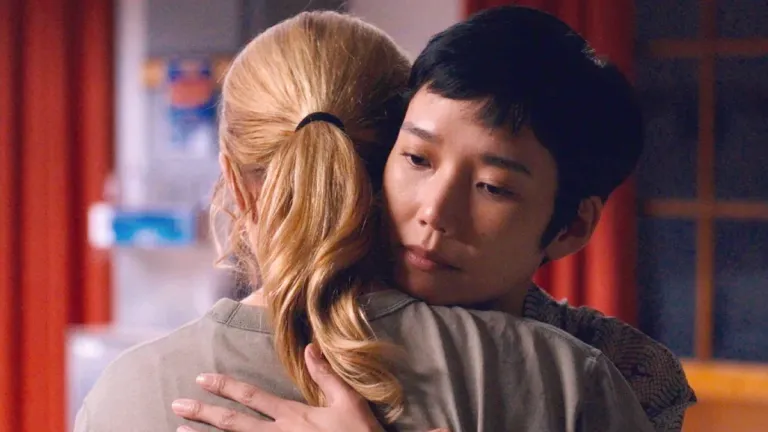
The film’s ending is a searing lament, yet one filled with a sense of liberation. In a deeply moving shot that visually pays homage to Pier Paolo Pasolini’s Teorema, Marie and Marilou embrace. The camera, positioned at a symmetrical angle, captures two different profiles of their faces. Death and life, philosophy and action, converge as a whisper resonates through the space: “There is no better world than this one, is there?” It is a magnificent surrender to this single lived moment in the face of eternity.
The final chapter unfolds with Marie’s death from cancer and the fulfillment of her last wish: to have her ashes scattered over the mist-shrouded mountains of Kyoto, at the very spot where she once stood with Marilou. The ashes disperse into the open mountain air: a pure image of disappearance, of vanishing without a trace, and of overcoming the terror of death. With All of a Sudden, Hamaguchi suggests that if capitalism has enslaved the body, time, and emotion, redemption lies not in defeating this colossal structure, but in reclaiming the small moments of touch, the sound of a bird that shatters our illusions, and the flight of ashes that no longer belong to any border or currency.
© 2026. Phoenix Review