



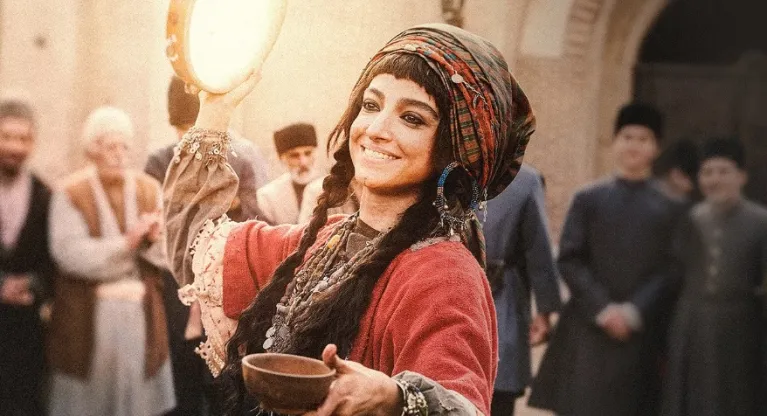
In a scene from the first episode of Red and Black, a series directed by Aida Panahandeh and recently released on the Filimo streaming platform, a young Romani woman named Fanoos dances with a tambourine in her hand, collecting money. When she approaches Nowruz, a young calligrapher and painter in the town, she coquettishly winks at him and asks for a coin to drop into her bowl. The playful glances and beautiful, doe-like eyes of Fanoos become the starting point for the events that follow in the series. It is a remarkable scene in which the woman is an active agent, and the central conflict of the story emerges through her actions. Fanoos, brought to life through Neda Jebraeili’s impressive performance, is yet another influential female character created by none other than Aida Panahandeh.
At 47, Aida Panahandeh has spent more than a decade establishing her name in the history of Iranian cinema as a successful woman filmmaker. A graduate of the Cinema program at the University of Tehran’s Faculty of Cinema and Theatre, where she earned her master’s degree, she demonstrated from her very first feature film, Nahid, that she not only understood the techniques and tools of cinema but also aspired to continue the path of great directors such as Bahram Beyzaie. Beyzaie was among the first filmmakers in Iranian cinema to place women at the center of his narratives, creating female characters unlike any that audiences had encountered in Iranian cinema before.
The women in Aida Panahandeh’s films and series are equally distinctive, each possessing particular qualities. They embody multiple, sometimes seemingly contradictory dimensions that nevertheless coexist without canceling one another out. Being a mother does not have to preclude being a lover, just as being a lover does not have to preclude being a mother. A woman is neither merely a victim of patriarchal relations nor an invincible heroine capable of transforming her life through a single, magical decision. Panahandeh’s women often live in the space between desire and impossibility: women who harbor desires for love, independence, security, and pleasure, while the world around them continually imposes limits on those desires.
What distinguishes the women in Panahandeh’s work above all is the complexity of their relationship with freedom. For these women, freedom is neither an abstract nor merely political concept. They live it. It is present in the smallest choices of their everyday lives: choosing a man to love, having the right to leave a relationship, making decisions about their own bodies, or even being able to experience happiness without feeling guilty.
In the world Aida Panahandeh creates, a woman is constantly confronted with a fundamental question: does she have the right to experience life as she wishes, even when her desires conflict with the expectations of her family, society, and its prevailing moral codes? This is the question Panahandeh pursues in her films and even her television series. It is precisely for this reason that the women in her work are bold and outspoken. No man, tradition, or law can simply stand in their way. They face their lives, and even their failures, with dignity. Women, too, have the right to fail, and they should not be humiliated for their failures.
In Aida Panahandeh’s first feature film, Nahid, Sara Bayat plays the title character, a young divorced woman with a teenage son who refuses to choose between being a mother and being with the man she loves. In her view, these two paths are not incompatible, but the social order does not allow her to pursue both. In many traditional narratives, motherhood entails the sacrifice of personal desires. Nahid, however, wants both her child and the right to fall in love. Her central conflict is not between good and evil, but between two legitimate rights that the social structures of a society such as Iran refuse to let coexist.
Nahid is by no means entirely independent or liberated. At times she conceals things, at times she is afraid, and at times she makes contradictory decisions, all while being crushed by economic pressures. It is precisely these imperfections that make her a believable character. Nahid represents a woman who wants to separate motherhood from the idea of self-sacrifice. The film was made in 2014 and received numerous awards at prestigious international festivals.
Panahandeh’s second film, Esrafil, tells the story of Mahi, a middle-aged woman played by Hedieh Tehrani, living in a town in northern Iran. She has recently lost her young son, and the return of her former lover, Behrouz, to the small town revives memories of her less-than-respectable past. Mahi is one of the most significant women in Panahandeh’s cinema because her predicament is about more than love: it is about the right to have a future after experiencing loss and social disgrace. She is a beautiful woman on the threshold of middle age, living in a closed community that expects her to remain trapped in the past and in mourning for her child. There is an unfinished love story behind her, a son she has lost, and a youth that has passed.
In this film, reproductive age and the possibility of motherhood also become criteria by which a woman is judged. Mahi is positioned in relation to Sara, Behrouz’s younger woman and present-day love interest, and an emotional choice becomes a question of youth, fertility, and a woman’s worthiness of love. Yet the film contains a contradiction of its own. Although it attempts to present Mahi as a woman in control of her choices, her final decision ultimately reproduces a form of feminine self-sacrifice that the narrative itself seeks to criticize. Does Mahi really make a choice? Or have social expectations become so deeply internalized that giving up her personal desires has come to seem like a moral virtue? The film was made in 2016.
One of the most distinctive, unconventional, and beautiful female characters Aida Panahandeh has created is Titi, played by Elnaz Shakerdoost in the important film of the same name, made in 2018.
Titi is a young woman who works as a cleaner in a hospital in northern Iran. At the insistence of the man she lives with, she also rents out her womb to help another couple conceive. Possessing extraordinary abilities, including the capacity to speak with animals and foresee people’s futures, she is an exceptionally sensitive and kind-hearted woman. If Nahid fights to preserve her rights, and Mahi remains burdened by the weight of the past and tradition, Titi experiences the world according to a different logic. She sees the world not merely through the lens of profit and loss, but through emotion, generosity, and human connection.
Her unique quality lies in her ability to preserve her desire for life in a world that continually humiliates and exploits her. Perhaps this is why she remains kind even to the man who sells the use of her womb, despite her consent. Titi’s character embodies a form of indirect resistance: a resistance that takes shape not through explicit protest or a raised voice, but through silence and a refusal to accept the dominant logic of masculine power in the world.
Titi is one of those celestial angels whose arrival in northern Iran remains something of a mystery. Through the power of her emotional generosity and feminine compassion, she brings not only Ebrahim, a university physics professor played by Parsa Pirouzfar, but the world itself to its knees.
Aida Panahandeh, whose artistic career also includes several short films and documentaries, made a remarkable impression with the creation of Mahrokh, played by Hoda Zeinolabedin, in her first streaming series, At the End of the Night. Mahrokh is a middle-class woman and the mother of a young child whose marriage has been thrown into crisis by financial pressures and emotional exhaustion. She is neither a flawless woman nor simply a victim of her husband. At times she is controlling, angry, strict, and incapable of communicating. Yet these very qualities distance her from the stereotypical image of the patient, endlessly self-sacrificing woman.
Mahrokh is a woman who no longer wants the entire burden of holding a family together to rest on her shoulders. If Nahid fights for the right to fall in love, Mahrokh fights for the right to be tired and to bring an exhausted relationship to an end. In this series, rather than focusing on a major dramatic event, Panahandeh concentrates on the accumulation of small forms of exhaustion: financial problems, grueling commutes, the heavy responsibilities of raising a child, sexual dissatisfaction, emotional neglect, silences, and recurring resentments.
What makes Mahrokh distinctive is that she does not need a tragic catastrophe to justify leaving a relationship. Sometimes emotional exhaustion within a relationship is itself an objective reality that warrants reconsidering whether a marriage should continue. Mahrokh, who fell in love with Behnam, her painting instructor played by Parsa Pirouzfar, when she was a university student studying painting, can no longer tolerate her husband’s indifference, emotional coldness, financial difficulties, and outbursts of anger—even if that husband happens to have a face as attractive as Parsa Pirouzfar’s. This approach results in one of the most mature forms of female characterization in Panahandeh’s work.
In my view, the most important quality of Aida Panahandeh’s women lies in their contradictions. They can be loving and angry, independent and vulnerable, kind and full of mistakes. At her best, Panahandeh’s cinema allows women to move beyond the familiar binary of the female victim and the female hero. From Nahid to Mahrokh, we can trace this courageous trajectory: from a woman fighting to have her desires recognized to a woman who is no longer willing to erase herself merely to preserve the appearance of a life.
Panahandeh also raises a more fundamental question in her work: why is the right to an ordinary life, the right to fall in love, make mistakes, experience pleasure, and even feel exhausted so difficult and costly for Iranian women? The answer must be sought not only in the fates of women in Iranian films, but also in the social and cultural relations that compel them to constantly explain themselves, fight, or sacrifice some part of who they are in order to claim their most basic human rights.
The most significant quality of the women created by Aida Panahandeh is that they are women who do not struggle to become heroines. They cry out: Let us be human beings first, and women second.
© 2026. Phoenix Review