



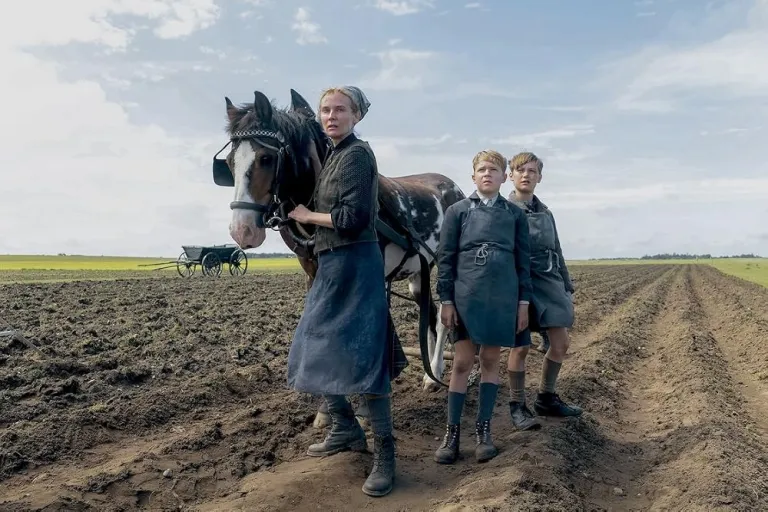
Fatih Akin’s cinema can be understood as a cinema of borders: borders sometimes drawn on maps, sometimes within people themselves. From Hamburg to Istanbul, from migration and alienation to violence and loss, Akin’s characters are often searching for somewhere to stand—a place between a past that refuses to let them go and a future that has yet to take shape. The German-Turkish filmmaker has repeatedly returned to the question of belonging, treating identity not as something fixed but as something forged through a person’s encounters with history, family, geography, and memory. This time, however, his camera leaves behind turbulent cities and cultural frontiers for a small island in the North Sea. Here, in the final days of the Second World War, the tranquil yet harsh natural world of Amrum stands in contrast to one of the darkest chapters in German history. Amrum begins with precisely this contradiction: an island that might resemble the world’s last refuge, yet whose soil and houses bear the weight of a troubled past; and a child who, at the very moment this world begins to collapse, must learn anew what family, belonging, and truth mean.
Amrumtakes place in the spring of 1945, as the Second World War approaches its end and Nazi Germany stands on the brink of collapse. Yet Akin tells the story from a place seemingly far removed from the center of this devastation: an island in the North Sea where life still follows the rhythms of nature, the sea, agriculture, and old traditions. Here, war is present less on the battlefield than in food shortages, the absence of men, the anxiety of families, the arrival of refugees, and the fear of what lies ahead. Rather than viewing history from above, the camera follows it on the scale of everyday life, from a child’s eye level.
At the center of this world is Nanning, a twelve-year-old boy who has come with his mother, sister, and brother from Hamburg to his mother’s ancestral home on Amrum. From the outset, this relocation places him in a contradictory position. On the one hand, through his mother’s family, Nanning considers himself an Amrumer; on the other, the islanders do not see him that way. The arrival of Polish refugees makes this divide even more apparent. The schoolchildren draw a line between insiders and outsiders, and Nanning, despite belonging to a family whose roots on Amrum stretch back generations, is treated as a stranger because he was born and raised in Hamburg. He is neither entirely from Hamburg nor sufficiently Amrumer. Jasper Billerbeck conveys this duality with a restrained, understated performance, expressing it largely through Nanning’s glances and brief pauses. This contradiction is one of the film’s most subtle ideas, because Amrum explores identity not only on a national scale but within the smallest geographical unit imaginable. Even an island has its own criteria for accepting someone. To counter this rejection, Nanning’s mother appeals to ancestry and blood. She tells him that although he was born in Hamburg, the blood of nine generations of Amrumers runs through his veins, and that their family descends from whalers. In his mother’s eyes, then, being Amrumer is hereditary, almost biological—something that must be proven through blood. Gradually, however, the film reveals that belonging, contrary to her belief, cannot be acquired through ancestry alone. Nanning must live it, experience it, and even pay a price to be accepted.
From this point on, his central mission takes on a different meaning. On the surface, after his mother gives birth prematurely and sinks into depression, Nanning tries to find her white bread, butter, and honey—foods that, under conditions of scarcity and famine, have become almost impossible to obtain. After hearing the news of Hitler’s death, his mother stops eating and asks for nothing but this simple combination. Nanning goes from house to house to fulfill her wish, bargaining with the islanders, exchanging one thing for another, and gradually gathering the ingredients he needs. But this quest is more than a child’s attempt to make his mother happy. On a deeper level, with every step Nanning takes, he is trying to find his place on the island; he wants to prove that he truly belongs there. Bread, butter, and honey thus become symbolically charged objects. On one level, they represent the simple needs of a depressed mother; on another, they are the price of Nanning’s admission into Amrum’s community. Through these small exchanges, he must learn the island’s social relations and discover how to fight for what he wants in a world where everything has a value and a price. His quest resembles a rite of passage: the boy from Hamburg must pass the island’s tests before he can consider himself an Amrumer.
Sometimes these tests take a very tangible form. One of the film’s key scenes involves imitating seals. On the shore, Nanning must mimic the animal’s movements in order to hunt it. Here, too, Billerbeck conveys Nanning’s stubbornness and vulnerability through his physical gestures, without exaggeration or theatricality. The scene appears simple, even playful, but within the film it acquires a meaning that extends beyond the immediate action. To survive, Nanning must learn the rules of a place to which he claims to belong. His body must adapt to the shore, the sea, and the animals that inhabit this landscape. Becoming an Amrumer, it seems, requires more than knowing one’s name and ancestry; it means learning how to live in this environment. His first experience of hunting rabbits follows the same pattern. Nanning goes hunting with his friend and then has to gut the rabbit himself. At this moment, the camera draws him out of the protected world of childhood and confronts him with the reality of death. The film does not turn this encounter into an explicit moral lesson. In this world, death is part of the machinery of survival. To eat, the child must hunt; to hunt, he must confront the animal’s dead body. Alongside the seal hunt and the discovery of a man’s corpse washed ashore, this experience gradually expands Nanning’s understanding of death. Death is no longer merely a radio report about Hitler or a distant event on the battlefront. It becomes something tangible, something he can touch.
Nanning also enters a rudimentary system of barter. To obtain white flour, sugar, or butter, he must possess something that someone else considers valuable. He seeks help from different people, gives something in exchange for something else, and in the process comes to understand the network of relationships that holds the island together. These encounters also shape the film’s narrative structure: a very simple mission that encounters a new obstacle at every turn, pushing Nanning one step further away from childhood.
Beneath this quest, however, lies a past that calls into question the very meaning of familial belonging. Nanning’s family is not merely the heir to nine generations of life on Amrum; it is also the heir to a dark chapter in that family’s history. Uncle Theo’s presence in the film transforms this past from a passing family reference into a moral wound. Theo, Nanning’s mother’s cousin, left for America years earlier to work on a whaling ship and, with the outbreak of war, was unable to return to the island. The whaling knife he left behind, which Nanning discovers in an old chest in the house, becomes an object connecting two histories: the history of Amrum’s seafaring and whaling traditions, and the history of violence that entered his family with the rise of Nazism.
It is here that Amrum’s connection to Moby-Dick takes on greater depth. Nanning is not simply a child living on an island by the sea, discussing Herman Melville’s novel with his friend; he comes from a family whose ancestors made their living from whaling. Uncle Theo’s whaling knife, before it becomes merely a family keepsake, places the family’s actual past in tension with the version of that past his mother tells Nanning. His mother speaks of blood and lineage, but the knife recalls what that lineage has passed through: the sea, migration, labor, loss, and people separated from their homes and families by political history. The stories of Theo and Ruth form the dark core of this family history. Theo was in love with Ruth, but under the shadow cast over everything by Nazi power and ideology, his return and his relationship with her become impossible. Ruth is denounced to the Nazis and killed, while Theo remains in America. What shocks Nanning even more is the realization that his mother and the rest of the family were not merely uninformed witnesses to this tragedy. Because of Nanning’s father’s position and the family’s place within the power structure, his mother could have helped Theo and Ruth, but chose not to.
At this point, Amrum moves beyond a coming-of-age story and becomes a film about moral inheritance. Nanning is not responsible for his parents’ crimes, but he cannot escape knowing about them. Uncle Theo returns to him in a dream, confronting him with a past that has remained hidden beneath the family’s official narrative. The central idea of this encounter is crucial: Nanning is not guilty, but he is implicated in this inheritance. This distinction between guilt and responsibility is one of the film’s most significant achievements. Nanning cannot be punished for the decisions of his mother, his father, or the generations who lived before him, but neither can he pretend that this past has nothing to do with him. One of the strengths of Billerbeck’s performance is his ability to make this inner transformation visible in Nanning’s face and silences, without spelling it out. It is precisely here that the meaning of being Amrumer changes. If, at the beginning of the film, his mother defines belonging through blood and nine generations of ancestry, by the end Nanning faces a more difficult truth. An inheritance is not only something to be proud of; sometimes it is something that must be acknowledged, confronted, and prevented from recurring.
Moby-Dick, then, is not merely a favorite book shared by two children. Alongside Ahab’s pursuit of the white whale lies the history of Nanning’s family’s whaling past, a history bound up with the sea, travel, and hunting that later gives way, within his family’s story, to political violence and separation. Nanning’s whaling ancestors, his relationship with the sea, and Uncle Theo’s knife all form a network of meanings with Melville’s novel. On one side are the sea and hunting as a way of life and as part of the island’s inheritance; on the other is Ahab’s ship, driven by its captain’s destructive obsession. In this sense, Moby-Dick becomes a language through which two kinds of inheritance can be understood: the inheritance one receives from one’s land and family, and the inheritance that may be passed on to the next generation in the form of a destructive obsession or ideology. Even Nanning and Hermann’s games, in which they imagine Ahab as Hitler, the ship as Germany, and speculate about what the white whale might represent, acquire a new significance within this framework. Through a maritime story, the children are trying to understand their own history. They do not yet have the language to articulate the complexities of politics, historical responsibility, and atrocity, but they can grasp the relationship between a man consumed by obsession and a ship that carries its crew toward destruction.
For this reason, Nanning’s journey to obtain a piece of white bread with butter and honey is deceptively small in scale but expansive in meaning. At first, he wants to save his mother; then, he wants to prove that he is an Amrumer. Along the way, this effort forces him to confront animal bodies, death, hunger, refugees, exclusion, and his family’s past. Eventually, he discovers that the question is not simply whether he belongs, but what he belongs to. Through this seemingly modest journey, Amrum poses one of its most complex questions: Can one embrace the inheritance of a place without also accepting its dark legacy? At the beginning, Nanning wants to prove that he is an Amrumer; by the end, he must redefine what being an Amrumer means. Neither blood, nor ancestry, nor an ancestral home is sufficient in itself. If belonging is to have an ethical meaning, it must involve a choice. Nanning cannot change his family’s past, but he can decide not to perpetuate it.
Perhaps this is where Akin’s cinema returns once again to its enduring concern with belonging. This time, the conflict does not unfold between two countries or two cultures; it takes place within a single island and a single family. Amrum shows that sometimes the most difficult border is not the one drawn between two territories, but the one a person must draw between himself and a past that was fashioned for him before he was born.
© 2026. Phoenix Review