



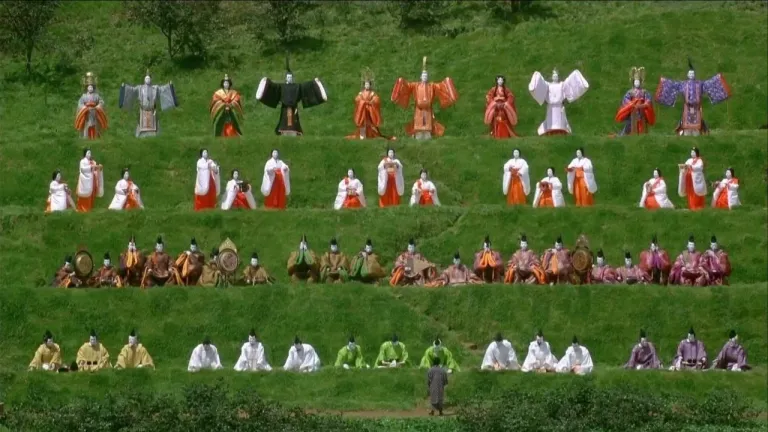
Akira Kurosawa’s cinema has consistently offered a comprehensive and profound vision of humanity’s fundamental concerns, the boundaries of morality, the erosion of values, and human existence in today’s increasingly corrupted world. His enduring and acclaimed masterpiece Dreams (1990), through its episodic and deeply personal form, delves into the collective trauma of the Japanese people during the protracted aftermath of the Second World War. At the same time, it reaches beyond the constraints of any particular time or place to address universal and far-reaching themes—ones that have acquired an unsettling new resonance for Iranians over the past year and a few months, especially when we recall the period when Trump implicitly threatened to destroy our homeland’s civilization. In this respect, the masterpiece by the emperor of Japanese cinema feels strikingly relevant today.
Kurosawa brings together elements of fantasy and personal reflection to reimagine the concerns of his later years through fluid, often nightmarish visions. He raises unanswerable questions through the medium of imagination, making the unimaginable dimensions of catastrophe visible before our eyes. Among the film’s various episodes, three are directly or indirectly bound up with war, destruction, and its horrific, unforgivable consequences. These episodes are not only psychological and historical explorations of a nation wounded by catastrophe; they also serve as warnings to all humanity about the madness of power, the conflict between technology and nature, and the potential annihilation of life on Earth.
The consequences of the Second World War in general, and the unprecedented catastrophe of the American atomic bombings of Hiroshima and Nagasaki in the final days of the conflict in particular, are central to these three episodes. Moving beyond reductive historical narratives and purely documentary descriptions, Kurosawa elevates these profound human traumas into the realm of visual and psychological metaphor. He seeks the presence of war not on battlefields amid smoke and gunpowder, but in the troubled consciences of survivors, the wandering shadows of the dead, and the poisoned wasteland left by atomic explosions.
One: Reviewing a Battalion of Ghosts — The Purgatory of Responsibility and the Price of Guilt
Perhaps Kurosawa’s most brilliant visual and dramatic conception in the film appears in the episode about a former military commander or officer. The sequence opens with an image of the officer walking alone along a desolate, dusty road at dusk. The road leads him to the entrance of a dark, terrifying tunnel, a passage that seems to belong to purgatory. Naturally, the tunnel is more than an architectural structure or a physical passageway: it becomes a metaphor for the horrifying threshold between life and death, memory and oblivion, guilt and remorse.
As the officer emerges from the tunnel, a bloodied dog leaps out of the darkness, letting out an ominous whine. A bomb is strapped to its body: another manifestation of the war’s naked, animalistic, uncontrollable violence. Then a young soldier emerges from the darkness, his face deathly pale. The soldier, who served under the officer during the war, does not yet realize that he is dead. With a voice steeped in sorrow, he speaks of his home, his parents, and the warm meal that had been waiting for him. He asks his commander why he and his fellow soldiers had to be annihilated.
Then, to the reverberating sound of heavy, orderly military footsteps, an entire battalion of fallen soldiers emerges from the same dark tunnel and forms ranks before the officer. Trapped in the purgatory of his own conscience, the surviving officer is forced to review the very regiment and battalion he once commanded, every member of which has perished. This review of a vanished battalion of ghosts, standing before their commander with rigid postures, lifeless eyes, and faces stained by the darkness of death, is a profoundly Kurosawan metaphor.
These soldiers are innocent victims sent to the slaughter in the name of the homeland, hollow ideals, or military orders. They stare at their commander expectantly. He has survived, but he has sent all his men into the arms of death. The officer’s bitter cries and tears before these soldiers, his admission of guilt and inadequacy, and the merciless compulsion to review them as they march once more back into the darkness of the same purgatorial tunnel resonate powerfully in the present day as well. The human, psychological, and moral consequences of war do not disappear with the signing of ceasefire agreements or peace treaties, nor do they fade with the passage of time. They continue indefinitely within the troubled consciences of survivors and commanders.
Two: The Disaster at Mount Fuji and the Nuclear Nightmare — The Destruction of Life and Nature’s Revolt
In another episode, Kurosawa confronts the historical trauma of the atomic bombings of Hiroshima and Nagasaki directly, while also addressing the looming dangers posed by nuclear power plants and uncontrolled technology. The story begins in an apocalyptic landscape in which nuclear power plants at the foot of Mount Fuji explode one after another. The sky turns red, yellow, and purple, while torrents of lava and clouds of radioactive poison engulf the entire horizon. Mount Fuji, Japan’s most sacred, beautiful, and enduring symbol of nature and national identity, burns and crumbles beneath a rain of atomic clouds.
In this apocalyptic wasteland, people flee in panic and terror toward the sea, but the sea offers no escape either. The end of the world has arrived. Amid the chaos, only three people remain: a young man, who is the familiar alter ego and narrator of Kurosawa’s dreams; a woman with two small children; and a nuclear engineer or scientist who played a role in the construction and development of these power plants. Fully aware of what the colored radioactive clouds signify, the scientist explains what kinds of toxic, deadly substances each color represents—substances that will soon melt their victims’ lungs and cause agonizing cancers.
The scientist’s guilt in this episode is directed at a form of modernity that has placed a destructive power in human hands without considering its ethical and environmental consequences. At the end of the episode, overwhelmed by remorse and confronted with the innocence of the children, he throws himself from a cliff into the poisoned sea. Kurosawa suggests that the atomic catastrophe of Hiroshima and Nagasaki is not merely a historical event. Its malevolent spirit still hovers over humanity, threatening at any moment to destroy the entire biosphere.
Three: The Mountain of Giants and Mutated Creatures — Humanity’s Deformation in a Post-Destruction World
The third episode connected to war and environmental catastrophe can, in a sense, be understood as a continuation of the same nuclear nightmare. The young narrator enters a dark, rocky land where everything has become distorted and deformed. As a result of nuclear contamination and devastating atomic wars, flowers and plants have grown to the size of giant trees, assuming grotesque and terrifying shapes. In this infernal environment, the people who survived the explosions have undergone genetic mutations, transforming into giants or one-horned demons.
The narrator encounters one of these one-horned giants, who was once an ordinary, responsible person. The giant explains how the horns growing from their heads cause excruciating, unbearable pain, forcing them to groan and scream day and night. Once masters of the Earth, waging wars and accumulating weapons of mass destruction, they are now condemned to devour one another in this hell of their own making, writhing in eternal agony.
Through this extraordinary allegory, Kurosawa depicts humanity’s moral and physical deformation. In his vision, nuclear war does not merely destroy cities; it also corrupts human nature and the beauty of the natural world. The groaning, one-horned demons wandering the mountains may be the very leaders and military figures who, driven by the madness of warmongering, created hell on Earth and now burn in the flames of their own making.
Four: The Universal Reach of Kurosawa’s Themes and Visual Form
What connects these three war-related episodes in Dreams is their exploration of the profound psychological, historical, and philosophical roots of catastrophe. Kurosawa views the atomic bombings of Hiroshima and Nagasaki not simply as a source of national suffering for the Japanese people, but as a trauma for all humanity. He condemns the United States as the direct perpetrator of these atomic atrocities and identifies warmongering powers as the principal agents of destruction. Yet his critique extends further, encompassing modernity as a whole and an instrumental rationality severed from ethical considerations.
Formally, the director’s use of vivid colors, dazzling paintings as elements of production design, long and oppressive silences, and maximalist compositions lends the film a sense of solemnity and elegiac mourning. Rather than relying on restless, crowded camera movements, he employs static, dignified frames that give the audience time to contemplate the full depth of the catastrophe.
This late-career work by one of cinema’s giants is a meditation by an aging master. Although Kurosawa would return behind the camera twice more, Dreams stands as an exquisite testament to humanity’s corruption. By summoning the spirits of war’s victims, revealing the ashes of nuclear nightmares, and portraying humanity’s deformation in the wasteland left by atomic explosions, he warns us that unless human beings learn from their past and accept moral responsibility for their actions, their dreams will become nightmares from which there is no escape.
© 2026. Phoenix Review