



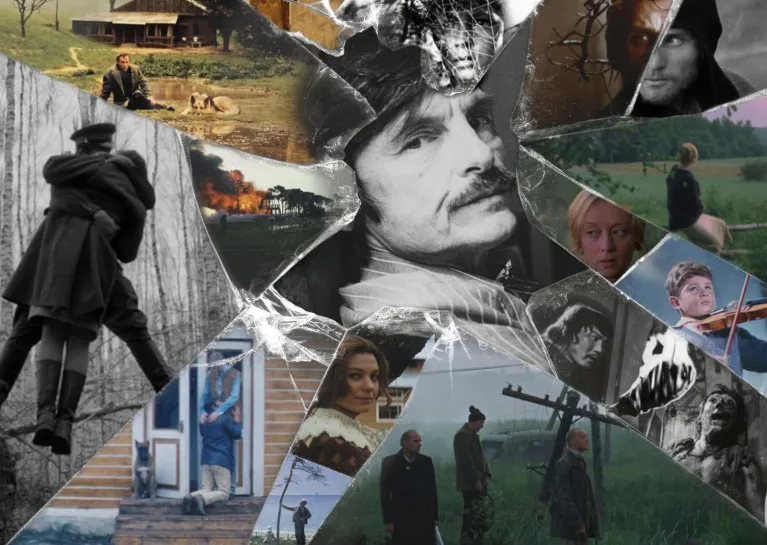
Among twentieth-century filmmakers, few have brought the question of time so explicitly and consciously to the center of their cinematic theory and practice as Andrei Tarkovsky. Even the title of his theoretical book, Sculpting in Time: Reflections on the Cinema, indicates that time is not merely one formal element of cinema alongside image, editing, sound, and mise-en-scène, but the very substance of cinema itself. Explaining the relationship between cinema and time, Tarkovsky writes: “Time, imprinted in its factual forms and manifestations, is the supreme idea of cinema as an art” (Tarkovsky, 1989, p. 62). He regards cinema as an art that expands the possibilities of temporal experience for human beings. Elsewhere in the book, he writes that spectators go to the cinema to experience “lost time, spent time, or time yet to be experienced” because, unlike any other art, cinema expands an individual’s experience (Tarkovsky, 1989, p. 63). In his view, the filmmaker’s fundamental task is “sculpting in time.”
This definition of cinema carries far-reaching theoretical implications. If we understand a film not merely as a collection of images but as an embodiment of time, many features of Tarkovsky’s cinema that might initially appear to be stylistic characteristics—long takes, stillness, slow camera movements, pauses, silence, repetition, wandering, dreams, memory, and waiting—become components of a unified theory. What connects these elements is an attempt to liberate time from the dominance of narrative and transform it into a palpable experience.
In this sense, “waiting” in Tarkovsky’s cinema should not be confused with narrative suspense. For Tarkovsky, waiting does not necessarily mean waiting for an event to occur. Sometimes a character is waiting; sometimes the spectator is waiting; and sometimes the film itself seems to be waiting for something that has not yet acquired a definite name or form. This waiting may be for a return, redemption, a miracle, home, memory, love, faith, or even death. What all these forms have in common, however, is that the future has not yet become the present. Rather than filling this interval with narrative momentum, the film preserves it. Tarkovsky’s cinema can therefore be understood as a cinema of “the interval between the present and what has not yet arrived.” To understand this idea, however, we must first return to Tarkovsky’s own conception of time, which in Sculpting in Time emerges not as an abstract theory but through its relationship to personal cinematic experience, memory, art, ethics, and death.
Tarkovsky describes his book as a study of “the cinematic figure” and argues that what matters is the way time flows within a shot: its tension or attenuation, or, more precisely, “the pressure of time within the shot.” At first glance, he appears to subscribe to the classical opposition between the shot and montage, clearly taking the side of the shot, since the cinematic figure exists only within it. Yet this is merely a superficial impression. The force or pressure of time extends beyond the boundaries of an individual shot, while montage itself operates within time and is animated by it. For Tarkovsky, the idea of the cinematic figure finds its realization in Stalker: the cinematographer must succeed in fixing time through indicators or signs that can be perceived by the senses.
Tarkovsky’s theory of time may initially seem complex, but it is not, in itself, particularly difficult to understand. What makes his cinema challenging is its praxis, or practical realization. Precisely identifying the “time-image,” which is necessary to maintain the desired consistency in the level of temporal pressure between shots, is no easy task. The temporal wave must be allowed to propagate freely from one shot to the next. Otherwise, a form of resistance emerges against the “gap,” and the purity of visual and auditory situations—the basis for the direct perception of time—is lost.
Gilles Deleuze writes about the significance of this “gap” in the sensorimotor connection:
“In what is called modern cinema, something different happens from the outset. The ‘sensorimotor’ schema is no longer operative, but it has not been shattered or surpassed; rather, it has been broken from within. Perceptions and actions are no longer linked together, and spaces are neither coordinated with one another nor filled in [that is, gaps have appeared]” (Deleuze, 1989, pp. 40–43).
It is here, within these “gaps,” that a reversal takes place: time is no longer dependent on movement; instead, aberrant movement becomes dependent on time. The static relationship between the sensorimotor connection and the indirect image of time gives way to a nonlocalized relationship between pure optical and sound situations and the direct image of time. Modern cinema, therefore, is not a language that operates through predefined cinematic units, such as the shot as a basic unit or the montage cell. Nor is montage a supra-unitary system that organizes sub-unitary shots (Deleuze, 1989, pp. 40–43). Tarkovsky’s films operate in the interstitial space between narrative experience and dreamlike experience, characterized by a form of poetic expression grounded in temporal duration and spiritual themes. Rather than serving merely as vehicles for expanding the plot and advancing the narrative, these films enact a kind of cinematic asceticism that refuses to offer ready-made meanings or answers.
One of the most fundamental theoretical passages in Sculpting in Time is the chapter titled “Imprinted Time.” At the beginning of this section, Tarkovsky cites a conversation from Dostoevsky’s novel Demons concerning the end of time, distinguishing between historical time and existential time. In Dostoevsky’s novel, Stavrogin tells Kirillov, “In the Apocalypse, the angel swears that there will be no more time.” Kirillov agrees, adding, “When all mankind has attained happiness, there will be no more time, because it will no longer be needed.” Stavrogin then asks, “Where will they put it, then?” To which Kirillov replies, “They won’t put it anywhere. Time is not a thing. It is an idea. It will die out in the mind” (Tarkovsky, 1989, p. 57).
Tarkovsky continues: “Time is a condition for the existence of our ‘I’… What is commonly called death is the death of an individual’s time” (Tarkovsky, 1989, p. 57). A little later, he adds that human beings need time in order to come into their own “as a personality.” This statement offers an apt starting point for understanding his cinema. For Tarkovsky, time is not merely something that passes over human beings; it is within time that human beings take shape. Consequently, linear and quantitative time—that is, time that merely enables us to carry out tasks—is insufficient to explain human experience. He explicitly states that he does not mean linear time: the kind of time in which one can perform an action and achieve a result.
This distinction is crucial to understanding waiting. If we regard time solely as a means of accomplishing tasks, waiting becomes nothing more than wasted time. Within such a system, the person who waits is someone who has not yet done anything and is therefore wasting time. But if time is itself the medium in which human existence takes shape, waiting is no longer a period of inactivity; it can become a mode of being. This is one of the most important differences between Tarkovsky’s cinema and a cinema that places time primarily at the service of action. In a film where time is subordinate to action, a moment in which nothing happens must be shortened. In Tarkovsky’s cinema, by contrast, that very moment in which “nothing happens” may contain the film’s most significant temporal experience. Tarkovsky then offers what might be considered the core of his philosophy of time: “History is not time, nor is evolution. Both are consequences. Time is a state: the flame in which the salamander of the human soul lives” (Tarkovsky, 1989, p. 57).
Time, then, is no longer a linear sequence in which events are arranged but a “state”: the medium in which human beings exist. It follows that time cannot be explained merely by listing the events of a life. Time is something that must be experienced. And this is precisely what cinema makes possible for Tarkovsky. Having defined time as a condition of existence, he goes on to connect it with memory, writing: “Time and memory merge into each other; they are like the two sides of a coin” (Tarkovsky, 1989, p. 57).
This connection between time and memory helps explain the temporal structures of many of his films. If memory were merely a repository of images from the past, we could separate the past from the present. For Tarkovsky, however, memory is part of the present itself. The past remains alive in the present, and characters encounter it not through a logical reconstruction of what has happened but through its palpable presence in present time. This is why Mirror cannot be understood as a film that simply recounts the director’s past. The past is not reconstructed as an event that has come to an end; it is experienced as something that continues to inhabit the present. Images of childhood, the house, the mother, war, nature, and the poetry of Arseny Tarkovsky are not arranged in a linear temporal order. Instead, they superimpose different layers of time within a single cinematic present.
The same structure can be observed in Solaris. At the beginning of the film, Kris appears to be living in the present, but the past gradually begins to infiltrate it. Hari, a woman who appears to have died, returns as an embodiment of memory and past guilt. Here, the past is not something Kris can simply recall; it enters the present as a living being. In Nostalgia, the situation becomes more complex still. The past is no longer merely personal; it becomes bound up with homeland, language, home, culture, and belonging. Both Domenico and Gorchakov live, in a sense, within lost time. Nostalgia in this film is precisely the experience of losing something that belongs to the past yet remains present in the here and now. We can therefore understand waiting and memory in Tarkovsky’s cinema as two opposing but complementary movements. Memory draws the present toward the past, while waiting directs the present toward the future.
Tarkovsky uses the metaphor of sculpture to define filmmaking. Just as a sculptor extracts the final form from a mass of stone, the director extracts what is essential to a film from a “mass of time”—the vast, dense accumulation of living realities (Tarkovsky, 1989, pp. 62–63). This definition should not be understood as merely a poetic metaphor. For Tarkovsky, the raw material of cinema is reality as recorded in time. The director does not first construct something and then place it in time; rather, they discover and shape the time already present in reality. This is also why Tarkovsky approaches editing with caution. In the chapter “Time, Rhythm, and Editing,” he writes that the dominant and determining factor in the cinematic image is the rhythm that expresses “the course of time within the frame” (Tarkovsky, 1989, p. 113).
Here, one of the most significant theoretical differences between Tarkovsky and conventional understandings of editing and the montage theory of Russian filmmakers, including Eisenstein, becomes apparent. For Tarkovsky, editing does not generate the film’s rhythm in and of itself. Rather, rhythm exists prior to editing, within the time unfolding in each shot. For Eisenstein, it was the cut that determined the meaning of a film; for Tarkovsky, however, time is the governing force that shapes editing techniques. The time within the frame therefore expresses something that extends beyond the visible events on the screen and the actions unfolding within the frame. In Tarkovsky’s view, Eisenstein’s theoretical framework of “montage of attractions”—a dialectical editing method that places two concepts (thesis and antithesis) alongside one another to produce a third, new concept (synthesis)—cannot fully explain the nature of cinema. Tarkovsky’s theory thus emerges from what he regards as an incomplete understanding of time in Eisenstein’s theory, whose temporal concepts bear a strong resemblance to the indirect perception and processing of time in Newtonian physics (Tarkovsky, 1989, pp. 113–125).
Eisenstein’s montage of attractions produces a kind of “explosion of meaning,” prompting viewers to infer specific ideas and concepts. By contrast, Tarkovsky’s temporal rhythms offer a way of seeing life in its very essence and representing the actual movements of life. Moreover, this poetic expression of the material world can exceed the artist’s original intentions and be received and experienced differently by each viewer. Nevertheless, David Menard argues that “although Tarkovsky and Eisenstein may initially appear to hold opposing views on montage, Sculpting in Time incorporates certain categories of Eisensteinian montage into its own editing system, including rhythmic, tonal, and overtonal montage” (Menard, 2003).
Even if we agree with Menard, we cannot disregard Tarkovsky’s assertion that the foundation and essence of art cinema lie in the internal rhythm of the shot itself. In his view, cinema is, in effect, a representation of distinct flows or waves of time—flows conveyed directly to the viewer through the shot’s internal rhythm. Unlike the Soviet montage theorists, Tarkovsky did not regard the cinematic image as the product of arranging different shots within a defined structure and temporal sequence. His argument was that if the cinematic image is not a combination or sum of different shots, then rhythm must be the primary and dominant element of a film. As he writes, “Rhythm is not determined by the length of the edited pieces, but by the pressure of time that runs through them” (Tarkovsky, 1989, p. 117). “Time-pressure,” therefore, refers to a quality that flows within a shot.
But what exactly does Tarkovsky mean by “time-pressure,” and how is this pressure felt within a shot? If we were to restate Tarkovsky’s argument in Deleuzian terms, time becomes material and tangible when we sense that something significant and real is at stake—something that exceeds the visual and auditory situations presented on screen. The audiovisual events depicted on screen are merely material signs of something that extends beyond the infinite possibilities of the image. The dominant force in Tarkovsky’s cinema is a two-way process: a film is truly alive within time only when time is also alive within it.
In Cinema 2, Deleuze takes up Tarkovsky’s concept of “the pressure of time within the shot” in his discussion of the “time-image.” As we have seen, for Tarkovsky, rhythm is not the product of a shot’s duration but the result of the temporal pressure flowing within it. For Deleuze, too, the “time-image” does not necessarily imply an absence of movement. An image may be highly dynamic, yet instead of concealing time, its movement can reveal it. “Waiting” in Tarkovsky’s cinema therefore has a dual structure: a character waits for something within the fictional world, while the viewer waits for a meaning that the film has not yet revealed.
The “crystal-image,” meanwhile, which forms the cornerstone of Deleuze’s concept of the “time-image,” is an image that brings together the pastness of a recorded event and the presentness of the moment in which it is viewed. The crystal-image is an indivisible unity of the virtual image and the actual image, shaping time as a constantly reciprocal mirror. It is highly significant both to Tarkovsky’s theory of “time-pressure” and to rhythmic montage. Unlike Tarkovsky, Deleuze does not accept that a long take—or the time recorded within a shot—possesses a value or a kind of temporality different from that recorded through montage, as in Eisenstein’s cinema. For Deleuze, this distinction is superficial, because the force or pressure of time extends beyond the boundaries of the shot; montage itself operates within time and lives in it.
For Tarkovsky, a true film resembles a living organism because, once it leaves the editing table, it continues to grow in form and meaning. The film separates itself from the author’s original intentions, allowing itself to be experienced and interpreted in personal and different ways, much like the unique and precious moments we encounter in real life. This approach represents a radical shift in modern cinema, liberating the film from the constraints imposed by its creator and allowing the work to live independently in time.
According to David George Menard, Tarkovsky applies his theory of editing based on “time-pressure” with great precision, down to the smallest elements of his films. In doing so, he establishes a separation between authorial intention and the viewer’s active participation. Menard argues that films such as Solaris and Mirror, as works of “time-memory,” allow each individual to develop a different understanding of what they see (Menard, 2003).
The concept of “time-pressure” is crucial to understanding “waiting.” If time were merely the duration of a shot, we could measure waiting in seconds. A five-second shot would be short, and a five-minute shot long. But Tarkovsky explicitly rejects this definition. Two shots of equal duration can produce entirely different experiences of time.
Tarkovsky asks how time makes itself perceptible within a shot. His answer is that time becomes tangible when the viewer senses that something meaningful and real is unfolding beyond the events on screen—something to which the frame merely alludes, extending it beyond its own boundaries and even toward infinity (Tarkovsky, 1989, pp. 116–117).
This definition offers a new way of understanding “waiting.” In Tarkovsky’s films, waiting emerges when the frame contains more than it shows. Something has not yet arrived; something remains unrevealed; or something exists outside the frame that the viewer nevertheless senses. Waiting, then, is not necessarily an anticipation of the next event, but an anticipation of the revelation of something the film deliberately postpones.
In Tarkovsky’s films, this postponement is often accompanied by movement. A character walks, the camera moves, water flows, the wind stirs the trees, and fire burns. Yet these movements do not necessarily drive the narrative toward an immediate conclusion. Movement becomes a vehicle for time. In this sense, contrary to the common perception, Tarkovsky is not a filmmaker of “slow cinema,” in Paul Schrader’s sense of the term. Rather, he is a filmmaker who does not separate time from movement, but transforms movement into a means of making time perceptible.
Tarkovsky uses the metaphor of sculpture to define filmmaking. Just as a sculptor extracts the final form from a mass of stone, the director extracts what is essential to a film from a “mass of time”—the vast, dense accumulation of living realities (Tarkovsky, 1989, pp. 62–63). This definition should not be understood as merely a poetic metaphor. For Tarkovsky, the raw material of cinema is reality as recorded in time. The director does not first construct something and then place it in time; rather, they discover and shape the time already present in reality. This is also why Tarkovsky approaches editing with caution. In the chapter “Time, Rhythm, and Editing,” he writes that the dominant and determining factor in the cinematic image is the rhythm that expresses “the course of time within the frame” (Tarkovsky, 1989, p. 113).
Here, one of the most significant theoretical differences between Tarkovsky and conventional understandings of editing and the montage theory of Russian filmmakers, including Eisenstein, becomes apparent. For Tarkovsky, editing does not generate the film’s rhythm in and of itself. Rather, rhythm exists prior to editing, within the time unfolding in each shot. For Eisenstein, it was the cut that determined the meaning of a film; for Tarkovsky, however, time is the governing force that shapes editing techniques. The time within the frame therefore expresses something that extends beyond the visible events on the screen and the actions unfolding within the frame. In Tarkovsky’s view, Eisenstein’s theoretical framework of “montage of attractions”—a dialectical editing method that places two concepts (thesis and antithesis) alongside one another to produce a third, new concept (synthesis)—cannot fully explain the nature of cinema. Tarkovsky’s theory thus emerges from what he regards as an incomplete understanding of time in Eisenstein’s theory, whose temporal concepts bear a strong resemblance to the indirect perception and processing of time in Newtonian physics (Tarkovsky, 1989, pp. 113–125).
Eisenstein’s montage of attractions produces a kind of “explosion of meaning,” prompting viewers to infer specific ideas and concepts. By contrast, Tarkovsky’s temporal rhythms offer a way of seeing life in its very essence and representing the actual movements of life. Moreover, this poetic expression of the material world can exceed the artist’s original intentions and be received and experienced differently by each viewer. Nevertheless, David Menard argues that “although Tarkovsky and Eisenstein may initially appear to hold opposing views on montage, Sculpting in Time incorporates certain categories of Eisensteinian montage into its own editing system, including rhythmic, tonal, and overtonal montage” (Menard, 2003).
Even if we agree with Menard, we cannot disregard Tarkovsky’s assertion that the foundation and essence of art cinema lie in the internal rhythm of the shot itself. In his view, cinema is, in effect, a representation of distinct flows or waves of time—flows conveyed directly to the viewer through the shot’s internal rhythm. Unlike the Soviet montage theorists, Tarkovsky did not regard the cinematic image as the product of arranging different shots within a defined structure and temporal sequence. His argument was that if the cinematic image is not a combination or sum of different shots, then rhythm must be the primary and dominant element of a film. As he writes, “Rhythm is not determined by the length of the edited pieces, but by the pressure of time that runs through them” (Tarkovsky, 1989, p. 117). “Time-pressure,” therefore, refers to a quality that flows within a shot.
But what exactly does Tarkovsky mean by “time-pressure,” and how is this pressure felt within a shot? If we were to restate Tarkovsky’s argument in Deleuzian terms, time becomes material and tangible when we sense that something significant and real is at stake—something that exceeds the visual and auditory situations presented on screen. The audiovisual events depicted on screen are merely material signs of something that extends beyond the infinite possibilities of the image. The dominant force in Tarkovsky’s cinema is a two-way process: a film is truly alive within time only when time is also alive within it.
In Cinema 2, Deleuze takes up Tarkovsky’s concept of “the pressure of time within the shot” in his discussion of the “time-image.” As we have seen, for Tarkovsky, rhythm is not the product of a shot’s duration but the result of the temporal pressure flowing within it. For Deleuze, too, the “time-image” does not necessarily imply an absence of movement. An image may be highly dynamic, yet instead of concealing time, its movement can reveal it. “Waiting” in Tarkovsky’s cinema therefore has a dual structure: a character waits for something within the fictional world, while the viewer waits for a meaning that the film has not yet revealed.
The “crystal-image,” meanwhile, which forms the cornerstone of Deleuze’s concept of the “time-image,” is an image that brings together the pastness of a recorded event and the presentness of the moment in which it is viewed. The crystal-image is an indivisible unity of the virtual image and the actual image, shaping time as a constantly reciprocal mirror. It is highly significant both to Tarkovsky’s theory of “time-pressure” and to rhythmic montage. Unlike Tarkovsky, Deleuze does not accept that a long take—or the time recorded within a shot—possesses a value or a kind of temporality different from that recorded through montage, as in Eisenstein’s cinema. For Deleuze, this distinction is superficial, because the force or pressure of time extends beyond the boundaries of the shot; montage itself operates within time and lives in it.
For Tarkovsky, a true film resembles a living organism because, once it leaves the editing table, it continues to grow in form and meaning. The film separates itself from the author’s original intentions, allowing itself to be experienced and interpreted in personal and different ways, much like the unique and precious moments we encounter in real life. This approach represents a radical shift in modern cinema, liberating the film from the constraints imposed by its creator and allowing the work to live independently in time.
According to David George Menard, Tarkovsky applies his theory of editing based on “time-pressure” with great precision, down to the smallest elements of his films. In doing so, he establishes a separation between authorial intention and the viewer’s active participation. Menard argues that films such as Solaris and Mirror, as works of “time-memory,” allow each individual to develop a different understanding of what they see (Menard, 2003).
The concept of “time-pressure” is crucial to understanding “waiting.” If time were merely the duration of a shot, we could measure waiting in seconds. A five-second shot would be short, and a five-minute shot long. But Tarkovsky explicitly rejects this definition. Two shots of equal duration can produce entirely different experiences of time.
Tarkovsky asks how time makes itself perceptible within a shot. His answer is that time becomes tangible when the viewer senses that something meaningful and real is unfolding beyond the events on screen—something to which the frame merely alludes, extending it beyond its own boundaries and even toward infinity (Tarkovsky, 1989, pp. 116–117).
This definition offers a new way of understanding “waiting.” In Tarkovsky’s films, waiting emerges when the frame contains more than it shows. Something has not yet arrived; something remains unrevealed; or something exists outside the frame that the viewer nevertheless senses. Waiting, then, is not necessarily an anticipation of the next event, but an anticipation of the revelation of something the film deliberately postpones.
In Tarkovsky’s films, this postponement is often accompanied by movement. A character walks, the camera moves, water flows, the wind stirs the trees, and fire burns. Yet these movements do not necessarily drive the narrative toward an immediate conclusion. Movement becomes a vehicle for time. In this sense, contrary to the common perception, Tarkovsky is not a filmmaker of “slow cinema,” in Paul Schrader’s sense of the term. Rather, he is a filmmaker who does not separate time from movement, but transforms movement into a means of making time perceptible.
In Mirror, Tarkovsky divides history into different temporal categories and situates the characters’ personal histories within them in order to reveal the unifying dimensions of time. The film contains three distinct temporal periods—the present, the recent past, and the distant past—which separate time from the apparently unified narrative of the protagonist Alexei’s personal history. Alexei is the film’s narrator, whose voice we hear in voice-over, off-screen narration. The present corresponds to approximately 1975. The recent past belongs to the postwar period of the mid-1940s, while the distant past reflects the prewar years of the 1930s.
Through carefully composed, dreamlike cinematography and meticulously structured mise-en-scène, particularly through color tonalities and sound design, Tarkovsky captures this temporal unity. He also harmonizes archival and documentary footage from these periods with the temporal sensibility of his own shots. In other words, he intercuts documentary images with “time-images” generated through editing based on “time-pressure.” This form of editing, which Tarkovsky had already employed in his graduation film, The Steamroller and the Violin (1960), stands in direct opposition to the Soviet montage style.
In his book, Tarkovsky describes memory as a spiritual concept, arguing that a person deprived of memory will ultimately lose their connection with the external world (Tarkovsky, 1989, p. 57). Mirror, then, is not simply a film about remembering; it is about the necessity of preserving one’s temporal connection with oneself. “Waiting” in this film is, in effect, a form of waiting to recover oneself.
Yet in none of Tarkovsky’s films does “waiting” come as close to a spiritual condition as it does in Nostalgia. Gorchakov lives in Italy but remains psychologically in Russia. He is caught between two places, two cultures, and two temporalities. Domenico, too, lives in a fragmented world and struggles toward a form of personal and collective redemption.
This spiritual condition reaches its culmination in the candle-carrying scene. Gorchakov must carry a lit candle across a long, difficult stretch from one side of a pool to the other without allowing the flame to go out. Narratively, the action is quite simple, but Tarkovsky prolongs it until the act itself becomes an extended suspension and a prolonged experience of “waiting.” The viewer waits for Gorchakov to carry the candle across the pool without extinguishing it, yet at the same time waits for something beyond his success. In this scene, time is no longer a means of reaching an outcome; instead, the very process of reaching that outcome becomes the meaning of the scene.
This is why, in his analysis of the sequence, Gerard Loughlin draws on Giorgio Agamben’s concept of “messianic time” to argue that Tarkovsky’s long take separates time from the mere succession of events. In this experience, the viewer waits for something whose emergence is made possible by waiting itself. If we connect this analysis to Tarkovsky’s own theory, the candle in Nostalghia is not merely a symbol of faith. The time spent carrying it transforms faith itself into an experience. Faith here is not a theoretical belief but a form of remaining—of staying with something. And to remain means to give time to something that has not yet happened.
In The Sacrifice, “waiting” takes on an even more fundamental form. The film opens with the threat of nuclear war and the possibility of the world’s destruction. The characters find themselves in a situation in which the future no longer appears as an ordinary possibility before them; instead, it takes the form of catastrophe. Faced with this situation, Alexander turns to a kind of vow and sacrifice. In The Sacrifice, waiting is not a character’s anticipation of some minor event, but the anticipation of the end of the world. Yet unlike Hollywood dystopian films, Tarkovsky prolongs time rather than rapidly depicting nuclear catastrophe. The catastrophe never actually occurs on screen, but the viewer waits for it until the very end of the film. A future that has not yet come to pass has already occupied the present.
In The Sacrifice, we encounter one of the central concerns of Tarkovsky’s intellectual world: faith. In Sculpting in Time, Tarkovsky also links art to the possibility of confronting death and spirituality. In his view, the purpose of art is not merely to convey ideas or provide instruction; art should prepare human beings for death and turn their souls toward the good (Tarkovsky, 1989, pp. 42–43). This understanding of art and life, grounded in faith, gives “waiting” a different meaning in his films. For Tarkovsky, waiting is a form of spiritual exercise. We wait because something lies beyond our power and will, something over whose occurrence we have no control. Waiting therefore requires us to accept the limits of our agency. From this perspective, Tarkovsky’s cinema stands in opposition to a cinema in which every problem is resolved through action. In his world, one must have faith, and one must wait.
Heidegger demonstrated that the future is not simply a collection of events that have yet to occur, but one of the fundamental dimensions of the temporality of existence. In his view, human beings are always open toward their own possibilities. Tarkovsky translates this idea into the language of cinema. His characters often find themselves confronted with something that has not yet come to pass. But this “not yet” is not merely a narrative delay; it is a quality of existence. In Stalker, we have not yet entered the Room. In Nostalghia, we have not yet carried the candle to its destination. In The Sacrifice, we still do not know whether the world will be destroyed. In Solaris, we still do not know whether Hari has truly returned or whether her return is a representation of desire and memory. In Mirror, we do not know precisely where memory begins or where it ends. This “not yet” is the temporal space in which the film lives.
In conventional classical narrative cinema, many moments and stretches of so-called dead time are removed through editing because they are considered informationally unnecessary. A character leaves home, and the film can cut directly to their workplace. The time between these two points has no narrative significance. For Tarkovsky, however, this dead time may be precisely what cinema must preserve, because time is not merely what lies between two events; time itself is part of the experience of life. Eliminating dead time may therefore mean eliminating part of the truth. In his discussion of rhythm, Tarkovsky emphasizes that the time recorded within the frame must be connected to the “life of the object” within it. In his view, a film that organizes this time artificially and superficially lacks temporal truth (Tarkovsky, 1989, pp. 116–118).
The philosophy of “waiting” in Tarkovsky’s cinema cannot be separated from the question of death. If time is the condition of the existence of the self, then death marks the point at which an individual’s time comes to an end. In Sculpting in Time, Tarkovsky establishes a connection between death and the end of individual time. He writes that the moment of death also marks the death of a person’s particular time, after which their life becomes something inaccessible to those who remain (Tarkovsky, 1989, p. 57). Cinema, then, is for Tarkovsky an attempt to resist this disappearance.
Tarkovsky’s philosophy of time cannot be reduced to the simple claim that he makes long, slow films. He understands time as the condition of human existence, memory, and ethical becoming. For Tarkovsky, time is not a neutral line along which events are placed, but a living medium in which human beings take shape. Cinema is therefore an art capable of recording, preserving, and making time experienceable.
Tarkovsky’s films are filled with scenes of return: the return home, the return to childhood, the return of the dead, the return of memory, the return to faith, and the return to nature. These returns are never fully realized, because if they were, there would no longer be any “waiting.”
© 2026. Phoenix Review