



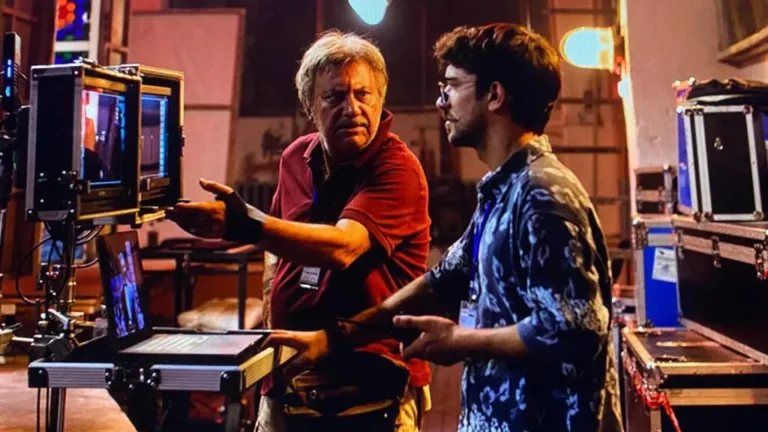
Shahram Mokri, long regarded as one of the most challenging and controversial filmmakers in Iranian cinema, opens his latest work, Black Rabbit, White Rabbit, not with a linear narrative but with a philosophical paradox: Chekhov’s famous principle of the gun. In this film, the gun does not merely fire—it seems to shatter the very structure of cinema itself. The result is an ambitious attempt at a multilayered psychological drama that constantly blurs the boundaries between reality and imagination, plunging the viewer into a state of profound bewilderment. But does this complexity come at the cost of losing sight of the human element?
1. A Suffocating Structure: Formal Vertigo Instead of Substance
The film’s first—and perhaps greatest—challenge is that the filmmaker appears trapped within the labyrinth he has created. Black Rabbit, White Rabbit is constructed with such elaborate complexity that at times it feels as though Mokri is playing more with the camera and the editing than with his characters. The transition from the first chapter, “The Spirit Breathes,” which begins as a family drama centered on Sara, to subsequent chapters revealing multiple layers of a film production in Tajikistan, is so abrupt and unpredictable that the audience spends more energy trying not to get lost than engaging with the characters’ destinies.
This complexity functions less as an intriguing puzzle and more as a barrier to emotional connection. When form reaches this degree of intricacy, content becomes its casualty, leaving us with a film that is technically sophisticated yet lacking in simple, accessible human resonance.
2. The Collapse of Boundaries: When Genres Collide
In this work, Mokri deliberately and aggressively dismantles the boundaries of time, space, and genre. The story begins with a car accident and Sara’s illness, only to suddenly shift into a psychological drama involving Babak, the man responsible for handling firearms on a film set. Another layer is then added: the recreation of a classic film.
These shifts undoubtedly demonstrate the director’s skill in weaving together multiple narrative strands. Yet because none of these strands connect organically and often seem to exist primarily as structural devices, the resulting instability is experienced less by the characters than by the audience. Time and space remain in constant flux, and this excessive fluidity transforms dramatic suspense into a form of exhausting disorientation.
3. Cinema About Cinema: Mystery and Meta-Cinema
The film functions simultaneously as a cinematic mystery and a self-reflexive study of filmmaking itself. Babak’s anxiety over possessing a real gun and the director’s obsessive insistence on precise reconstruction serve as metaphors for the filmmaking process in Iran—a space where the boundary between art and reality often feels perilously thin.
Mokri effectively demonstrates how “play” can become “danger.” The problem, however, is that these abstract ideas become entangled with numerous other narrative layers—Sara’s personal life, the antique shop, and various peripheral stories—to the point that the central message becomes obscured. The film seeks to explore the instability of narrative itself, but its own narrative becomes so unstable that it is ultimately difficult to follow.
4. Technical Mastery Without Affection: Why the Film Is Hard to Love
There is little doubt that Shahram Mokri is an accomplished filmmaker. The framing, lighting, and performances—particularly those of Hasti Mohammadi and Babak Karimi—are admirable. Yet technical mastery alone does not make a film lovable.
Black Rabbit, White Rabbit feels calculatedly cold. At no point does the viewer truly care for Sara or Babak, because the film never allows them to develop genuine emotional depth. They function less as fully realized human beings than as chess pieces moved around by the director. This structural absence of empathy means that, once the film ends, it lingers less as a memorable emotional experience and more as an exhausting intellectual exercise.
A film that never allows its audience to breathe, however technically accomplished, risks emotional failure.
5. Excessive Ambiguity: When Reality Itself Becomes Uncertain
One of the film’s most significant weaknesses is its excessive manipulation of the boundaries between reality, illusion, and fantasy. In successful surrealist cinema, illusion serves to reveal a character’s deeper truth. Here, however, the boundaries become so blurred that they begin to erode meaning itself.
When we cannot determine whether the accident is real or merely part of the film-within-the-film, or whether the gunshot in the final chapter is an actual event or another layer of fiction, the dramatic impact is diminished. This excessive ambiguity feels less like a narrative tool and more like a directorial trick designed to mislead the audience.
The result is not a sense of revelation but of unresolved frustration. Ambiguity, taken to extremes, produces not mystery but narrative emptiness.
6. Fragmented Events and Final Disorientation
Perhaps the film’s most troubling aspect is the apparent disconnect among its events. The death of a man in an antique shop, an actress confronting her mother, and a wealthy woman trapped in a restrictive marriage all appear, on the surface, to have little connection to one another.
Mokri suggests that these elements belong to a shared narrative network, yet the links between them are so tenuous and artificial that the audience is forced into elaborate speculation simply to perceive any coherence. Rather than forming parts of an integrated whole, these strange and disconnected incidents remain scattered puzzle pieces in the viewer’s mind.
This pervasive confusion transforms the film from a psychological drama into an unsolvable riddle—one that points less toward life itself than toward a void at its center.
The Symbolism of the Rabbits: Creatures of the In-Between
At first glance, the film’s title, Black Rabbit, White Rabbit, may seem like a simple metaphor or playful allusion. Yet within the fabric of the film, the rabbits assume a vital and multilayered role. They appear as creatures that are simultaneously “real,” “unreal,” and “puppets.” The rabbit itself traditionally symbolizes vulnerability, fear, and flight. But why two rabbits? Why black and white?
This opposition mirrors the film’s central duality: reality and illusion, death and life, truth and deception. The puppet rabbits function as metaphors for the film’s characters—performers manipulated by the director, the god-like figure of the narrative, deprived of genuine agency. When a puppet rabbit appears within a scene charged with mortal danger, the film suggests that these human characters—Sara and Babak alike—are themselves puppets, sacrificed within a larger game of life and death orchestrated by forces beyond their control.
The coexistence of the living rabbit, a symbol of frightened and fleeing life, and the puppet rabbit, a symbol of predetermined and controlled fate, underscores the sense that the characters are trapped within a system from which escape is impossible. The black rabbit embodies the dark shadow of violent reality; the white rabbit represents the seductive illusion of safety or perhaps the filmmaker’s own fantasies. Moving across the film’s various narrative layers, the rabbits function like an invisible thread binding together otherwise disconnected fragments of the story. Yet this symbolic cohesion alone is insufficient to compensate for the film’s deeper structural weaknesses.
Shahram Mokri’s Ambitious Experiment
Black Rabbit, White Rabbit represents Shahram Mokri’s ambitious attempt to push beyond the conventional boundaries of Iranian dramatic cinema. In striving to create a cinematic puzzle, however, the film inadvertently becomes an exhausting nightmare. Its excessive complexity, unresolved ambiguities, and emotional distance from its characters prevent it from achieving genuine intimacy despite its undeniable technical accomplishments.
Ultimately, Chekhov’s gun does fire—but the sound of the shot reverberates merely as the cold echo of the void at the center of the narrative. The film offers an important lesson about a certain kind of formally driven cinema: losing the audience within the labyrinth of form may ultimately mean losing contact with their emotional and spiritual engagement altogether.