



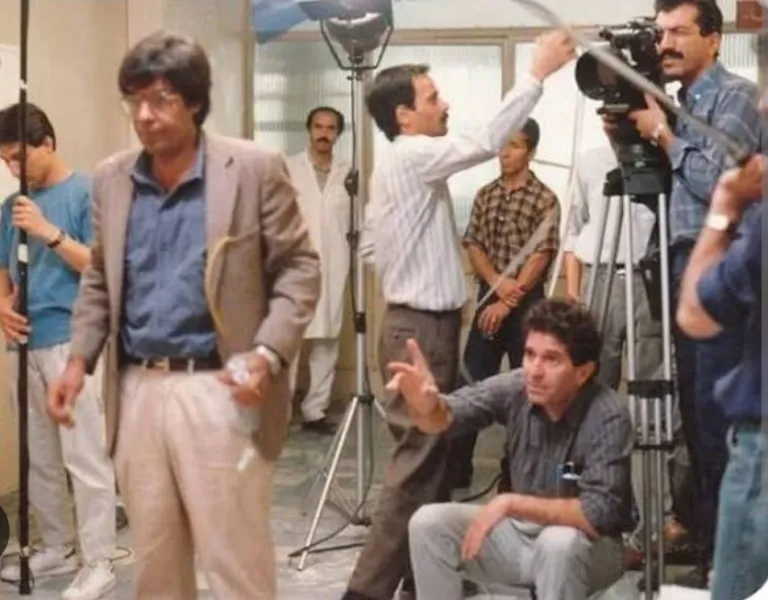
Dariush Mehrjui’s cinema can be regarded as one of the most important arenas for representing intellectual life in the history of Iranian cinema. In his films, the intellectual is neither a flawless hero in possession of absolute truth nor a powerless individual who has surrendered to the forces of society. In Mehrjui’s world, the intellectual is a complex, contradictory figure: someone who wants to understand the world, overcome inequalities, and find meaning in life, yet often falls short of realizing these ideals when confronted with the realities of everyday existence.
Over several decades of filmmaking, Mehrjui developed a multifaceted portrait of the Iranian intellectual, one shaped by crises of identity, the distance between thought and action, an inability to connect with others, and the individual’s confrontation with social structures. His characters are often less answers to society’s questions than subjects of inquiry themselves. Can awareness free people from the limitations of their lives? Can the intellectual reconcile their ideas with the actual conditions of everyday existence? And is their failure merely the result of external pressures, or must some responsibility also be attributed to their personal weaknesses and contradictions?
On the third anniversary of Mehrjui’s death, revisiting these questions offers an opportunity to reflect on the work of a filmmaker who understood intellectual life not as a privileged social position, but as a human and historical condition—a condition in which the desire for freedom and independence continually encounters personal and social constraints.
From The Cow to The Mina Circle: Humanity’s Search for Understanding
Although Mash Hassan in The Cow (1969) is not an intellectual in the conventional sense, the film stands among Mehrjui’s earliest significant explorations of identity and the relationship between human beings and the world around them. Mash Hassan is so deeply attached to his cow that the animal’s death destabilizes the very foundations of his identity. Unable to accept the loss, he gradually assumes the identity of the cow. His psychological collapse reveals how profoundly people may depend on relationships and attachments over which they imagine themselves to have control.
The significance of The Cow for a discussion of intellectual life lies less in its protagonist than in Mehrjui’s broader understanding of the human condition. In his cinematic world, individuals do not necessarily possess mastery over their own identities or the realities surrounding them. Identity can be fragile, and awareness, even when present, does not always offer a way out of crisis. This perspective acquires new dimensions in the filmmaker’s subsequent works, particularly in his portrayals of the urban intellectual.
In The Mina Circle (1975), Mehrjui turns his attention to the economic and social relations through which poverty and illness create conditions for human exploitation. Ali, the film’s protagonist, enters a world in which economic interests can override human values. Beyond recounting the life of an individual, the film exposes the social mechanisms that produce inequality.
Here, understanding reality means uncovering the hidden relations underlying seemingly ordinary behavior. Yet Mehrjui draws a distinction between awareness and the ability to change the world. Recognizing a problem does not necessarily mean being able to solve it, just as witnessing injustice does not, by itself, make resistance possible. This gap is one of the central themes of his cinema, and it would later reappear in his intellectual characters in a more personal and complex form.
Hamoun: The Intellectual Besieged by Contradictions
Hamoun (1989) is perhaps Mehrjui’s most representative work in its depiction of the Iranian intellectual’s crisis. Hamid Hamoun, an educated man preoccupied with philosophy, mysticism, and existential questions, struggles to find meaning in life. Yet the deeper he retreats into his thoughts, the greater the distance between himself and everyday reality becomes. His marital crisis with Mahshid is not merely a domestic dispute; it signals the disintegration of a world that Hamoun is trying to hold together through his concepts and beliefs.
Hamoun wants to understand life, but in practice he cannot master its disorder. He asks questions about truth, faith, and the meaning of existence, yet struggles to communicate with the person closest to him. This contradiction makes him an enduring portrait of an intellectual caught between theoretical sophistication and practical ineptitude.
Nevertheless, Mehrjui does not reduce Hamoun to a ridiculous or defeated figure. He is a suffering human being who sincerely seeks the truth but cannot establish a lasting balance between thought and life. The problem is not necessarily the difficulty of Hamoun’s questions. Rather, he sometimes interprets life instead of living it, attempting to fit human relationships into his own intellectual framework instead of accepting their complexity.
From this perspective, Hamoun challenges the notion of the intellectual as a superior individual immune to error. Mehrjui strips him of his position as society’s judge and places him under scrutiny. The intellectual, too, must answer for his contradictions. He must explain why extensive knowledge does not always lead to a better understanding of others, and why the ability to analyze the world does not necessarily translate into the ability to live.
Hamoun also portrays the identity crisis of a generation caught between tradition and modernity, faith and doubt, and abstract ideals and social reality. This generation wants to think independently but has yet to discover how to turn intellectual independence into a sustainable way of life. The film’s enduring power stems in large part from this shared experience: that of a person searching for meaning who, the more questions they ask, the more new uncertainties they encounter.
Banu and Sara: Intellectual Life Put to the Ethical Test
In Mehrjui’s cinema, intellectual life is not defined solely by psychological and philosophical crises. Ethics and responsibility toward others are equally fundamental. Banu (1991) offers an important example of this approach. The film’s protagonist is an affluent woman who turns her home into a refuge for the underprivileged. At first, her actions appear to embody compassion and generosity. But as relationships multiply and social dynamics become more complicated, the distinction between helping others and seeking their approval begins to blur.
In this film, Mehrjui does not treat good intentions as a sufficient measure of ethical conduct. The central question is whether a benevolent person recognizes others as independent human beings or turns them into instruments for affirming a favorable image of themselves. This issue also concerns intellectual life: an intellectual, by virtue of their knowledge or social standing, may assume the role of guide to others and inadvertently establish unequal relationships.
In Sara (1992), the ethical question emerges within the context of marriage and gender relations. Sara makes sacrifices to support her husband, but these sacrifices gradually exact a cost from her identity and independence. The film shows how values such as loyalty, responsibility, and the preservation of the family can, under unequal conditions, become instruments for restricting individual choice.
Comparing Sara with Hamoun is significant in this respect because Mehrjui places the crisis of the male intellectual and the woman’s experience within familial relations on opposite sides of the same social problem. Hamoun struggles with mental turmoil and an inability to put his own life in order, while Sara bears the burden of preserving their marriage. These experiences are not identical, but both demonstrate that private relationships cannot be separated from power structures and social expectations.
In these works, intellectual life acquires credibility only when it moves beyond claims and manifests itself in the way one treats other people. Someone who speaks of freedom and justice but refuses to recognize another person’s independence may reproduce precisely the relations they oppose in theory. In Mehrjui’s view, critical thought without ethical responsibility is always at risk of becoming a form of self-deception.
From Leila to Laminor: Individuality Against Society
In Leila (1996), Mehrjui portrays the conflict between individual choice and the pressure of family traditions with subtlety and emotional force. Leila and Reza’s marriage comes under the shadow of family expectations and the question of having children. Rather than dividing the characters into simple categories of good and evil, the film shows how social pressure can take the form of affection, concern, and a sense of responsibility.
Leila faces a situation in which the boundary between free choice and compliance with the wishes of others is far from clear. Even when someone has intellectually distanced themselves from a tradition, they may remain unable to free themselves from its influence in practice. Under such circumstances, awareness of one’s constraints does not necessarily confer the ability to overcome them. Once again, Mehrjui demonstrates that individual freedom depends not merely on willpower, but also on social relations and the genuine availability of choices.
This concern continues in his later works. In The Orange Suit (2012), the relationship between the individual, the social environment, and civic responsibility becomes the central subject. Through the protagonist’s transformation, the film raises a question: Does social reform begin with individual change, or will individual action remain limited without a transformation in collective relations?
In Laminor (2020), too, the desire for self-determination and artistic fulfillment confronts familial and social constraints. Individuals need independence to shape their own futures, but this independence does not develop in a vacuum. Family, tradition, and social expectations can restrict their choices and even prevent their talents from flourishing.
Ultimately, the intellectual in Mehrjui’s cinema is neither a fixed nor a one-dimensional figure. At times, they are trapped in a crisis of identity; at others, they fail in their ethical relationships or lose the freedom to choose in the face of social structures. What connects these characters is the distance between ideal and reality, awareness and action, desire and ability.
On the third anniversary of Dariush Mehrjui’s death, the importance of his cinema lies precisely in this critical perspective. Mehrjui strips the intellectual of moral immunity without denying them the right to question and think. The intellectual is neither an infallible savior of society nor a useless figure, but someone who must confront external constraints while also acknowledging their own share in their failures and contradictions.
Perhaps Mehrjui’s most important legacy in this regard is his insistence that thought becomes a liberating force only when it steps beyond the confines of the mind and finds expression in one’s way of living, one’s relationships with others, and one’s acceptance of social responsibility. In his world, the intellectual is not someone who knows the answers to every question, but someone who has the courage to confront difficult questions, even when doing so leads to an awareness of their own weaknesses and limitations.
From this perspective, Mehrjui’s cinema is not merely a reflection of the lives of intellectuals in a particular historical period. It is a mirror held up to a society that continues to grapple with individual freedom, ethical responsibility, and the difficulty of realizing its ideals. This mirror offers neither a flawless nor a comforting image, but it makes contradictions visible—and that is one of the most important functions of critical art.
© 2026. Phoenix Review