



I don’t keep a calendar in my apartment. I spend most of my time at home, and I usually figure out what day it is by listening to the sounds outside. If I don’t hear the laughter of the employees from the office behind my building, I know it’s a public holiday. If cheerful religious music begins pouring from a loudspeaker somewhere I can’t locate, I assume it’s a religious celebration. If the streets fill with elegies and mourning chants, I know it must be a day of commemoration. Sometimes everything overlaps: lamentations from one loudspeaker, pop music from a neighbor’s apartment, and birthday songs drifting from the office next door. These past few days, I haven’t even been able to see the city through my window. Only the constant sound of helicopters told me that something significant was unfolding outside. It feels as though, for quite some time now, I have come to know the city more through my ears than through my eyes.
But this act of listening is not my choice. No one asks my permission before deciding which sounds should enter my home. Noise arrives uninvited—from loudspeakers, from a neighbor’s stereo system, from the blades of helicopters—and quietly settles into my everyday life. Perhaps that is why, while watching Ettore Scola’s A Special Day, I found myself thinking less about its story than about the peculiar relationship a city establishes with its inhabitants: a relationship that is often involuntary, even one-sided.
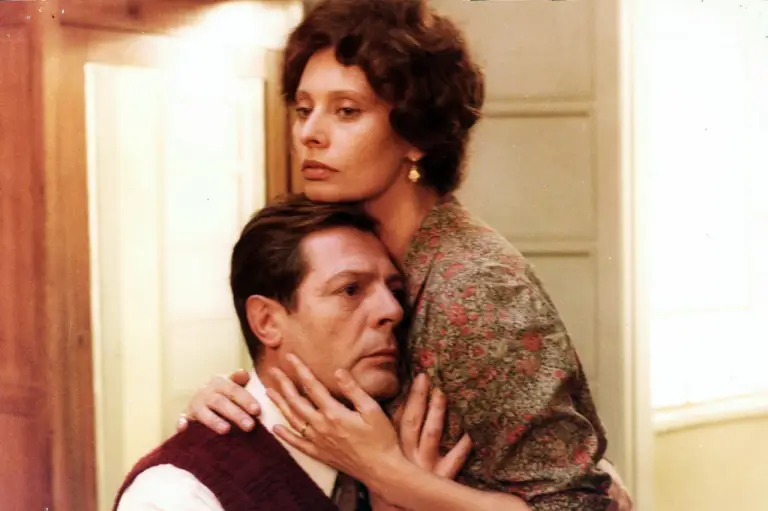
A Special Day takes place in Rome, yet curiously, we almost never see the city itself. The narrative unfolds on the day when nearly the entire population has left home to celebrate Hitler’s visit to Mussolini’s Italy. Rather than following the crowds into the streets, however, Scola confines us almost entirely to a single apartment building, to the homes of Antonietta and Gabriele.
Rome exists in this film not through its streets or monuments, but through its sounds. The building’s caretaker functions as an agent of Fascist propaganda, making sure no one forgets what is happening outside. By turning on the radio, he fills the building with military marches, speeches, and the sounds of celebration—remarkably similar to the unsolicited noises that occasionally invade my own home, only under different names. Yet he is not merely the guardian of the building’s order; he is also the guardian of its inhabitants. His gaze extends through the windows into private apartments. In many ways, the caretaker becomes the city’s eye.
The city enters domestic space through every possible opening, and it seems to me that Scola establishes this principle from the very first shot. The camera circles the building’s central courtyard before gradually rising upward, lingering on rows of identical windows until it finally discovers Antonietta. It then enters her apartment almost without ceremony, quietly assuming the role of another watchful eye, observing the private interior and reminding us that even the home is never entirely private.
Scola therefore constructs his film between two interconnected scales: the scale of the city and the scale of the home. This is precisely why he chose a real residential complex—Palazzo Federici, designed by architect Mario De Renzi in 1931 in the Rationalist architectural style favored by the Fascist regime. Seen from above, Palazzo Federici resembles a fortress. Around its central courtyard, every apartment opens inward, creating a seemingly semi-private space where everyone can observe everyone else, remain informed about each other’s lives, and constantly feel the presence of others.
Whenever I look at the architecture of the building—particularly its central courtyard, its rigid geometry, and its endlessly repeated windows—I cannot help thinking of the mechanism of a Panopticon. The windows overlooking the courtyard become the eyes of society itself; the courtyard amplifies sound, carrying the echoes of totalitarian speeches into every corner of the building.
Even Gabriele briefly experiences this unsettling sensation. Looking out from Antonietta’s apartment toward his own, he quietly remarks, “How strange it is to see your own home from someone else’s window.” It is as though his home—his very identity—has momentarily detached itself from him and become something external.
This collective residential complex, which ought to provide shelter, instead becomes a prison for the film’s isolated protagonists. Its monumental scale crushes the fragile individuality of Antonietta and Gabriele beneath the immense weight of Fascist ideology. Gabriele himself expresses something very close to this feeling during one of his telephone conversations.
Although Ettore Scola was a committed man of the Left and closely associated with the Italian Communist Party, directing the sharpest edge of his critique toward Mussolini’s Fascism, his film ultimately transcends the conventional boundaries separating Left and Right. It becomes, more broadly, an indictment of every totalitarian system. The severe Rationalist architecture reflects not only Fascist Italy but also evokes the vast grey apartment blocks of Stalinist Soviet cities—spaces where dissent and individual identity are systematically erased in favor of the regime’s grand narrative.
Consequently, the home—which ought to constitute the safest and most private sphere of human existence—becomes another extension of public authority. And this intrusion occurs through more than surveillance alone. Mussolini’s portrait hanging on the wall, Antonietta’s family album, and the carefully manufactured ideal of womanhood imposed upon her all reveal how ideology has entered through the window, moved from the living room into the kitchen, and ultimately reached the bedroom itself.
Antonietta proudly speaks of her six children while simultaneously regretting that she has not yet produced a seventh, unaware that she is unconsciously reproducing Fascist propaganda surrounding the Battle for Births. Within Mussolini’s totalitarian vision, the female body and the domestic sphere become little more than state-owned factories for producing future soldiers. The chain begins in the public square and ends in the marital bed.
Yet even within this oppressive chain, cracks remain. Transitional spaces—the corridors, stair landings, and above all, the rooftop—belong neither entirely to the public realm nor fully to the private one. It is precisely within one of these liminal spaces that the film’s emotional climax occurs. Hidden from the collective gaze, Antonietta finally confesses her feelings, while Gabriele reveals his homosexuality.
And then there is the myna bird, for whom the boundaries imposed by architecture carry no meaning whatsoever. It flies freely from apartment to apartment, passes effortlessly through windows, disrupts the order imposed upon the residents, and ultimately becomes the catalyst that brings Antonietta and Gabriele together.
In a world where Fascism has reduced everyone to predetermined roles—wife, mother, husband, soldier, exemplary citizen, or social deviant—these two individuals manage, for a few brief hours, to encounter one another simply as human beings. Together, they step outside the identities that society has assigned them.
Their dance belongs to this same act of resistance. Outside the building, thousands march together in perfectly synchronized formation—a collective movement dictated entirely by ideology. Inside the apartment, however, two people dance. This movement arises not from political command but from the body itself.
It begins when Antonietta becomes fascinated by the placement of their feet upon the floor. Gabriele then takes her hand and introduces her to an entirely different way of inhabiting her own body. A body that until now has existed only to bear children and perform domestic service discovers, for the first time, a movement that belongs solely to itself. The radio abruptly interrupts this fragile moment.
The book Gabriele gives her is Alexandre Dumas’The Three Musketeers. At first, Antonietta rejects it, claiming she has no time to read. Yet the deeper obstacle is not the absence of time but the absence of belief that she is capable of reading it at all. The regime has stolen not only her reproductive autonomy and her womanhood, but something even more fundamental: her confidence in her own intellectual capacity.
This condition recalls Simone de Beauvoir’s notion of immanence—a life trapped within biological repetition and perpetual service to others. Gabriele brings the book back once more and gently insists until she finally accepts it. It is only a small gesture, yet it becomes the first step away from immanence.
Even the novel’s famous motto—“All for one, one for all”—acquires an ironic resonance within the suffocating atmosphere of the apartment complex. In Dumas’ novel it signifies solidarity and resistance against oppression; under Fascism, the same principle has been transformed into an instrument for dissolving individuality into the collective.
Against the radio that broadcasts the voice of the masses throughout the courtyard all day long, the book becomes Gabriele’s quiet weapon—a temporary means of rescuing Antonietta from her prison.
The same progression continues through their sexual relationship. Until this particular day, Antonietta’s intimacy with her husband has existed primarily as duty rather than desire. Even the number of children she has borne was never truly her own choice; motherhood was simply another role assigned to her. Her later monologue, after everyone has abandoned her, makes this painfully clear.
Dancing with Gabriele, accepting his book, and eventually sleeping with him constitute, in my reading, Antonietta’s first genuinely autonomous decisions. Scola wisely refuses to depict their lovemaking explicitly. Erotic pleasure is not what interests him. He is pursuing something far more profound—something Antonietta herself has not yet learned to name.
That unnamed experience receives its meaning only afterward: what Beauvoir would call transcendence, or what narrative theory would simply recognize as genuine character transformation.
Scola constructs this transformation through three symbolic movements: the body in the dance, the mind through the book, and desire through intimacy. Each step carries Antonietta slightly further away from immanence. Because the entire film unfolds within a single day, this compressed progression becomes dramatically necessary; transformation must occur through these concentrated symbolic gestures.
For this reason, the ending matters so deeply. Rather than leafing once more through her family album or returning to the marital bed to conceive yet another child, Antonietta picks up the book. Choosing to read instead of to sleep is, ultimately, choosing transcendence over immanence.
Yet I do not believe Scola intends to suggest that human connection can overthrow structures of power. The ending demonstrates precisely the opposite. Gabriele is arrested and disappears into the building’s dark corridor. Antonietta returns to the life that has already been written for her. The city quietly places each of them back inside the mold assigned to them. Nevertheless, something within Antonietta has changed forever.
Perhaps she has discovered something about herself. Perhaps she now understands that these small, tangible, deeply human experiences enabled her, if only for a few hours, to think and choose for herself. In that sense, the film reminds me of Michel de Certeau’s distinction between strategies and tactics. Antonietta and Gabriele possess none of the instruments of power, yet within the very spaces imposed upon them, they briefly invent their own tactics for slipping beyond its grasp.
Now, as another loudspeaker outside my window merges with the music of a passing violinist until neither voice can be clearly distinguished from the other, I find myself thinking that I, too, have my own small tactics inside this apartment. I may never completely escape the strategies imposed upon me, but I know that the sounds entering my home without permission do not define the entirety of my relationship with this city.
© 2026. Phoenix Review