



Great Iranian Films at Forty | No. 3: The Tenants (Dariush Mehrjui)
The Tenants was released at a time when the average quality of Iranian cinema seemed strangely disconnected from the extraordinary transformations taking place in Iranian society. Historically speaking, these were years of remarkable vitality and excitement: on the one hand, an unexpected creative resurgence among seasoned filmmakers—Bahram Beyzaie, Nasser Taghvai, Abbas Kiarostami, Masoud Kimiai, Amir Naderi, Ali Hatami, and Dariush Mehrjui—and on the other, the rise of a new generation of emerging directors such as Mehdi Eslami, Mohammad Hossein Sajjadi, Masoud Jafari Jozani, Fereydoun Farhang, and Kianoush Ayari. Together, they gave audiences every reason to feel optimistic about the future of Iranian cinema.
Forty years after its release, The Tenants is still widely regarded as the ultimate achievement in creating a comic world that is, at the same time, deeply meaningful. It remains the benchmark against which Iranian cinematic comedy is measured.
If one surveys the dominant patterns of comedy in Iranian cinema, they generally fall into one of two traditions. Either, as in the purpose-driven Samad series, they recycle the time-tested conventions of ru-hozi folk theatre, or they devolve into dubbed wisecracks, mockery of regional accents and physical disabilities, sexual jokes, and improvisational humor. The Tenants, however, is fundamentally different. From the ground up, it employs entirely distinct strategies for generating comedy.
In a roundtable discussion published by Film Monthly upon the film’s release, Shahram Jafari-Nejad dismissed several of the film’s mise-en-scène as superficial—most notably the reconciliation between the two brothers and their mother’s tearful reaction. He also questioned why audiences should laugh at the misery and helplessness of ordinary people, while criticizing what he considered the uneven quality of Mehrjui’s post-Revolution films, especially when compared with the coherent artistic vision of his four major pre-1979 works—The Cow, Mr. Naive, The Postman, and The Cycle—setting aside his debut feature, Diamond 33. These remarks encapsulated much of the skepticism that initially surrounded the film.
Today, Jafari-Nejad is widely recognized as one of Iran’s foremost authorities on comedy cinema. Yet his criticism at the time came to represent a broader critical attitude: one that judged The Tenants without regard for the historical moment in which it was made or for its deliberate fusion of comedy and satire, viewing the film with remarkable indifference toward the unique world it constructs. Although Khosrow Dehghan’s qualified endorsement during the same discussion went some way toward restoring balance, the dominant critical response remained largely skeptical. It was as though, in accordance with the old Persian saying—“What pleasure can the well-fed possibly understand?”—a philosophical filmmaker like Mehrjui ought simply to stay away from comedy altogether.
The film itself, however, draws upon human behavior, language, shared conventions, the audience’s cultural memory, and the power of imagination to create a remarkably coherent whole. It may well represent Mehrjui’s greatest artistic gamble: deploying everything he knows best by combining witty dialogue, the orchestration of a large ensemble cast, meticulously choreographed group mise-en-scène, and sharp historical and social commentary.
Mehrjui himself stated in at least two interviews that he regarded The Tenants primarily as a serious film—one that, at certain moments and entirely without prior intention, evolved into comedy. Yet from its opening minutes, through the introduction of its characters and the progression of its narrative, the film firmly establishes its own exaggerated stylistic contract with the audience. Before long, with the arrival of Asad Ghandi (Akbar Abdi), the director decisively distances himself from the didactic tendencies that dominated much of Iranian cinema at the time. Once the bathroom water pipe bursts, any hesitation about classifying the film—or its carefully engineered situations—as comedy becomes meaningless. From that point onward, the film maintains this approach with remarkable consistency all the way to its conclusion.
The position of intellectuals in The Tenants is itself worthy of close examination. Why, after all, does such a modest apartment building house three or four people involved in art and culture, each of whom seems so profoundly out of step with the world around them? The contrasting treatment of the crippled intellectual on the one hand and Mr. Tavassoli on the other can hardly be accidental. Then there is Sa’di, fluent in French and thoroughly versed in Western classical music. He delivers a melancholy account of the many homes he has lived in before finally arriving here, delighted at last to have found neighbors with some appreciation of art. (His first example is wonderfully ironic: Ghandi! Such an intellectual, and such an audience.)
Mrs. Tavassoli, meanwhile, is fluent in legal terminology, possesses a disciplined and analytical mind, takes Valium to ease her anxiety, offers practical advice to her husband, and notably refers to a clinic rather than a “medical center”—a word that was hardly commonplace in Persian at the time. Naturally, the film cannot help reflecting aspects of Mehrjui’s own intellectual milieu, the people he associated with over the years, and the experiences he himself had lived through.
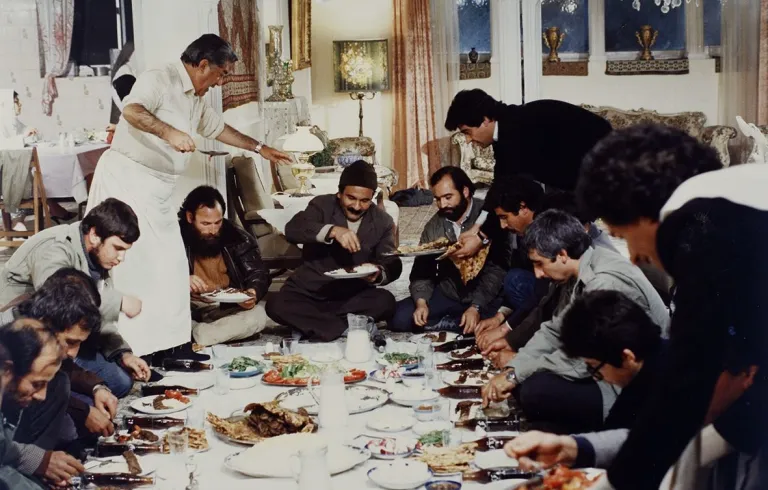
The film’s meticulously crafted mise-en-scène is among its most striking formal achievements. Examples abound; one particularly overlooked instance deserves attention. Mr. Tavassoli and his wife deliberately reveal to Abbas Agha that the building is legally ownerless, leaving him stunned. He quietly withdraws from the group, only to return moments later with what he imagines is an ingenious idea. As he re-enters the frame, Mehrjui subtly recomposes the shot, timing Abbas Agha’s return precisely with the unveiling of his “solution.” The sly sound design—particularly the emphasis placed on a passing vehicle—completes the visual construction of the scene.
Attempting to explain why he never knew the landlord had died, Abbas Agha blurts out something to the effect of, “He died in some… I don’t know… train-whatever accident.” His shamelessness is so outrageous that it becomes hilarious. Mehrjui is clearly responding to the ugliness and moral vulgarity of the society around him. His instrument for doing so is simply a cramped apartment building with four units spread across three floors.
Even the building’s awkward architecture becomes an ironic reflection of the visual disorder of the modern city. It is no coincidence that the interior and exterior scenes were filmed in separate locations. Despite the technical limitations of Iranian cinema at the time—and the absence of a proper film studio capable of accommodating a production of this scale—the film never betrays those constraints.
The famous sequence in which water comes cascading down after a pigeon lands on the rooftop stands as a masterclass in the imaginative use of cinema’s visual and sonic resources. At the time, admittedly, it also provided easy ammunition for the film’s detractors. One cannot help recalling Hafez’s famous verse: “Otherwise this relentless flood would sweep away my very foundation.”
Likewise, in the domestic battle between Abbas Agha and Ghandi, and in the sequence where the workers are chased through the building, Mehrjui demonstrates his extraordinary ability to achieve remarkable cinematic effects with remarkably modest means.
From the screenplay onward, The Tenants treats cinema as a serious artistic medium. During production, the inspired ensemble casting, Mehrjui’s understated yet masterful direction, the intelligent use of production and costume design, sound, special effects, and a perfectly integrated musical score combine to produce a film of exceptional distinction.
Indeed, the performances alone merit a separate study—one that distinguishes each actor’s contribution and explains Mehrjui’s extraordinary gift for directing performers.
Ezzatollah Entezami, in the central role, synthesizes all the cunning, hypocritical characters he had previously played for Mehrjui. While creating unforgettable comic situations, he never loses command of his physical performance, vocal delivery, or instinctive mastery of each scene.
In his first major cinematic role, Akbar Abdi delivers an astonishing performance, balancing genuine emotional vulnerability with self-centeredness, a desperate desire to dominate every situation, and sheer foolishness. The culmination of all these qualities arrives in the now-legendary sequence in which Asad Ghandi flees from Abbas Agha, who is pursuing him with a pickaxe.
Part of the deep admiration inspired by Firdous Kaviani’s performance lies in his complete rejection of the familiar—and often demeaning—stereotype of the “ridiculous provincial.” His work is a textbook example of understated acting. Fortunately, his thick accent never descends into buffoonery.
Nadereh Kheirabadi elevates the familiar archetype of the kind-hearted mother or grandmother to perhaps its finest cinematic expression. Her performance is so convincing that audiences readily accept her as the mother of Ezzatollah Entezami, despite the actors being roughly the same age.
Drawing upon years of experience with the Workshop of Performance before the Revolution, Reza Rouygari seized what would become his only major opportunity to shine in cinema, giving a memorable performance as the delusional and hopelessly inept engineer.
Hossein Sarshar, meanwhile, was almost certainly cast as Sa’di because of his extraordinary background as an opera singer, voice actor, and connoisseur of classical music. Lines such as “Ghandi, don’t shout!” or the unforgettable “Gentlemeeeen… don’t shouuuuut!” are unimaginable without Sarshar’s uniquely resonant voice and magnificently exaggerated delivery. This distinction is established from his very first appearance: Beethoven’s portrait hangs on his wall; flowers flourish on the rooftop above him; and Western classical music floats through the air directly above a man like Asad Ghandi, whose temperament could hardly be more incompatible with such refinement.
Iraj Rad likewise presents a nuanced and effective portrait of an educated lawyer. His performance ranges from the utter desperation with which he cries, “I should be ashamed?!” to the affected dignity with which he inspects his books. Remarkably, only hours after clutching his injured leg as though his soul were leaving his body and requiring medical treatment, he confidently argues that the other tenants should join him in chasing after the workers. Once reassured that they will indeed follow him, he calmly changes into a formal suit, puts on a tie, and returns. Yet even so, his cultivated bourgeois demeanor differs fundamentally from Sa’di’s passionate and artistic nobility, and both stand apart from Salek, whose very name carries a slyly ironic resonance.
Manijeh Taslimi, with her overly formal diction—whether presenting legal arguments about the building’s ownerless status or carefully enumerating the fruit she has at home—and her constant fiddling with her glasses, gives a wonderfully controlled performance. Yarta Yaran portrays a man perpetually reluctant to let go of his former life, whose intellectual existence clashes painfully with his astonishingly uncivilized brother. Siavash Tahmoures (credited as Hassan Tahmoures-Nia) and Manouchehr Hamedi (credited as Reza Hamedi) also deliver effective performances through character types they would revisit many times throughout their careers.
Even those who do not admire The Tenants cannot reasonably deny its status as one of the great achievements of Iranian cinema. Abbas Agha mocks Sa’di for turning a tiny three-centimeter record player on the rooftop into what he sarcastically calls “Zuleikha’s liver”—a metaphor for pretentious excess. Yet the film itself avoids precisely the fragmentation that plagues so many ensemble productions. Through its remarkably harmonious integration of contrasting acting styles and its creation of a coherent cinematic universe, The Tenants escapes that common pitfall altogether. Forty years after its release, it still has no genuine rival for the title of the greatest comedy in the history of Iranian cinema.
© 2026. Phoenix Review