



I cross Fatemi Street and turn eastward. At the far end of the street axis, I see Mount Damavand resting in the distance. The sight connects, somewhere deep in my subconscious, to a building nearby—next to Laleh Park; a building whose pulse I can constantly feel in the depths of my memory.
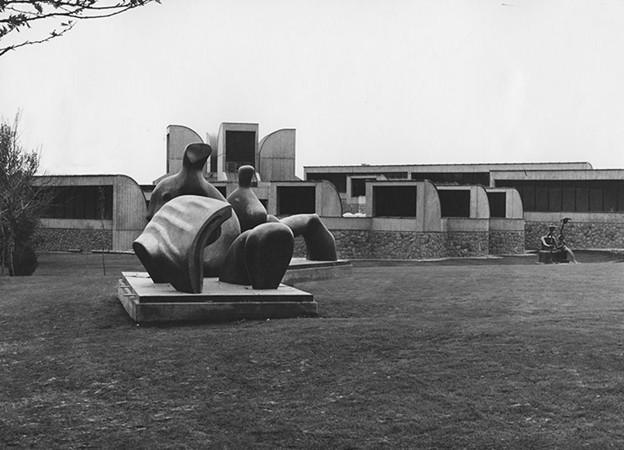
For an inhabitant of the desert cities of long ago, who built windcatchers into their homes, the sight of domes rising on the horizon—shaping the skyline—was likely part of daily life. But here and now, for a twenty-first-century dweller of the capital—living amidst the chaos of concrete and glass cubes of every height—encountering an open horizon in the city, punctuated by domed forms, feels strange and unfamiliar. These domes belong to an architecture whose body lies beneath a grass-covered surface, and together with the scattered abstract sculptures around it, they compose a world that seems to belong to another realm: the Tehran Museum of Contemporary Art, designed by Kamran Diba (inaugurated in 1977).
Being its neighbor, I’ve often communed with this architecture—walked within it, felt its presence. I know that beneath the four windcatcher-like towers at its center lies a powerful core that generates an invisible field, subtly affecting the surrounding spaces.
This time, however, I don’t enter through the automatic glass doors level with the city sidewalk—the ones that welcome visitors inside. Instead, in my mind, I step through the four towers themselves and descend beside the parapet of the central void.
Concrete columns rise before my eyes—upright, firm, solemn. Their bases are set around a rectangular basin sunk into the stone floor, their shafts fading upward into light. A spiral ramp coils around the columns and the basin. There is no water in the basin; instead, a black liquid lies there, smooth as polished marble, with a patch of light floating on its surface.
From the interplay of these elements arises a mythical sensation that fills my being. Time dissolves. I imagine these piercing columns were once beams of light—sent by celestial forces to protect a basin of water. But through some spell, they turned cold and mute, and the vibrant, living world that once rippled around them became trapped in their stillness and rigidity. Later, light managed to seep back through only a few cracks into this gray realm.
The spiral ramp, coiling like a serpent around the basin, draws me downward into the earth, to the basin’s edge. I pause beside it and read the plaque affixed nearby: “Matter and Mind,” by Haraguchi.
Near the museum’s basin, a wall catches my attention—a wall with an oval carved out of it, revealing glimpses of the space beyond. My curiosity stirs, propelling my body forward. Crossing the boundary formed by this wall, I enter a rectangular room where space unfolds. At its far end, a doorway suggests the continuation of the path. A feeling grows within me: the beginning of a journey.
As I continue, the spaces expand and contract in turn—rooms and galleries giving way to corridors that sometimes run straight, sometimes twist. The uncertainty of the destination keeps my curiosity alive, preserving the continuity of my experience in the present moment.
Along the way, the walls curve, split, or open into framed voids that challenge my perception and sustain my connection with the architecture throughout the journey. At the same time, an active silence pervades the air. My footsteps fall softly on the flooring, and the thick, wall-like outer shells of the building guard this silence against the invasion of the city’s noise.
The building’s true identity seems to lie in its nested geometry—perceived only through movement within it. The backdrop to this movement is formed by smooth, gray-toned surfaces, which play their subtle role beneath the foreground: the art. The neutrality of the colors keeps the eye calm, leaving it sharp and alert for viewing the works. Meanwhile, the focus thus achieved opens the eye of imagination, and alongside this physical journey, a mental and inner one begins to unfold.
If an exhibition is being held at the museum, the artworks prompt pauses in my movement—like pins marking my path. These pauses never linger long; they remain moments of stillness. Only in the central vestibule do I truly stop—a midpoint that opens onto the courtyard. I sense an axis linking the center of the vestibule to the courtyard’s heart, extending beyond. Standing along this axis, I see the four windcatcher-like towers on the horizon. The suspension of the journey eases; I regain a sense of spatial orientation. Yet I realize the journey is not over—the corridor leading from the vestibule tells me so.
The second half of the journey unfolds with similar rhythms and new surprises. The openings that once framed interior views now reveal glimpses of the city. In parts of the path, long horizontal windows let my gaze cross the courtyard and reconnect with spaces from the earlier route. The height of these surprises comes when, walking through a corridor, the path suddenly turns and brings me into another gallery—where, at the far end of my view, I see them again: the columns. The same cold, solemn concrete pillars, encircled by the round central void. I realize then that the corridors, with their subtle, gradual incline, have brought me upward—from the depths of the earth to the surface. I step toward the circular walkway and look down: my reflection stares back from the black pool, merging the start and end of my journey.
Before me lies the central courtyard—a knot of movement that ties together beginning, middle, and end. Just beyond, through the glass embedded in the concrete walls, Laleh Park waves back at me.
Once again, I have lived another journey. Yet these journeys never lose their charm or become repetitive. It seems that this architecture, beyond its mythical and legendary aura, possesses a quality that—like myth itself—extends through time, reinterpreted with every encounter, reproduced in our minds, and, through us, in our culture, art, and history.
In these journeys, I’ve found joy in the company of fellow travelers—each weaving their own stories and memories with and within the museum. Once, I saw an elderly man with a backpack standing before a Picasso painting, summoning the young version of himself who had stood before that same painting fifty years earlier, at the museum’s opening. A child ran laughing through the corners of the museum, telling his father, “You keep getting lost and found in here.” Young art students sat sketching before sculptures by Parviz Tanavoli, Giacometti, Henry Moore, and René Magritte. This architecture links all of us—our stories and our memories—into a shared chain. Our collective memory takes shape and slowly expands through time.
The glass door before me opens. I step onto Amirabad Street. Retracing my path, I smile at the sculptures around the museum and the trees of Laleh Park. Crossing Fatemi Street once more, I see Damavand—watching from afar, as the mountain and the city gaze at each other across the distance.