



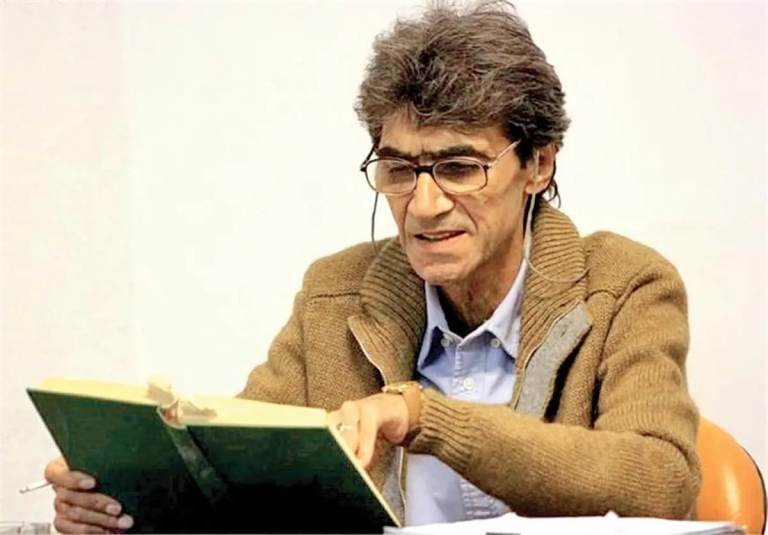
Nasser Taghvai is best known for his films — from Tranquility in the Presence of Others to Captain Khorshid, a masterful adaptation of Ernest Hemingway’s To Have and Have Not, and the celebrated television series My Uncle Napoleon, based on Iraj Pezeshkzad’s novel of the same name. Yet Taghvai also has a literary work to his name: a collection of eight short stories titled That Same Summer. The director’s cinematic fame — and the heavy censorship imposed by the Islamic Republic — have caused this collection to remain far less known than his films.
Taghvai began his career in literature. He studied Persian literature at the University of Tehran and, in 1963, published his first short story in Arash magazine, edited by Cyrus Tahbaz — a publication that featured many of the leading voices of modern Iranian literature, including Ebrahim Golestan, Bahram Beyzaei, and Gholamhossein Sa’edi.
Safdar Taghizadeh — to whom Taghvai dedicated his only short story collection — recalls the young Taghvai’s early attempts at fiction:
“A day or two later, as I was waiting for him, I saw through the window a dark-skinned, lean, and modest young man extinguish his cigarette at the door — perhaps out of respect. He must have been nineteen or twenty. I had earlier asked him to write two or three more stories and bring them in. He had done so. We read the stories together and talked for two or three hours. When he left, I watched him from the window lighting his cigarette again — maybe in satisfaction with my approval — and drawing the smoke deep into his lungs. I sent one or two of his stories to Tehran, and they were published in Arash magazine.”
Taghvai published That Same Summer in 1969. The stories are set in southern Iran and, in narrative style and language, closely resemble the short fiction of Ernest Hemingway. As Asghar Abdollahi writes about the characters in the collection:
“They spend their days at the docks, their evenings in taverns, and their nights in brothels. They are not witty or even joyful; they drift through their days idly, trying to forget the losses of the day before.”
Later, Taghvai joined Ebrahim Golestan’s film workshop and turned to documentary filmmaking professionally. He never wrote fiction again. In this essay, I will look at “Between Two Rounds”, one of the stories from That Same Summer.
Taghvai’s writing in this story clearly reveals Hemingway’s influence — particularly the Iceberg Theory. According to Hemingway, only the tip of the iceberg is visible in a story; most of its mass lies hidden beneath the surface. The reader must actively participate in constructing the meaning — to perceive the entire iceberg. Taghvai’s “Between Two Rounds” follows this same principle. The entire story covers little more than an hour and takes place in a single setting: Garakin’s tavern.
When the narrator, Ashur, enters, it is still before noon — we know this because the clock strikes twelve midway through the story and once more near the end. Yet through this short slice of time, Taghvai shows us an entire world of characters. The verb to show is crucial here — for showing, not telling, is the visible tip of Taghvai’s iceberg.
Ashur walks into the tavern. “Khorshidu” is sitting with his back to the door, drinking, while outside, wind and rain lash the streets. He is preparing to smuggle twenty-seven people to Kuwait, where they hope to find work. He waits for “the old man,” who is supposed to give him information about the passengers. The old man arrives and says that many of the travelers have lost their nerve after seeing the storm and no longer wish to cross the sea illegally. Khorshidu becomes furious — he refuses to lose again. In the end, we realize that the old man, who had posed as Khorshidu’s friend and helper, is himself too afraid to make the journey and has likely dissuaded the others. Enraged, Khorshidu storms out of the tavern, unwilling to accept defeat. He will challenge the storm and the sea.
The narrator gives us only fragments of Khorshidu’s past. Rather than telling, he shows the man’s life and temperament through gestures and dialogue — a style that reflects Taghvai’s cinematic eye.
“His hands were large, and the glass disappeared in his fist. Back then he was a boxer; I knew him from the edge of the ring. He fought for the Workers’ Club. He wasn’t a good boxer, though he hit hard in street fights. He never won any major matches or became a national champion. The kids always wished they could carry him on their shoulders through the taverns just once — but it never happened.”
Khorshidu’s repressed anger is conveyed through the narrator’s vivid imagery:
“The old man didn’t turn around, or maybe the clock drowned him out. He faced the wall opposite. First the clock struck fast and loud, then slower, as if each strike might be the last — but it wasn’t. I didn’t hear the twelfth blow. It was swallowed in Khorshidu’s fist and Garakin’s shout: ‘That bull’s gone mad!’
‘Lucky he didn’t hear that,’ I thought.”
Even within this objective narration, Taghvai uses similes that guide us toward the story’s deeper meaning. After describing Khorshidu’s punch that silences the clock, the narrator adds:
“I’d seen how he brought his heavy, sluggish fist down. The glass didn’t break. What it takes to break glass wasn’t behind his punch. He looked like a beaten boxer, throwing the last of his strength into one final, futile blow at the bell.”
Khorshidu seems determined to take revenge for all his past defeats. The title “Between Two Rounds” points us toward this meaning.
The first “round” is his defeat as a boxer, when he fought for the Workers’ Club. He never managed to lead the club to victory, never overpowered an opponent, and eventually realized — as the narrator notes — that boxing was different from brawling in the streets. The story’s setting feels liminal — suspended between two rounds. The second round, however, is far more perilous: a contest against the raging sea, against nature itself — a foe that recalls the tragic antagonists of Greek mythology: fate. Wrestling with nature’s fury is the modern form of struggling against destiny.
Although That Same Summer consists of eight interconnected short stories, even if we consider only “Between Two Rounds,” the outcome of this second contest seems predetermined. No tragic hero can ever truly defeat fate.
That Same Summer remains one of the finest examples of modern Persian short fiction — a work that, due to the Islamic Republic’s censorship, cannot legally be published today. Yet censorship can only harm the author materially; it cannot erase the work. Among readers, students, and aspiring writers, scanned PDFs, photocopied booklets, and offset prints of That Same Summer continue to circulate — and to be read.