



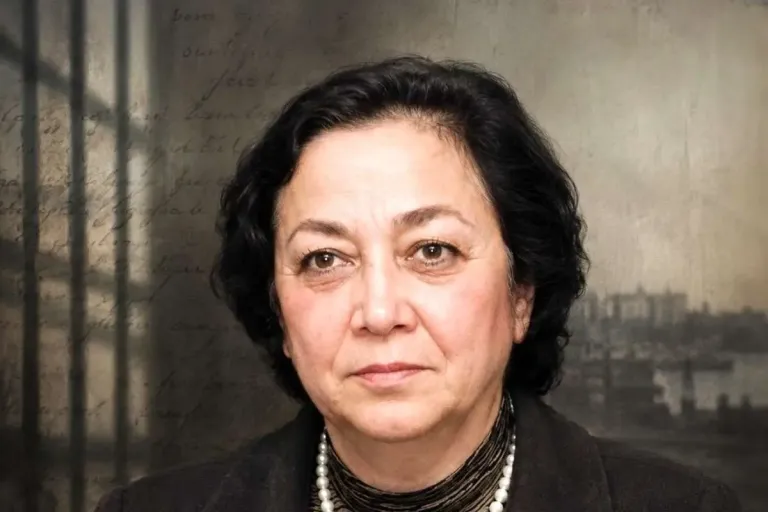
When Gabriel García Márquez—the towering figure of contemporary world literature and one of the defining voices of magical realism—was once asked where the many surreal events in his fiction came from, he famously replied: “From the everyday lives of my people in Colombia.” It is from this perspective that I would like to revisit the work of Shahrnush Parsipur, one of the most important writers of modern Iranian literature, who passed away on July 3 at the age of eighty.
Parsipur‘s novella Women Without Men, first published in Iran in 1989, tells the story of five women living in Tehran in the aftermath of the 1953 coup d’état. What distinguishes their stories, however, is not simply their historical setting but the seamless fusion of reality and the supernatural that shapes their lives. Yet this fusion differs in important ways from the magical realism of García Márquez. In Márquez’s fiction, magic is generally woven into the ordinary fabric of communal life. In Parsipur’s work, by contrast, supernatural elements emerge from Iranian history, mythology, mysticism, and the human psyche.
For this reason, it may be more accurate to describe Parsipur’s fiction not simply as magical realism in the Latin American tradition, but as a distinctly mystical magical realism—or even a form of Iranian mystical realism. Her supernatural imagery exists not merely to astonish readers but to express mystical experience, mythic consciousness, and specifically female ways of seeing the world.
Parsipur’s fictional universe is an intricate synthesis of both Eastern and Western literary traditions.
One of these influences is undoubtedly magical realism in the tradition of García Márquez. Like him, she introduces extraordinary events into ordinary life without inviting surprise. In Women Without Men, for example, Munis—one of the novel’s five protagonists—continues narrating events even after her death. She remains aware of political developments, moves effortlessly between the worlds of the living and the dead, and no one within the story finds this remarkable. Her condition is neither treated as a miracle nor dismissed as a dream or hallucination. It simply belongs to the natural order of the novel’s universe.
Readers encounter a similar acceptance of the supernatural in One Hundred Years of Solitude, where the living coexist naturally with ghosts, as though no meaningful boundary separates the two worlds. Another striking example appears in the character of Mahdokht, who gradually transforms into a tree. Her metamorphosis is presented not as legend or fantasy but as an accepted reality. Yet another powerful current in Parsipur’s work derives from Iranian mysticism.
Within Persian mystical thought, the individual must transcend the self in order to unite with the Divine—or with existence itself. In her novel Tuba and the Meaning of Night, Parsipur creates a woman whose entire life becomes a search for God, truth, and the meaning of existence. Her journey is less social or psychological than profoundly spiritual: an inward pilgrimage toward unity with the Absolute.
Likewise, in Women Without Men, the garden where the five women ultimately gather evokes the Persian garden—a traditional symbol of paradise on earth. It also represents a state of inner awakening. Only after passing through suffering do the women arrive in the garden, reaching a deeper form of knowledge and spiritual vision. Such imagery belongs unmistakably to Iran’s mystical heritage. Parsipur’s fiction also draws extensively upon ancient Persian symbolism.
In pre-Islamic Iranian culture, the tree symbolizes fertility, rebirth, life, immortality, and the connection between heaven and earth. Mahdokht transforms herself into a tree as an act of liberation from male domination and sexual violence. Nourished by the breast milk of Zarrinkolah—the woman who purchases the garden—she eventually becomes the source of countless seeds carried by wind and water to fill the world with the peace and compassion born of women.
Mahdokht, herself described as the daughter of the moon, becomes an unnamed tree—not a pomegranate, a willow, or any identifiable species. This anonymity is significant. She no longer exists merely as an individual woman but becomes an allegory for the female body, fertility, resistance to patriarchal sexuality, and the possibility of reproduction independent of male authority.
Parsipur’s writing also reflects the philosophical legacy of Persian Sufism, the same tradition that shaped the poetry of Rumi, Attar, and Hafez.
Within Sufi thought, truth is layered, hidden beneath successive veils. Death is not life’s conclusion but its continuation. The soul escapes the prison of the body and journeys toward deeper knowledge. Like many figures in Persian mystical literature, Munis acquires a more profound understanding only after death.
Similarly, Tuba’s life recalls the spiritual journey of the seeker described by Attar, who must travel through the Seven Valleys of Love before ultimately reaching fanā—the annihilation of the self through union with the Beloved, with divine light, and with God. Parsipur’s fiction also shares important affinities with Persian folklore. Animals speak. Gardens possess life. Trees have consciousness and personality. Human beings fly through the sky. The dead return to the earthly world.
Mahdokht’s transformation into a tree and the living consciousness of the garden evoke not García Márquez so much as the folktales passed from generation to generation by our grandmothers—stories in which nature itself is alive and speaks directly to humanity.
Even the title of her novel The Simple and Small Adventures of the Spirit of a Tree reveals this sensibility. The tree possesses not only life but a distinct soul and identity, reflecting the worldview of Iranian oral tradition and folklore. For these reasons, Parsipur’s work should not simply be classified as magical realism.
It is perhaps more accurately understood as an Iranian form of magical realism, or even mystical realism, because the primary source of its supernatural imagination lies not in Latin American literary tradition but in the myths, mystical philosophy, and indigenous storytelling traditions of Iran.
Had Shahrnush Parsipur been born almost anywhere else in the world, she would almost certainly have been celebrated as one of her country’s great literary voices. She might have written without fearing censorship, imprisonment, interrogation, or persecution. She might have produced even greater works under conditions of artistic freedom. She might have enjoyed financial security through her books, the support of cultural institutions, and invitations to literary festivals around the world. Instead, fate wrote a far more sorrowful story for her.
Parsipur lived in a society where being a woman could itself become a crime—let alone writing as a woman, writing about women, or portraying male violence with honesty and precision.
Her books were repeatedly censored, mutilated, and banned. During the 1980s, she spent four years in prison without ever being formally charged. Following the publication of Women Without Men in 1989, she was arrested and interrogated once again, in part because the novel openly addressed female virginity and included a scene in which a sex worker performs Islamic prayer while completely naked—an image that challenged deeply rooted social and religious taboos. Even before the 1979 Revolution, Parsipur had briefly been imprisoned after signing a letter protesting the arrest and execution of the poet and activist Khosrow Golsorkhi.
In 1991, she emigrated to the United States. For the next thirty-five years, she continued writing, teaching, mentoring younger writers, and working tirelessly despite constant financial hardship. She struggled against poverty until the very end of her life. After suffering both a heart attack and a stroke, she was hospitalized in San Francisco. In accordance with her advance directive, she did not wish to have her life artificially prolonged by machines. Life support was therefore withdrawn, and she departed this world on her own terms.
One cannot help but hope that her own destiny ultimately resembled the one she imagined for Munis:
a soul finally freed from suffering,
released from pain,
and joyful in its liberation.
© 2026. Phoenix Review