



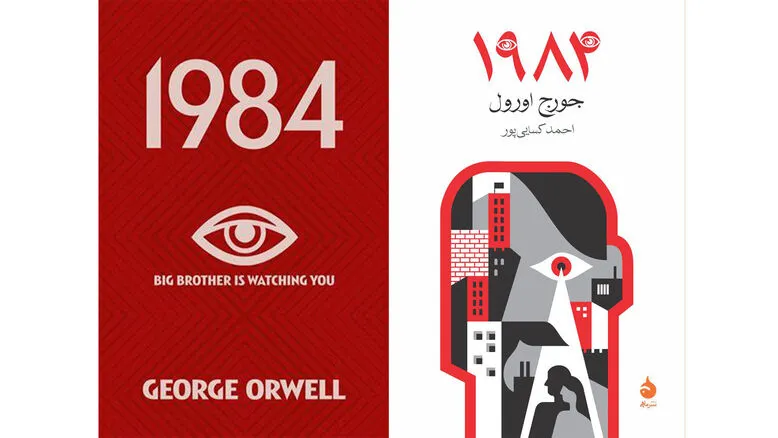
In the fourth installment of the “Revisiting a Literary Masterpiece” series, we turn our attention to one of the most controversial works of the 20th century: 1984 by George Orwell. A novel that, since its publication, has sparked conflicting opinions. Some consider it one of the most important novels of the 20th century, while there are critics who believe that 1984 is not even a good novel, let alone a literary masterpiece. The reasons given by these critics are varied: “This novel is too popular or overly exaggerated, making it unbelievable, or science fiction as a genre doesn’t have enough literary value to be taken seriously.” Regardless of these arguments, 1984 has been widely read since it was written in the mid-20th century and has managed to engage the minds of its readers, prompting them to think more critically about the political issues woven into daily life and to fight for individual freedoms. It is a novel that still has the ability to teach its audience, entertain them, and warn them—albeit in an exaggerated manner—about the dangers of an overgrown government and the consequent destruction of individual freedoms. Therefore, in this piece, I intend to explore several key concepts that Orwell imbued with narrative life, which not only engage the emotions but also provoke thought. Concepts like “doublethink,” “newspeak,” and “the relationship between the body and ideology,” which are heavily utilized in the novel and are crucial for understanding its themes.

Plot of 1984
The story is set in the year 1984 in the fictional country of Oceania, which includes England and London as part of its territory. In this country, the sole ruling party, led by the figure known as “Big Brother,” has absolute control over the lives of its citizens. People are under constant surveillance, and the “Thought Police” arrest anyone who even dares to think against the Party. The protagonist, Winston Smith, is a low-ranking employee in the Ministry of Truth, tasked with rewriting the past to align with the Party’s demands. He secretly despises the Party and longs for freedom and truth. Winston begins a forbidden love affair with a woman named Julia, and together they rebel against the Party. Eventually, they are arrested by the Thought Police and subjected to severe torture in the Ministry of Love. During the torture, Winston is forced to betray Julia and renounce his love for her, ultimately succumbing completely to the Party’s control.
Characterization in 1984
In the opening chapters of 1984, we are introduced to two central characters: Winston Smith and the totalitarian government. Yes, there are other important characters like O’Brien and Julia, whose roles are vital, but the main conflict is between Smith and the government. Orwell sets this conflict up for the reader right from the start: Smith, wearing the Party’s work uniform and carrying a notebook (which, by itself, is a kind of crime), enters the shabby, foul-smelling building. The electricity is out, the elevator is broken, and on every elevator door of each floor, there is a massive image of “Big Brother,” the Party leader (which the author describes as being out of place in the building’s interior).
This image alone is enough to pull us into the main story. From this image, it’s clear that in 1984, we are dealing with a government that has become extremely large and has infiltrated every aspect of its citizens’ lives (if they can even be called citizens). This government, like any totalitarian regime, has penetrated not only public life but even the private homes and personal lives of individuals. This infiltration is not just symbolic through posters; it’s physically carried out through devices known as telescreens. Surveillance helicopters patrol the streets, and Big Brother is always watching. The essence of this feature can be summed up as “control.” Control of citizens by the government, and the way this control is exercised, is one of the key themes of the novel. But this powerful government also has another feature: “inefficiency.” Power outages, Winston’s hunger, and the lack of basic amenities all reflect the government’s inefficiency.
The other central character is Winston Smith. He is a member of the Party with a bureaucratic job, yet his situation is far from good. He has physical problems and is sick, and most importantly, he harbors an unconscious internal rebellion against the Party. He writes “down with Big Brother” repeatedly in his secret notebook, doing so almost instinctively. Even his dreams (in a Freudian sense) reveal this repressed desire. However, Winston is not a hero in the traditional sense. He is an ordinary man with ordinary fears. He is not a guerrilla fighter or revolutionary.
The Suppression of Sexual Energy by a Totalitarian Government
In the early chapters of 1984, we encounter the theme of “sexual desire” and its suppression by the totalitarian government. In the world of this novel, sexual desire is not just a personal or instinctual behavior; it becomes a battleground between the forces of control and human freedom. This desire is both a threat to the Party and a possible avenue for resistance. The Party seeks to turn sexual relations into a mundane, compulsory duty for the sole purpose of reproduction and the creation of the next generation, not an act of pleasure. This is why the sexual relationship between Winston and Julia in the novel is described as a “political act.” In the third chapter of Part Two, it is written:
“It wasn’t just that the sexual instinct produced a world of its own that was beyond the Party’s control and should therefore be destroyed if possible. What was more important was that sexual desire created a kind of hysteria that the Party desired because it could be turned into the madness of war mongering and the worship of the leader. Julia expressed it this way: ‘When you make love, you use up energy; afterward, you feel happy and don’t give a damn about anything. They don’t want you to feel anything like that. They want you to stay full of energy all the time. All those parades, marches, whistling, clapping, waving flags—they’re just a distorted form of sexual relations.'”
Through this, Orwell explores the ways in which the totalitarian government seeks to control even the most intimate aspects of human existence, such as sexuality, in order to maintain its power.
Body and Ideology
From here, we can bridge a connection between “the body” and “ideology.” Winston Smith, the protagonist, cannot recall the world before the Party’s reign. Julia, who is younger than him, has always lived in a world dominated by the Party. They are unfamiliar with any other reality and do not recognize any alternative ways of life. But why do they rebel? The answer is one word: “the body.” They experience life through their bodies, senses, and instincts, which the Party cannot control. The needs of the body become the inner voice that shouts: “Something is wrong!”
Doublethink
Doublethink, or as it is sometimes translated, “dual thinking,” is one of the most significant concepts that forms the ideological foundation of the Party in 1984. Its meaning is the ability to believe in two contradictory statements at the same time: the individual must be able to know a truth and simultaneously deny it and, paradoxically, accept it as a necessary truth. The Party uses this tool to shape the minds of its citizens in such a way that they not only do not resist blatant lies but also enthusiastically accept them. For example, a person must believe that “War is peace” and “Freedom is slavery” without feeling or understanding the contradictions. Doublethink makes it possible to rewrite history, distort reality, and even shut down the logical processes of the mind. As a result, individuals surrender not only on the surface but at the very depths of their awareness. This internal surrender is the Party’s ultimate victory: control over the truth, achieved by destroying the human capacity for independent thought.
The concept of “doublethink” can also be observed outside of 1984 in totalitarian religious ideologies, where contradictions are not only tolerated but sanctified. In such systems, individuals may be asked to simultaneously believe in the kindness of God and the eternal damnation of sinners. Politically, citizens may be forced to accept that their country is “the freest in the world,” despite the absence of freedom of expression and the lack of the right to criticize sacred figures, or it may be claimed that “our enemies seek violence,” while the government itself uses violence as a tool to suppress its citizens.
The discussion of “doublethink” is complemented by the following concept of “Newspeak.”
Newspeak
The role of Newspeak in 1984 is pivotal and essential; it is one of the central themes of the novel. This constructed language is a tool the Party (or the totalitarian government) uses to control thought. Through Newspeak, the Party can limit or even make independent thought and freedom of expression impossible. Newspeak is designed to reduce the vocabulary of individuals. In every new edition of the Newspeak dictionary, numerous words are eliminated. With the structure of Newspeak, words lose their meaning, and truth becomes “simplified” to such an extent that no thought is needed to grasp the message and meaning. In reality, the last thing a totalitarian government desires is an intellectually active citizen. A totalitarian regime always needs simple concepts that its citizens can easily accept without thinking. Newspeak is not just a language; it is a tool of repression. One of its main goals is to make “thoughtcrime” impossible, meaning that individuals cannot even think of anything contrary to the Party’s pre-established thoughts because they lack the necessary language to do so.
Conclusion
In the end, one could argue that George Orwell, through 1984, demonstrates that a totalitarian government does not survive solely through physical means of repression, such as the police, security forces, torture, and secret police. Instead, tools like Newspeak (or language manipulation), historical distortion (Winston Smith’s main job), and creating fear and terror among citizens, atomizing them, and waging constant war (real or imagined) on enemies can seize and control the minds of the populace. 1984 might seem somewhat exaggerated, and in terms of believability, it might not measure up to realistic literature. It may even get bogged down in excessive narrative or become non-narrative (for example, the long sections about Goldstein’s book), losing the reader’s interest. But in terms of content, it offers tools that remain thought-provoking even after almost 76 years since its publication and continue to stimulate intellectual engagement.